This is default featured slide 1 title

Go to Blogger edit html and find these sentences.Now replace these sentences with your own descriptions.This theme is Bloggerized by Lasantha Bandara - Premiumbloggertemplates.com.

This is default featured slide 2 title

Go to Blogger edit html and find these sentences.Now replace these sentences with your own descriptions.This theme is Bloggerized by Lasantha Bandara - Premiumbloggertemplates.com.

This is default featured slide 3 title

Go to Blogger edit html and find these sentences.Now replace these sentences with your own descriptions.This theme is Bloggerized by Lasantha Bandara - Premiumbloggertemplates.com.

This is default featured slide 4 title

Go to Blogger edit html and find these sentences.Now replace these sentences with your own descriptions.This theme is Bloggerized by Lasantha Bandara - Premiumbloggertemplates.com.

This is default featured slide 5 title

Go to Blogger edit html and find these sentences.Now replace these sentences with your own descriptions.This theme is Bloggerized by Lasantha Bandara - Premiumbloggertemplates.com.

Facebook’s photo porting tool adds support for Dropbox and Koofr

Facebook’s photo and video portability tool has added support for two more third party services for users to send data via encrypted transfer — namely: cloud storage providers Dropbox and (EU-based) Koofr.

The tech giant debuted the photo porting tool in December last year, initially offering users in its EU HQ location of Ireland the ability to port their media direct to Google Photos, before going on to open up access in more markets. It completed a global rollout of that first offering in June.

Facebook users in all its markets now have three options to choose from if they want to transfer Facebook photos and videos elsewhere. A company spokesman confirmed support for other (unnamed) services is also in the works, telling us: “There will be more partnership announcements in the coming months.”

The transfer tool is based on code developed via Facebook’s participation in the Data Transfer Project — a collaborative effort started last year, with backing from other tech giants including Apple, Google, Microsoft and Twitter.

To access the tool, Facebook users need to navigate to the ‘Your Facebook Information’ menu and select ‘Transfer a copy of your photos and videos’. Facebook will then prompt you to re-enter your password prior to initiating the transfer. You will then be asked to select a destination service from the three on offer (Google Photos, Dropbox or Koofr) and asked to enter your password for that third party service — kicking off the transfer.

Users will receive a notification on Facebook and via email when the transfer has been completed.

The encrypted transfers work from both the desktop version of Facebook or its mobile app.

Last month, the tech giant signalled in comments to the FTC ahead of a hearing on portability scheduled for later this month that it would be expanding the scope of its data portability offerings — including hinting it might offer direct transfers for more types of content in future, such as events or even users’ “most meaningful” posts.

For now, though, Facebook only supports direct, encrypted transfers for photos and videos uploaded to Facebook.

While Google and Dropbox are familiar names, the addition of a smaller, EU-based cloud storage provider in the list of supported services does stand out a bit. On that, Facebook’s spokesperson told us it reached out to discuss adding Koofr to the transfer tool after a staffer came across an article on Mashable discussing it as an EU cloud storage solution.

A bigger question is when — or whether — Facebook will offer direct photo portability to users of its photo sharing service, Instagram. It has not mentioned anything specific on that front when discussing its plans to expand portability.

When we asked Facebook about bringing the photo porting tool to Instagram, a spokesman told us: “Facebook have prioritised portability tools on Facebook at the moment but look forward to exploring expansion to the other apps in the future.”

In a blog post announcing the new destinations for users of the Facebook photo & video porting tool, the tech giant repeats its call for lawmakers to come up with “clearer rules” to govern portability, writing that: “We want to continue to build data portability features people can trust. To do that, the Internet needs clearer rules about what kinds of data should be portable and who is responsible for protecting that data as it moves to different services. Policymakers have a vital role to play in this.”

It also writes that it’s keen for other companies to join the Data Transfer Project — “to expand options for people and push data portability innovation forward”.

In recent years Facebook has been lobbying for what it calls ‘the right regulation’ to wrap around portability — releasing a white paper on the topic last year which plays up what it couches as privacy and security trade-offs in a bid to influence regulatory thinking around requirements on direct data transfers.

Portability is in the frame as a possible tool for helping rebalance markets in favor of new entrants or smaller players as lawmakers dig into concerns around data-fuelled barriers to competition in an era of platform giants.


from Social – TechCrunch https://ift.tt/352nspG
via IFTTT
Facebook bans politician of India’s ruling party for violating hate speech

Facebook has banned a politician from India’s ruling party, Bharatiya Janata Party, for violating its policies against hate speech on its platform, the company said today, weeks after inaction on the politician’s posts landed the social giant in hot water in its biggest market by users.

The company said it had removed profiles of T. Raja Singh, who had posted about Rohingya Muslim immigrants to be shot among other anti-Muslim sentiments. Singh will no longer be allowed to create profiles across Facebook services and unofficial pages, groups, and accounts set up to represent him will be removed, too.

Singh, termed as a “dangerous individual” by Facebook, has a history of voicing problematic and hateful views on social platforms and in public appearances. Several of those posts, for which Facebook has banned him, remain online on Twitter and YouTube.

Today’s move comes weeks after the Wall Street Journal reported that a top Facebook executive in India had chosen to not take any actions on Singh’s posts because she was afraid it could hurt the company’s business prospects in the country.

A person familiar with the matter and local media reports claim that Facebook had removed some of Singh’s posts in the past. The Wall Street Journal also reported that the aforementioned Facebook executive — Ankhi Das — also showed support to BJP’s Narendra Modi before he was elected as Prime Minister in 2014 and disparaged the opposition party, Indian National Congress.

In a statement today, a Facebook spokesperson said, “the process for evaluating potential violators is extensive and it is what led us to our decision to remove his account.” 

In the last few weeks, Facebook has received some of the harshest criticism to date in India, where it reaches more than 400 million users. Politicians from both sides — the opposition and ruling party — have accused the company of having political biases.

In a letter to Facebook chief executive Mark Zuckerberg, India’s IT Minister Ravi Shankar Prasad earlier this month expressed concerns about the alleged political leanings of the company’s staff and accused them of suppressing pages that support right-wing views.


from Social – TechCrunch https://ift.tt/32R03EN
via IFTTT

Facebook now lets you customize your Watch video feed with #Topics

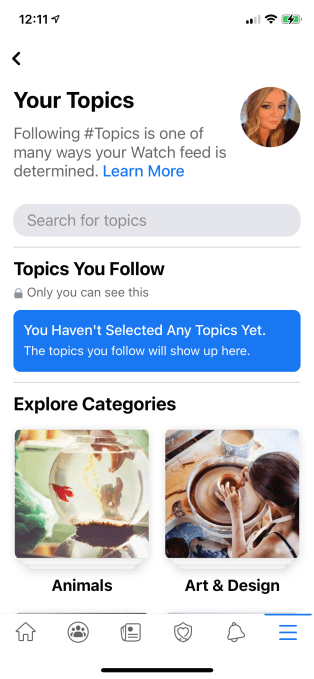
Facebook’s video destination, Facebook Watch, is introducing a new feature called “Your Topics” that will allow you to tailor its feed to include more of the content you want to see. Currently, Facebook leverages its existing understanding of each viewer’s interests to personalize the Watch Feed. Topics, however, will allow users to more explicitly tell Facebook what sort of things they like by exploring and subscribing to various content categories.

The feature has been quietly rolling out to Facebook users in recent days, and now some portion of the user base already has the feature in their own Facebook app.

Among the first to notice the new addition was Twitter user @whimchic, who regularly spots updates and changes to mobile applications before they’re made public.

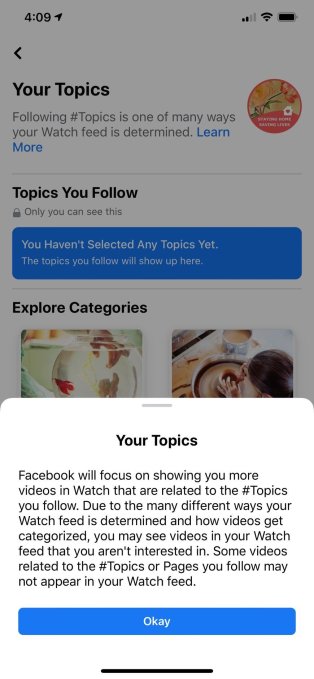
They were alerted to the feature through a pop-up within Watch on the Facebook mobile app, we’re told. Here, a message explained that Facebook will now focus on showing more of the videos related to the #Topics you follow.

“Due to the many different ways your Watch feed is determined and how videos get categorized, you may see videos in your Watch feed that you aren’t interested in,” the message also warned. “Some videos related to the #Topics or Pages you follow may not appear in your Watch feed,” it noted.

Image Credits: Facebook app, screenshot via @whimchic

If you have the feature, you can access it for yourself by clicking on the Profile icon in the Facebook Watch tab on mobile, then clicking on the link to “Your Topics” to browse the available categories.

The subcategories which you can actually follow or unfollow are grouped underneath broader category pages, like Animals, Art & Design, Books, Business, Education, Fashion & Style, Food, Games, History & Philosophy, Home & Garden, Music, Performing Arts, Science & Tech, Sports, Travel & Leisure, TV & Movies, and Transportation.

Image Credits: Facebook app, screenshot via TechCrunch

However, you can’t follow these high-level categories themselves — you have to click inside them to follow the individual topics. These can be very specific. For example, within Animals, you could follow #EndangeredSpecies or #GoldenRetrievers. Within Travel & Leisure, you could follow #TravelOceania or #WinterActivities. And so on.

But the subcategory listings are not comprehensive. Upon testing the feature within the Facebook app on my iPhone, a search for many other possible topics yielded no results. (What, no #Corgi videos?!) This, of course, could change in time as the feature is expanded.

Image Credits: Facebook app, screenshot via TechCrunch

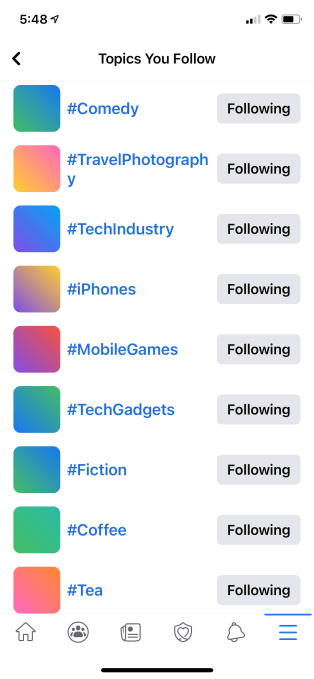
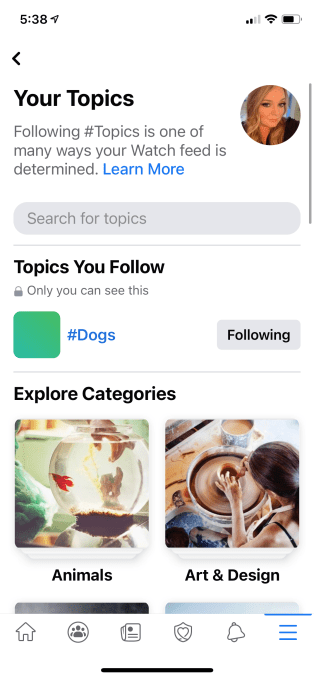
Once you follow a topic, a message will confirm your choice and then the topic will appear under “Topics You Follow” in the Your Topics section of Facebook Watch.

From here, you can choose to unfollow the topic later on if you decide you want to see less of it in your feed. And if you want to watch only videos from a given topic, you can tap the topic to delve into a customized feed.


The feature is now one of several ways users can personalize and filter their broader Facebook Watch feed.

You can also filter the feed by Live, Music, Following, Shows, Gaming and more, by tapping on the buttons at the top of the screen or from the What’s on Watch category picker that shows up as you scroll further down the Watch Feed.

Facebook also adds groupings like its editorially curated “Get Caught Up” section with videos from paid partners, or those groupings that are more algorithmically sorted, like the one with videos that got the most “HaHa’s” or “Loves” this week, or those that are popular with friends.

Image Credits: Facebook app, screenshot via TechCrunch

The new feature could make Facebook Watch more competitive with YouTube, where there’s historically been a heavier focus on connecting users with individual channels to subscribe to. But YouTube has also embraced Topics in its own way, with broad categories like “Gaming” and “Fashion & Beauty” that are now a part of its main navigation. And it puts personalized topics at the top of the home page directing signed-in users to categories of videos they tend to watch.

Twitter, of course, has its own Topics feature, too, which showcases top tweets that match a particular interest. These may or may contain videos, however.

Reached for comment, a Facebook spokesperson confirmed the addition of Topics, saying “we’re working on more ways to connect people with videos that match their interests.” No further details were provided.


from Social – TechCrunch https://ift.tt/3jApZes
via IFTTT

Snapchat had a big August amid TikTok uncertainty

The continual uncertainty around TikTok’s future may have provided a big boost to Snapchat in August. Or maybe it was just the Disney eyes filter that went viral. In any event, preliminary estimates from app store intelligence firm Sensor Tower indicate that Snapchat’s mobile app across both iOS and Android saw approximately 28.5 million new installs last month — its single largest month for first-time downloads since May 2019, when it had then seen 41.2 million new installs.

May 2019, however, was an outlier in Snapchat’s history. The only other month, besides May 2019, where Snapchat had seen more monthly downloads than it did in August was December 2016, Sensor Tower data indicates.

Based on the firm’s findings, Snapchat downloads were up 29% year-over-year in August 2020 compared with 9% growth in July.

It’s unclear what combination of trends or changes may have shaped Snapchat’s download data over the past month.

But one significant area of interest in the social apps space has been the ongoing news around a possible TikTok ban in the U.S. News coverage of the ban already had a notable impact on the app stores’ top charts in recent weeks. Earlier in August, a number of direct TikTok competitors — including Likee, Byte, Dubsmash, Triller and others — saw sizable increases in weekly active users in the U.S. But none have grown to the point where they’re an obvious shoo-in to take TikTok’s place if the Chinese-owned video app is banned from the U.S., per Trump’s executive order.

It’s been more difficult, however, to pinpoint how larger TikTok competitors — like Snapchat and Instagram –were impacted by the news of a TikTok ban. These broader social apps tend to continually grow on a month-over-month basis and they regularly add new features which could impact downloads and usage. For example, Instagram in recent weeks has been expanding features around live streaming, shopping and debuted its own TikTok alternative, Reels.

Though not a direct TikTok rival, Snapchat has also been working to attract the same young demographic that now favors the short-form video app.

This month, Snapchat announced its plans to launch a new music-powered feature that would appeal to TikTok users. The feature, due to arrive this fall, will allow users to set their Snaps to music, similar to TikTok. Snap also confirmed it has deals in place with top music industry partners, including Warner Music Group, Warner Chappell, Universal Music Publishing Group, NMPA publisher members, Merlin and others, who have licensed their content for use in the Snapchat app.

Image Credits: App Store, screenshot by TechCrunch

In addition, Snapchat in late July turned on a new feature called “Minis,” which are basically lightweight, simplified versions of apps that live within Snapchat’s chat section. The apps, built using HTML, allow users to engage with a range of tasks — like buying tickets, meditating with Headspace, collaborating with friends, and more — without having to leave the app.

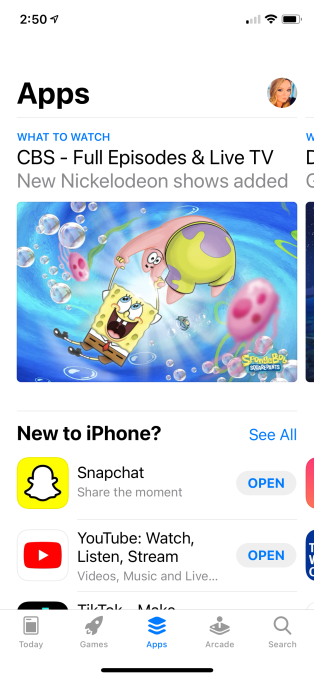
Snapchat has been benefitting, too, from a prominent position on the App Store. Apple currently has it featured in an editorially curated list of app suggestions called “New to iPhone?” which is on the App Store’s “App” homepage. The collection, which you don’t even have to scroll down to find, recommends apps that first-time iPhone users will want to download.

Other bumps in downloads could be attributed to increased marketing spend, as is common among larger app publishers. Snapchat, however, isn’t commenting on what, specifically, may have changed in August.

And maybe it was just those 66.4 million TikTok videos tagged #disneyfilter that gave Snapchat a bump this past month!

Sensor Tower’s new Snapchat data is considered preliminary because it’s only been finalized through August 26th. When the remaining days of August are also finalized, there may be some changes to the resulting numbers. But those changes will likely be minor, at best.

These figures were also initially reported by one of Sensor Tower’s financial services customers in an analyst note. They were not publicized by Sensor Tower’s data reporting team. But the company confirmed the data’s accuracy with TechCrunch.

Snapchat, as of its Q2 earnings in July, reported its daily active users had grown to 238 million, up nearly 4% from the 229 million the company reported in April. The company won’t comment on the new download data.


from Social – TechCrunch https://ift.tt/2YVOECs
via IFTTT

FB Messenger chief Stan Chudnovsky is coming to Disrupt

Stan Chudnovsky last spoke at Disrupt in 2016, so we’ve got a lot to catch up on.

Chudnovsky remains in charge of Facebook Messenger — his current title is VP of Messenger — so he can tell us more about how the product has evolved at this year’s Disrupt 2020 on September 14-18.

One of the biggest changes has been the launch of Messenger Rooms, a service that allows you to start and join video calls from within Facebook or Messenger (and eventually other Facebook products). The product’s appeal is pretty easy to see in a time of social distancing, but Facebook still has a long way to go if it wants to challenge Zoom.

Meanwhile, we’ve also seen increasing scrutiny about the role that messaging apps can play in spreading hate speech and misinformation. Among Facebook’s apps, WhatsApp has struggled the most visibly with these issues, but Messenger has also been adding tools to help people share accurate information about the COVID-19 pandemic.

On top of all that, we can get general updates on how FB Messenger has been doing during the pandemic, and what the big priorities are moving forward. Chudnovsky might also have some thoughts to share on the messaging landscape, and on the startup world — after all, before joining Facebook, he co-founded startups including Jiff, NFX, Ooga Labs and Wonderhill.

Learn more about the future of messaging at our all-virtual Disrupt 2020, which runs from September 14-18. Get your front row seat to see this panel live with a Disrupt Digital Pro Pass or a Digital Startup Alley Exhibitor Package. We’re excited to see you there.


from Social – TechCrunch https://ift.tt/3lFFeVn
via IFTTT

India’s IT minister accuses Facebook of suppressing right-leaning pages

Ravi Shankar Prasad, India’s IT, and Law and Justice minister has accused Facebook India’s leadership team of suppressing the reach of pages that support and promote right-leaning ideology, in what is the latest turn of events for the social giant in its biggest market by users where it has also been accused of playing favoritism to Prasad’s ruling party.

In a letter to Facebook co-founder and chief executive, RS Prasad wrote that he has learned that ahead of the general elections last year, social giant’s India management team, in a “concerted effort”, deleted or substantially reduced the reach as well as “provided no recourse or right of appeal to pages” that were supportive of the right-of-centre ideology.

“The above documented cases of bias and inaction are seemingly a direct outcome of the dominant political beliefs of individuals in your Facebook India team,” the minister wrote in the letter, without elaborating those cases. He said the ruling, right-of-centre Bharatiya Janata Party wrote “dozens of emails” to Facebook management team and received no response.

Prasad also accused some unnamed Facebook employees of abusing Prime Minister Narendra Modi and other senior ministers of BJP “on record.”

He characterized this alleged behaviour as “problematic.” “It is doubly problematic when the bias of individuals becomes an inherent bias of the platform. And it is unacceptable when political biases of individuals impinger on the freedom of speech of millions of people,” he added.

Prasad’s letter today comes as Ankhi Das, a top level Facebook executive in India, has been accused of showing support to Narendra Modi before he was elected as Prime Minister in 2014 and disparaging the opposition party, Indian National Congress.

According to the Wall Street Journal, Das had also opposed applying the company’s hate-speech rules to a member of Indian Prime Minister Narendra Modi’s party because she worried taking any punishing actions would hurt the company’s business prospects in India.

Politicians from both the sides have slammed Facebook for playing favoritism in India. In the letter, Prasad characterized these reporting to be based on “selective leaks” by some Facebook employees to “portray an alternative reality.”

On Tuesday, local newspaper Indian Express reported that ahead of last year’s polls, BJP flagged a list of 44 pages opposed to the party, claiming they were “in violation of expected standards” and carried posts “not in line with facts.’ At least 14 of those pages are no longer on the platform. The report claimed that Facebook India team was responsive to BJP officials.


from Social – TechCrunch https://ift.tt/2QNgfRG
via IFTTT

Facebook touts beefed up hate speech detection ahead of Myanmar election

Facebook has offered a little detail on extra steps it’s taking to improve its ability to detect and remove hate speech and election disinformation ahead of Myanmar’s election. A general election is scheduled to take place in the country on November 8, 2020.

The announcement comes close to two years after the company admitted a catastrophic failure to prevent its platform from being weaponized to foment division and incite violence against the country’s Rohingya minority.

Facebook says now that it has expanded its misinformation policy with the aim of combating voter suppression and will now remove information “that could lead to voter suppression or damage the integrity of the electoral process” — giving the example of a post that falsely claims a candidate is a Bengali, not a Myanmar citizen, and thus ineligible to stand.

“Working with local partners, between now and November 22, we will remove verifiable misinformation and unverifiable rumors that are assessed as having the potential to suppress the vote or damage the integrity of the electoral process,” it writes.

Facebook says it’s working with three fact-checking organizations in the country — namely: BOOM, AFP Fact Check and Fact Crescendo — after introducing a fact-checking program there in March.

In March 2018 the United Nations warned that Facebook’s platform was being abused to spread hate speech and whip up ethnic violence in Myanmar. By November of that year the tech giant was forced to admit it had not stopped its platform from being repurposed as a tool to drive genocide, after a damning independent investigation slammed its impact on human rights.

On hate speech, which Facebook admits could suppress the vote in addition to leading to what it describes as “imminent, offline harm” (aka violence), the tech giant claims to have invested “significantly” in “proactive detection technologies” that it says help it “catch violating content more quickly”, albeit without quantifying the size of its investment nor providing further details. It only notes that it “also” uses AI to “proactively identify hate speech in 45 languages, including Burmese”.

Facebook’s blog post offers a metric to imply progress — with the company stating that in Q2 2020 it took action against 280,000 pieces of content in Myanmar for violations of its Community Standards prohibiting hate speech, of which 97.8% were detected proactively by its systems before the content was reported to it.

“This is up significantly from Q1 2020, when we took action against 51,000 pieces of content for hate speech violations, detecting 83% proactively,” it adds.

However without greater visibility into the content Facebook’s platform is amplifying, including country-specific factors such as whether hate speech posting is increasing in Myanmar as the election gets closer, it’s not possible to understand what volume of hate speech is passing under the radar of Facebook’s detection systems and reaching local eyeballs.

In a more clearly detailed development, Facebook notes that since August, electoral, issue and political ads in Myanmar have had to display a ‘paid for by’ disclosure label. Such ads are also stored in a searchable Ad Library for seven years — in an expansion of the self-styled ‘political ads transparency measures’ Facebook launched more than two years ago in the US and other western markets.

Facebook also says it’s working with two local partners to verify the official national Facebook Pages of political parties in Myanmar. “So far, more than 40 political parties have been given a verified badge,” it writes. “This provides a blue tick on the Facebook Page of a party and makes it easier for users to differentiate a real, official political party page from unofficial pages, which is important during an election campaign period.”

Another recent change it flags is an ‘image context reshare’ product, which launched in June — which Facebook says alerts a user when they attempt to share a image that’s more than a year old and could be “potentially harmful or misleading” (such as an image that “may come close to violating Facebook’s guidelines on violent content”).

“Out-of-context images are often used to deceive, confuse and cause harm. With this product, users will be shown a message when they attempt to share specific types of images, including photos that are over a year old and that may come close to violating Facebook’s guidelines on violent content. We warn people that the image they are about to share could be harmful or misleading will be triggered using a combination of artificial intelligence (AI) and human review,” it writes without offering any specific examples.

Another change it notes is the application of a limit on message forwarding to five recipients which Facebook introduced in Sri Lanka back in June 2019.

“These limits are a proven method of slowing the spread of viral misinformation that has the potential to cause real world harm. This safety feature is available in Myanmar and, over the course of the next few weeks, we will be making it available to Messenger users worldwide,” it writes.

On coordinated election interference, the tech giant has nothing of substance to share — beyond its customary claim that it’s “constantly working to find and stop coordinated campaigns that seek to manipulate public debate across our apps”, including groups seeking to do so ahead of a major election.

“Since 2018, we’ve identified and disrupted six networks engaging in Coordinated Inauthentic Behavior in Myanmar. These networks of accounts, Pages and Groups were masking their identities to mislead people about who they were and what they were doing by manipulating public discourse and misleading people about the origins of content,” it adds.

In summing up the changes, Facebook says it’s “built a team that is dedicated to Myanmar”, which it notes includes people “who spend significant time on the ground working with civil society partners who are advocating on a range of human and digital rights issues across Myanmar’s diverse, multi-ethnic society” — though clearly this team is not operating out of Myanmar.

It further claims engagement with key regional stakeholders will ensure Facebook’s business is “responsive to local needs” — something the company demonstrably failed on back in 2018.

“We remain committed to advancing the social and economic benefits of Facebook in Myanmar. Although we know that this work will continue beyond November, we acknowledge that Myanmar’s 2020 general election will be an important marker along the journey,” Facebook adds.

There’s no mention in its blog post of accusations that Facebook is actively obstructing an investigation into genocide in Myanmar.

Earlier this month, Time reported that Facebook is using US law to try to block a request for information related to Myanmar military officials’ use of its platforms by the West African nation, The Gambia.

“Facebook said the request is ‘extraordinarily broad’, as well as ‘unduly intrusive or burdensome’. Calling on the U.S. District Court for the District of Columbia to reject the application, the social media giant says The Gambia fails to ‘identify accounts with sufficient specificity’,” Time reported.

“The Gambia was actually quite specific, going so far as to name 17 officials, two military units and dozens of pages and accounts,” it added.

“Facebook also takes issue with the fact that The Gambia is seeking information dating back to 2012, evidently failing to recognize two similar waves of atrocities against Rohingya that year, and that genocidal intent isn’t spontaneous, but builds over time.”

In another recent development, Facebook has been accused of bending its hate speech policies to ignore inflammatory posts made against Rohingya Muslim immigrants by Hindu nationalist individuals and groups.

The Wall Street Journal reported last month that Facebook’s top public-policy executive in India, Ankhi Das, opposed applying its hate speech rules to T. Raja Singh, a member of Indian Prime Minister Narendra Modi’s Hindu nationalist party, along with at least three other Hindu nationalist individuals and groups flagged internally for promoting or participating in violence — citing sourcing from current and former Facebook employees.


from Social – TechCrunch https://ift.tt/3gSzmEx
via IFTTT