This is default featured slide 1 title

Go to Blogger edit html and find these sentences.Now replace these sentences with your own descriptions.This theme is Bloggerized by Lasantha Bandara - Premiumbloggertemplates.com.

This is default featured slide 2 title

Go to Blogger edit html and find these sentences.Now replace these sentences with your own descriptions.This theme is Bloggerized by Lasantha Bandara - Premiumbloggertemplates.com.

This is default featured slide 3 title

Go to Blogger edit html and find these sentences.Now replace these sentences with your own descriptions.This theme is Bloggerized by Lasantha Bandara - Premiumbloggertemplates.com.

This is default featured slide 4 title

Go to Blogger edit html and find these sentences.Now replace these sentences with your own descriptions.This theme is Bloggerized by Lasantha Bandara - Premiumbloggertemplates.com.

This is default featured slide 5 title

Go to Blogger edit html and find these sentences.Now replace these sentences with your own descriptions.This theme is Bloggerized by Lasantha Bandara - Premiumbloggertemplates.com.

You can share tweets directly to Instagram Stories now

It’s a little thing, but one worth savoring.

If you’re tired of your Instagram feed mostly being a chaotic mashup of screencapped tweets and reshared TikToks, well, those things probably aren’t going away but one is about to look a lot better.

Twitter just added the capability to share a tweet directly to Instagram Stories, letting you port your clever cross-platform moments over properly. You can’t tap the tweets to hop back to Twitter, but they look nice now. Unfortunately for Android users, it’s iOS-only for now.


The new cross-platform feature is just a tiny sample of Twitter’s refreshing recent flurry of product activity — a result of mounting pressure from investors who accused the company of stagnating and planned to oust its CEO, Jack Dorsey. The company also just added two more major features to empower users to monetize their tweets: paid subscriptions known as “Super Follows” and ticketed events.

Twitter users have long waited for a laundry list of small quality of life tweaks to manifest, a phenomenon that often materializes as an entire cohort of journalists complaining about how you still can’t edit tweets. But if it can keep the pace, Twitter might finally be ready to deliver.

See, doesn’t that look nice?

Example of tweet embedded on Instagram Story


from Social – TechCrunch https://ift.tt/3gXRf71
via IFTTT

PairTree speeds adoption process with an online, self-matching platform and $2.25M seed

Making the choice to adopt, or to find an adopting family, is a legally complex, emotionally taxing, expensive and time-consuming process. PairTree aims to make one part at least considerably easier and faster with its online matching platform where expectant mothers and hopeful adopters can find each other without the facilitation of an agency or other organization. The company has just raised a $2.25 million seed round, a rarity in the industry.

The path to adoption is different for everyone, but there are generally some things they have in common: Once the process is started, it can take upwards of $50,000 and over a year-and-a-half to organize a match. While some of this comprises the ordinary legal hurdles involved in any adoption, a big part of it is simply that there are limited opportunities for adoption, and compatibility isn’t guaranteed. As many people considering adoption are doing so on the heels of unsuccessful fertility treatment, it can be a lot to take on and a dispiriting wait.

Erin Quick, CEO and co-founder (with CTO Justin Friberg) of PairTree, said that the modern adoption landscape is marked by the fact that nearly 95 percent of adoptions are open, meaning there is ongoing contact between a biological mother and adopting family.

“They’ll be working together forever, and that makes finding a highly compatible match that much more important,” Quick, herself a happy adopter, told TechCrunch in an interview. But because of the way adoption is generally done — through agencies licensed by states — there are limitations on how far anyone involved can reach.

“It’s so bound by geography,” she said. “It’s regulated at the state level and has been facilitated by state level, not because of state laws — there’s no rule saying you can’t adopt out of state — but because the facilitators are small nonprofits. They bind themselves to their geographic region because that’s what they can serve. We’re building a platform that makes what people are already doing much easier and more efficient.”

That platform is in many ways very much like a dating app, though of course the comparison is not exact and does not reflect the gravity of choosing to adopt. But like in the dating world, in adoption you have a cloud of people looking to connect over something highly dependent on personality and individual needs.
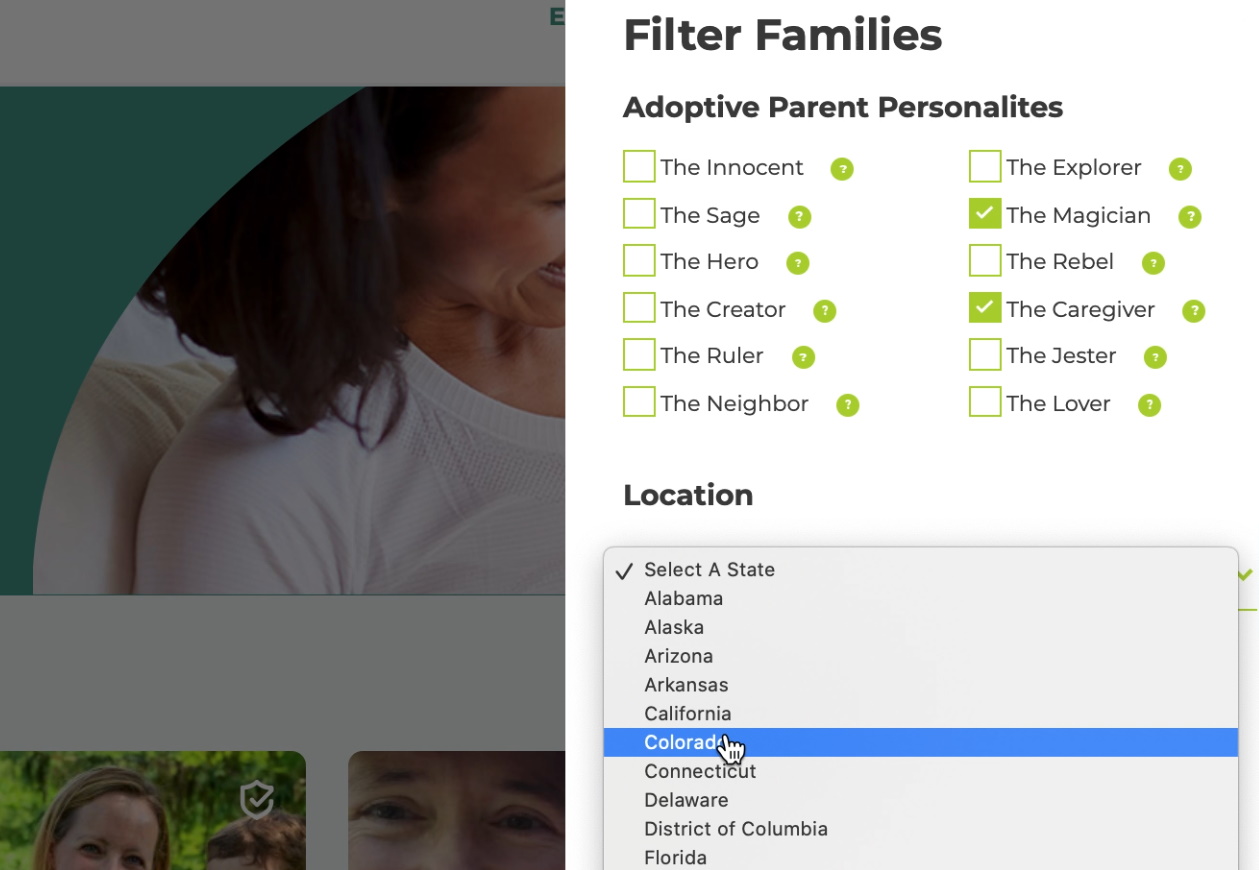
Screenshot of the way expectant mothers can filter and search for compatible adopting families.

PairTree onboards both expectant mothers and adopters with personality tests — not the light-hearted stuff of OkCupid but a broader, more consequential set of Jungian archetypes that signal a person’s high-level priorities in life. Think “wants to travel and learn” versus “wants to provide and nurture” (not that these are necessarily incompatible) — they serve as important indicators of preferences that might not be so easily summarized with a series of checkboxes. That’s not the only criterion, of course. Other demographic and personal details are also collected.

The adopters are added to a pool through which expectant mothers can sift and, if desired, contact (in this, Quick suggested, PairTree mirrors Bumble, where women must message first). PairTree also does basic due diligence stuff like identify verification and confirmation of other important steps like home studies.

If a likely match is found, all the relevant information is passed to the adoption facilitator, who will be coordinating the other legal and financial steps. PairTree isn’t looking to replace these agencies — in fact Quick said that they have been huge proponents of the platform, since it can shorten wait times and improve outcomes. She said based on their existing successful adoptions that the wait can be cut by half or even two-thirds, and thus the cost (which involves recurring payments as the agency searches and does the legal work) by a similar amount.

“These are small nonprofits; they don’t have a lot of tech chops. When we launched we went to attorneys first, actually, and we were surprised when agencies started reaching out,” she explained.

Agencies have been referring their adopters to PairTree, which has led to a lot of early traction, Quick said. And importantly, they’ve seen great diversity in their early success.

“Adoption has historically been denied by faith-based systems — LGBTQ families and single women have been subject to discrimination,” she noted. And in fact just last week a Supreme Court decision held up the right of religious adoption agencies to deny services to same-sex couples. Quick was proud to say that they have already facilitated adoptions by same-sex couples and single parents.

The company will also set aside 5 percent of its net profits, which hopefully will manifest in volume, for the Lifetime Healing Foundation, which offers counseling and support to birth mothers who have gone though the adoption process.

The $2.25 million seed round was led by Urban Innovation Fund, with Founder Collective, Female Founders Alliance and Techstars participating. It will surprise few to hear that adoption is not a particularly hot industry for venture capital, but rising interest and investment in fertility tech may have shed light on opportunities in adjacent spaces. Adoption is one where significant improvements can be enabled by technology, meaning startups can grow fast while having a positive impact.

The company plans to use the money to expand its product portfolio, pursue more partnerships, and perhaps most importantly for its users, build a native mobile app, since 90 percent of the service’s viewership is mobile.

“We’re grateful to our expert and diverse group of investors who share our vision that adoption should be a viable path to parenting for more people,” said Quick in the release announcing the raise. “Like us, our investors believe in the importance of supporting Biological and Adopting Families along with the Adoptees, because adoption is not a single transaction but a journey they’re taking over the course of a lifetime.”


from Social – TechCrunch https://ift.tt/3wQZY1v
via IFTTT

Instagram’s newest test mixes ‘Suggested Posts’ into the feed to keep you scrolling

The days of a scrolling to the end of your Instagram feed look to be coming to an end. After adding algorithmic suggestions to the bottom of the app last year, Instagram is running a test that would splice more recommended posts from accounts you don’t follow into the feed with those you do.

In the next few days, the company will begin testing an expansion of “Suggested Posts” which would sprinkle that content through the regular feed. As it stands now, Suggested Posts appear at the bottom of Instagram after you’ve scrolled through all of the content from people you follow and hit the “You’re all caught up” message that the app implemented in 2018. Depending on how many accounts you follow, it’s possible to not run into that message or Instagram’s recommendations very often, if at all.

In addition to boosting the prominence of Suggested Posts, Instagram will test an option that lets users “snooze” the feature, removing it from the feed for 30 days. Anyone in the test will be able to offer feedback when a specific post doesn’t interest them, but it sounds like you won’t be able to disable Suggested Posts in the feed in a permanent way.

The Suggested Posts expansion will be accompanied by a way for users to shape what they see through managing their interests — stuff like cats, makeup or basketball. If you’ve seen enough cats, you can toggle that interest off or tell Instagram that you never wanted to see those damn cats to begin with when it shows you the next one.

A Facebook spokesperson described the expansion of Suggested Posts to TechCrunch as an “extension” of the Instagram feed, noting that the ratio of these algorithmic recommendations to posts from followed accounts will be variable based on how someone uses the app.

The test will roll out to a small number of users in English-speaking countries only, though the company declined to specify how many accounts will be involved.

The experiment might not make it into the final product, but from the way the winds over at Facebook have been blowing lately it looks pretty likely. Like we mentioned, Instagram and parent company Facebook introduced some tools to give people more control over their own behavior on the notoriously addictive-by-design apps back in 2018, including the “You’re all caught up” message and a way to track time spent.

Those tools weren’t a sea change for a company that generally values keeping people glued to its services (and its ads) at all costs, but they showed that Facebook was at least mildly self aware of the conversation about social media addiction sweeping through the tech world at the time.

In 2020, it sounds like Facebook is done humoring those concerns. The new way Suggested Posts work is just a test for now, but mixing algorithmic suggestions into the feed with posts from accounts you follow would be a pretty big change to the core way the app works. As it stands, if people want a truly endless Instagram experience they could turn to the Explore tab or scroll past the “caught up” message. Many doubtless did to stave off boredom, to the likely detriment of their mental health.

But under the test, it will be less possible to use Instagram to only keep up with just the accounts that you’ve got a personal interest in, whether they’re friends, local businesses or influencers of your choosing. Instagram wants to inject more of what it wants you to see into that experience, or what the company believes you’d want to see but you just don’t know it yet.

The end result might not be that noticeable for people who follow huge swaths of accounts already and rarely meet the end of their feed, but it strays even further from the original product — a distant memory at this point — while giving Instagram a way to keep people on the app for longer while serving them more ads.


from Social – TechCrunch https://ift.tt/3d7es5w
via IFTTT

Facebook adds Shops to WhatsApp, among other e-commerce updates

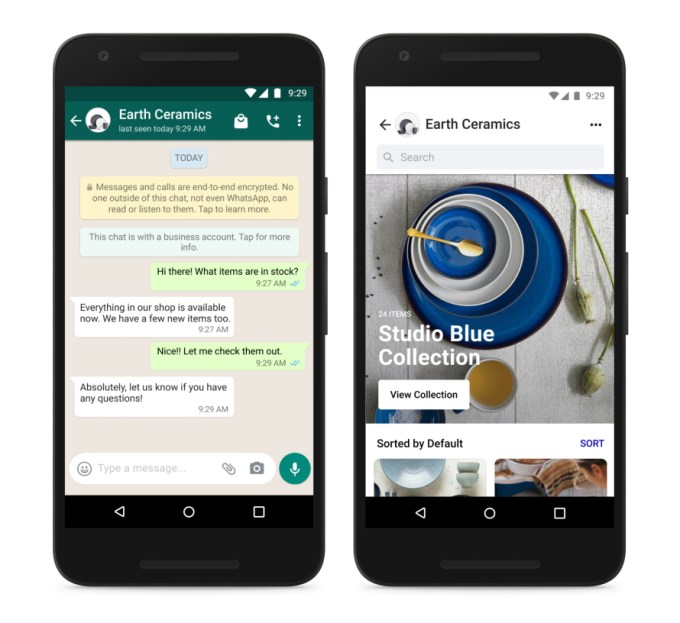
Facebook is making it even easier to buy stuff while you scroll past photos of your high school lab partner’s dog. Yes, Instagram Shops and Facebook Marketplace are already displayed prominently on the apps’ bottom navigation tabs. But now, you can shop on WhatsApp too, along with other updates.

Today on a Live Audio Room, CEO Mark Zuckerberg announced three e-commerce updates that are coming to Facebook products: Shops on WhatsApp and Marketplace, Shops Ads and Instagram Visual Search.

“More than 1 billion people use Marketplace each month, so we’re making it easy for businesses to bring their Shops into Marketplace to reach even more people,” Zuckerberg wrote in a Facebook post. When customers view a shop on WhatsApp, they’ll have the option of chatting with a business before buying something.

Image Credits: WhatsApp

At its F8 conference earlier this month, Facebook revealed updates to WhatsApp for Business — previously, it could take weeks to set up a business account, but now, businesses can sign up in just a few minutes. Though WhatsApp has more than 2 billion global users, only about 175 million people message with WhatsApp Business accounts daily for things like customer support. Since Facebook has been pushing e-commerce on platforms like Instagram, it makes sense that this initiative will expand to WhatsApp too.

The rollout for Shops in WhatsApp will start soon, and Shops inventory in Marketplace is available now for Shops in the U.S. with on-site checkout.

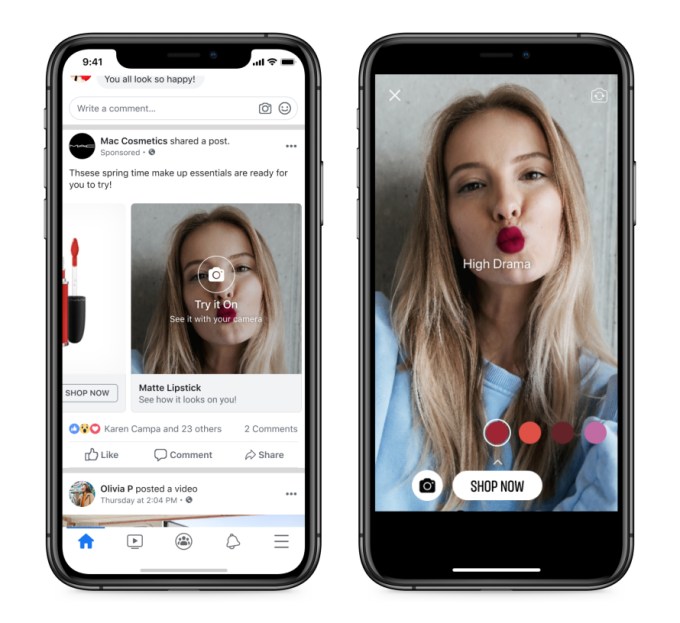
The next feature, Shops Ads, aims to provide a more individualized shopping experience based on people’s individual shopping habits. Zuckerberg said, “We’re launching the ability for a business to send shoppers to where you’re going to be most likely to make a purchase based on your shopping behavior.” Starting now, AR Dynamic Ads are available in the United States — companies like Huda Beauty and Laura Mercier are using these ads to let customers test lipstick shades with AR before making a purchase. These AR try-on experiences are made available through API integrations with Modiface and Perfect Corp. Earlier this year, Pinterest collaborated with ModiFace to launch an AR eyeshadow try-on.

Image Credits: Facebook

Over on Instagram, an AI-based Visual Search feature will roll out for testing in the coming months.

“A lot of shopping discovery begins with visual discovery, right, so you see something that you think is awesome. And then, you know, maybe you want to see other products that are like that, or you want to figure out how to get that product,” Zuckerberg explained. “And this is the type of problem that AI can really help out with.”

Using this AI, people will be able to upload their own photos — even ones they haven’t posted on Instagram — to find similar items. Facebook isn’t the first company to use this technology — see Cadeera, Donde Search or Stye.ai, for instance. But bringing this technology to major platforms might change the way we shop, which seems to be Facebook’s current goal.


from Social – TechCrunch https://ift.tt/3wRkGyi
via IFTTT

Super Follows and Ticketed Spaces are coming to Twitter

In Twitter’s latest appeal to one-up competitors from Clubhouse to Patreon, the company announced today that it will begin rolling out applications for Super Follows and Ticketed Spaces.

Twitter first teased the Super Follow feature during an Analyst Day event in February. Super Follows allow creators on Twitter to generate monthly revenue by offering paywalled content to followers who subscribe to them for $2.99, $4.99, or $9.99 per month.

Twitter will only take 3% of creators’ revenue after in-app purchase fees – but, on the App Store and Google Play, in-app purchase fees are 30%, which means that creators will take home about two-thirds of what their followers are paying. Once they exceed $50,000 of lifetime earnings on Twitter, the app will take “20% of future earnings after fees.” When combined with the 30% in-app purchase fee, that leaves creators with about half of their followers’ payments. Meanwhile, Patreon only takes between 5% and 12% of a creator’s earnings (it bypasses in-app purchase fees since it’s a web-based platform). While creators who primarily engage with their audience on Twitter might benefit from having a way to monetize without directing followers to another app, the difference in payout here is stark. Creators might not abandon their existing Patreon systems for Super Follows, but at the very least, this could offer a supplemental income stream.

“Our goal is to elevate people driving the conversations on Twitter and help them earn money,” said senior product manager Esther Crawford. “We updated our revenue share cuts after spending more time thinking about how we could support emerging voices on Twitter.”

Image Credits: Twitter

Ticketed Spaces seem more promising though, since Clubhouse, Spotify Greenroom, and other competitors don’t offer similar options yet (Discord is testing ticketed audio events on its Stage Discovery portal, but they aren’t out yet). Through Ticketed Spaces, users can set their ticket price anywhere between $1 and $999. Creators can also limit how many tickets are sold, which might incentivize someone to actually use the $999 ticket price for a one-on-one conversation with a celebrity (still… yikes?). Twitter will remind attendees that the Ticketed Space is happening through push and in-app notifications.

Clubhouse and Instagram have features that let listeners tip speakers or award badges in a live audio space, but the apps don’t yet allow for advance ticket sales. Another way for top creators to make money on these apps is through Creator Funds. Spotify Greenroom and Clubhouse have both announced plans for Creator Funds, but it’s not yet clear how the earning potential will compare with selling access to Ticketed Spaces on Twitter.

This slew of updates to Twitter comes after activist shareholders attempted to oust CEO Jack Dorsey last year. Now, Twitter is rapidly adding new features and acquiring companies like Revue (a newsletter platform), Ueno (a creative agency), and Breaker (a social podcasting platform).

Image Credits: Twitter

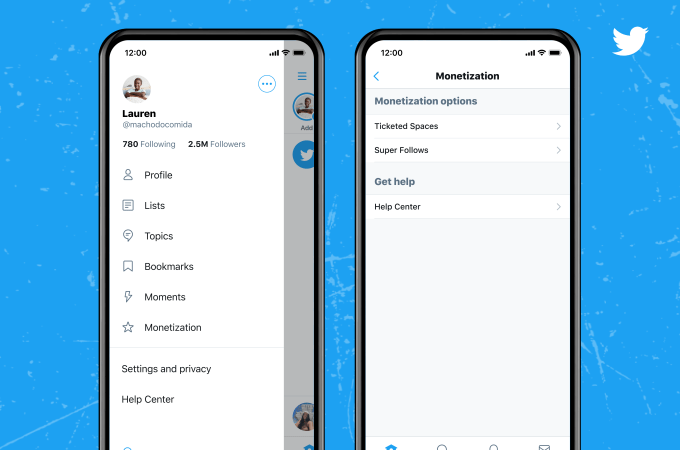
Applications to use Super Follows and Ticketed Spaces are only available on mobile (so, no avoiding the in-app purchase fees) and for people in the U.S. Currently, only iOS users can apply for Super Follows, but Ticketed Spaces applications are available on both iOS and Android. Twitter is adding a brand new Monetization button to the sidebar in the app, where users navigate to see if they’re eligible to apply to be part of the test groups for these features. These features will launch more broadly in the coming months.


from Social – TechCrunch https://ift.tt/3qpAypt
via IFTTT

If you love voice messaging, you’ll love Squad

Squad used to be an app that connected people with similar interests for in-person meetups. Then the coronavirus pandemic hit. While most social apps thrived under these conditions — people craved digital connection more than ever — Squad couldn’t operate.

Founder Isa Watson didn’t know how long the world would be in shutdown. Instead of waiting for a return to normalcy, she shifted the scope of the app entirely.  

Today, Squad relaunches as an audio-based social app that aims to help users deepen their relationship with their existing circle of close friends. Squad is an audio-only app, but don’t worry — it’s not another Clubhouse wannabe. Instead, it functions as a news feed of voice message updates from your closest friends, which expire after 24 hours.

You can add up to 12 friends to your “squad,” and once you post an update, your squad members can emoji react or send a private voice message in response — these also expire after a day, encouraging users to be more open about what they share. Soon, Squad will support phone calls, but there currently isn’t functionality for group calls or group audio messaging. But, users might be incentivized to talk on the phone via Squad rather than a typical call, since you can add a title to your call. That way, your squad member knows why you’re calling before they pick up. 

Image Credits: Squad

“There’s a big gap in the social landscape, because most of the tools are discovery platforms, broadcast platforms and personal branding platforms,” Watson said. “There’s a huge opportunity for us to come in and help people maintain stronger connections with the people that they enjoy the most.”

Posting a voice update feels more genuine than a curated Instagram shot or a crafted Facebook status update (and Facebook is decidedly uncool among Gen Z and millennials). As the popularity of apps like Dispo show, young people are responding well to ephemeral, authentic social media experiences. But the audio-only medium could be a hard sell for people who aren’t already sending voice messages on WhatsApp or iMessage. However, while Squad’s initial rollout will be domestic, there’s great potential for an app like this outside of the U.S., where voice messaging is more popular. 

“A lot of the conversations that would happen on text message are now happening in an asynchronous audio type of way,” Watson added. “So we expect that to continue to penetrate further into our habits.” 

Watson raised a $3.5 million seed round in 2019, and she was featured on TechCrunch with advice on raising venture capital as a woman of color in Silicon Valley. Despite changing the direction of her app, her investors — which include Michael Dearing (Harrison Metal), Aaron Levie (Box), Katrina Lake (Stich Fix), Jen Rubio (Away) and Stewart Butterfield (Slack) — remain supportive. Watson secured another million dollars of funding after the seed round, bringing Squad’s funding to a total of $4.5 million to date. 

“One thing [the investors] said to me was, ‘Isa, you’ve been talking about this shift in social for years now, and people told you you were crazy, that social was all figured out and there was nothing that was going to happen,’ ” Watson said. “Now, people are buying into that change.”

Image Credits: Squad

Even though Squad isn’t a Clubhouse competitor, the rise of audio-only media is a good sign for the app’s ability to crack a saturated social market (so many social apps are trying to compete with Clubhouse, it’s a miracle we don’t yet have audio-only Tinder speed dating). In Squad’s beta test, 87.5% of users completed the onboarding process. Still, Squad falls victim to the same accessibility issues that plague Clubhouse and many of its clones. As of yet, Squad doesn’t support captioning, though Watson says this is something the company has discussed and hopes to implement down the road. Not only could captioning broaden Squad’s audience, but it could also further differentiate the app from messaging giants like iMessage and WhatsApp. 

Still, if you’re someone who loves to send voice messages in your group chats, you might want to get your friends on Squad. Currently, the app is invite-only with a waitlist. Once you’re off the waitlist, you get three invites. If you post for five days straight, you get three more invites, and if someone you invited signs up, you get two more invites as well. This continues until you round out your 12-member squad.


from Social – TechCrunch https://ift.tt/2UizRlM
via IFTTT

Clubhouse is building a DM text chat feature

Some Clubhouse users were treated to a surprise feature in their favorite app, but it wasn’t long for this world. A new UI element called “backchannel” popped up briefly before disappearing late last week, pointing the Clubhouse faithful to a new area of the app and generating plenty of chatter among users ready for more ways to connect.

While the backchannel screen was totally blank without so much as a text entry box, it looks like the company is working on building out the text chat feature that Clubhouse CEO Paul Davison previously discussed in a company town hall.

“…. I think that there are so many people who do DM backchannels all the time, so many people who want to deepen friendships and relationships with people and do all sorts of other stuff — I think this is something that we should have,” Davison said.

The Clubhouse co-founder went on to say that building the feature to suit the app’s use cases won’t be trivial and wouldn’t be happening right away. He also declined to elaborate on if the app would add traditional one-on-one DMs or a more open group text chat feature.

When reached for comment, Clubhouse didn’t dissuade TechCrunch from the assumption that a messaging feature is around the corner, but issued a coy statement.

“As part of our product building process, Clubhouse regularly explores and tests potential features,” a Clubhouse spokesperson told TechCrunch. “These functions sometimes become part of the app, sometimes they don’t.”

Spotify’s new Clubhouse copycat app Greenroom offers its own live text chatroom that users can access by swiping right in the app, giving it a bit of flexibility that Clubhouse has yet to offer. From the looks of the Clubhouse backchannel feature, it also lives in window accessed through swiping, though that’s obviously subject to change.


from Social – TechCrunch https://ift.tt/3gQSE0F
via IFTTT