This is default featured slide 1 title

Go to Blogger edit html and find these sentences.Now replace these sentences with your own descriptions.This theme is Bloggerized by Lasantha Bandara - Premiumbloggertemplates.com.

This is default featured slide 2 title

Go to Blogger edit html and find these sentences.Now replace these sentences with your own descriptions.This theme is Bloggerized by Lasantha Bandara - Premiumbloggertemplates.com.

This is default featured slide 3 title

Go to Blogger edit html and find these sentences.Now replace these sentences with your own descriptions.This theme is Bloggerized by Lasantha Bandara - Premiumbloggertemplates.com.

This is default featured slide 4 title

Go to Blogger edit html and find these sentences.Now replace these sentences with your own descriptions.This theme is Bloggerized by Lasantha Bandara - Premiumbloggertemplates.com.

This is default featured slide 5 title

Go to Blogger edit html and find these sentences.Now replace these sentences with your own descriptions.This theme is Bloggerized by Lasantha Bandara - Premiumbloggertemplates.com.

Showing posts with label TechCrunch. Show all posts

Over 100 Goodwill stores are bringing their inventory to OfferUp

Goodwill and mobile marketplace app OfferUp have announced a new partnership focused on bringing Goodwill’s secondhand inventory to the millions of OfferUp shoppers, for both local pickup and delivery. The deal sees more than 100 Goodwill stores listing their inventory in OfferUp in New York, New Jersey, San Francisco, San Mateo and Marin Counties, South Florida, Greater Detroit, San Antonio and Central and Southern Indiana.

The move brings Goodwill’s pre-owned inventory to a modern mobile e-commerce platform, allowing staff to track sales and view the real-time flow of products, payments and data in one interface.

However, it’s not the first time Goodwill has gone online. The organization today runs its own e-commerce site, ShopGoodwill.com, and many of its local stores have a presence on eBay.

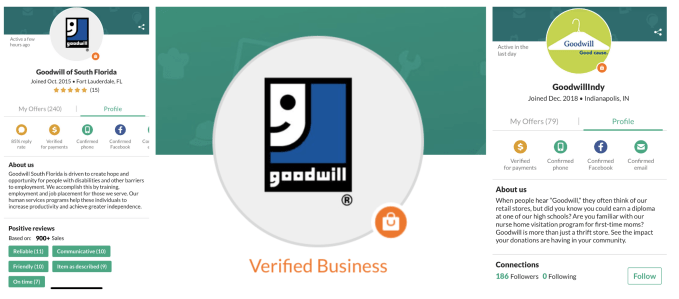
Via OfferUp, mobile users will now be able to browse their Goodwill’s local inventory in the app alongside other sellers’ content. New items will be uploaded regularly, and listed under the regional Goodwill handles so customers know they’re buying from Goodwill as opposed to an individual seller. These handles will feature a “Verified Business” badge, as well, and the profiles will include helpful information like the store hours, address and an “about us” section.
The partnership is powered by OfferUp’s new API, currently in beta testing, and Upright Labs’ Lister software, which handles the inventory uploads to OfferUp.

Goodwill will be responsible for managing its listings, including the product images, shipping, order management, financial reporting and auditing. It’s largely using OfferUp as another sales channel, instead of relying largely on foot traffic to its brick-and-mortar locations.

Like any other OfferUp user, Goodwill doesn’t have a financial relationship with the mobile marketplace.

If a customer buys a Goodwill item, they can go to their local store and pay with cash with no fee. However, if they choose to have the item shipped, OfferUp charges a 9.9% fee to cover shipping and handling across the 48 contiguous U.S. states. This is the same fee any other seller would pay on OfferUp.

The individual Goodwill stores can choose whether or not to offer shipping, the company also says. Some may opt to ship smaller items, like tech, games or jewelry, but only allow for local pickup if it’s a larger item, like furniture.

The two organizations had already been testing the system ahead of today’s formal announcement about availability. Though early, several Goodwill locations are reporting positive outcomes.

“We started to list furniture and other items from our stores on OfferUp in January, and the early results have been great. The majority of the items we post on OfferUp sell within 72 hours, and some have sold in as quickly as 10 minutes after being listed on the app,” said Jay Lytle, vice president and chief information officer, Goodwill of Central & Southern Indiana. “The exposure of our high-quality donations to so many new customers, coupled with the feedback and engagement we’ve experienced on OfferUp, has been tremendous for us,” he added.

“Potential shoppers were unaware of the great inventory that our local stores have for sale,” said Goodwill South Florida CEO David Landsberg, in a related statement. “OfferUp allows us to showcase large, pickup only inventory and increase foot traffic to stores. This also translates into new donors, and helps us fulfill our mission of training and employing people with disabilities and other barriers to work here in South Florida.”

OfferUp says it forged the deals with the individual stores in the supported regions, not at a national level, because Goodwill stores operate independently and because employee bandwidth and resources vary by store.

“Every store is looking to increase foot traffic, along with sales, and the leaders we’ve worked with manage multiple stores in heavily trafficked markets,” an OfferUp spokesperson explains. “With the OfferUp API and Upright Lab’s Listing Tool, employees can take a picture using a mobile device and instantly upload to OfferUp, so it’s improved the flow of receiving and selling their items,” they added.


from TechCrunch https://tcrn.ch/2R7PRSg
via IFTTT

Uber and AT&T team up for always-on connectivity for Uber Copter and Uber Air

Uber is partnering with mobile network operator AT&T on the always-on connectivity it’ll require for its aerial transportation service network. The on-demand mobility company announced the team-up at its annual Elevate Summit, which brings together a number of key players working toward making affordable, accessible in-city aerial transit a reality.

Uber said that it’s already working with AT&T on the network it’ll use for Uber Copter, the Manhattan-to-JFK helicopter-based service that it’s launching in New York in July. The service is promising connection with ground transportation at both ends, and it’s also anticipating travel times and working backwards to provide transportation on-demand as needed to get passengers to their destination at the time they request. So, for instance, Uber Copter customers could say they need to be at JFK by 5 PM and the app will figure out when they need to get a car to get to the heliport to make that work.

This is just the first step in a broader-ranging partnership Uber Elevate Head of Product Nikhil Goel described that will eventually scale to cover all of its needs for Uber Air, the service it aims to provide that will provide on-demand short-distance air travel within cities, with a targeted launch time frame of 2023. Goel noted that this will also include leveraging AT&T’s 5G network as it rolls out, which should provide exactly the kind of high-bandwidth, always-on reliability needed for this kind of aerial and ground-based integrated transportation network.


from TechCrunch https://tcrn.ch/2Ix81J2
via IFTTT

Misfits Market raises $16.5 million for their ‘ugly’ produce subscription box

As grocery shopping moves online, one piece of the puzzle hasn’t been directly addressed: fresh fruits and vegetables. That also happens to be a category in which there is a ton of food waste, with a good deal of fruits and veggies never making it out of the grocery store to begin with.

Misfits Market has raised $16.5 million in Series A to handle just that.

Greenoaks Capital led the round, but Misfits isn’t disclosing other participants in the financing. Other Greenoaks Capital investments include Deliveroo, OYO, Clover Health, Brex and Discord.

Misfits Market offers a subscription box of “ugly” fruits and veggies, the ones with blemishes or odd shapes that make a grocery shopper think twice before checking out, each week.

Misfits sources these fruits and veggies straight from farms. This means that the extra time spent shipping them to a grocery store, and then sitting on shelves, is eliminated from the equation with Misfits.

The company currently operates in all zip codes in Pennsylvania, New York, New Jersey, Connecticut, Delaware, Massachusetts, Vermont, New Hampshire, Rhode Island, Maine and Ohio, with plans to expand into Washington, D.C., Maryland, Virginia, West Virginia, North Carolina, South Carolina, Georgia and Florida.

Currently, Misfits Market offers two different box options. The smaller box, called The Mischief, includes 10 to 12 pounds of fruits and veggies each week for $23.75 à la carte, or less than $20 as a weekly subscription. The Madness, Misfits’ bigger box, includes 18 to 20 pounds of fresh fruits and veggies for $42.50 as a one-time purchase, or for $34 as a subscription.

Users can pause their weekly subscription or cancel at any time.

CEO and founder Abhi Ramesh said the idea for Misfits Market started when he visited a farm a few years ago. The farmer was collecting apples that he said weren’t of the grade he could sell to grocery stores or farmers’ markets, and that they’d either be given away to neighbors or thrown away.

“That was my sort of romanticized light bulb moment,” said Ramesh.

He was fascinated and started interviewing farmers in the north east and asking them how much of their produce ended up going to waste because it wasn’t pretty enough for grocery stores. The answer was consistently between 20% and 40%.

Ramesh says there is an opportunity down the line to expand beyond fruits and veggies, but that for now the company is laser-focused on that category.

Since launching in 2018, Misfits has sent out 5 million pounds of produce that would have gone to waste otherwise.


from TechCrunch https://tcrn.ch/2R7Fhuw
via IFTTT

Colombian point-of-sale lender ADDI nabs $12.5 million from Andreessen Horowitz

Andreessen Horowitz <3 Latin American startups.

Latin America is the only region outside of the U.S. where the venture firm is routinely investing capital, and it just made another commitment, doubling down on its early-stage support for the point-of-sale lending startup ADDI.

ADDI picked up $12.5 million in new financing in April of this year as the company looks to expand its lending services online.

For an American audience, the closest corollary to what ADDI is up to is likely Affirm, the point-of-sale lender that’s raised a ton of cash and come in for some (valid) criticism for its basic business model.

Like Affirm, ADDI lets its borrowers apply for credit at the moment of purchase. The company likens its service to the layaway and credit plans that already exist in Colombia — but involve pretty onerous requirements to use. Company co-founder Santiago Suarez and Andreessen Horowitz general partner Angela Strange both commented on how, in some cases, Colombian shoppers have to have three people vouch for a borrower before a store will issue credit or agree to a layaway plan.

The difference between an ADDI loan — or any loan — and layaway is that an installment payment plan doesn’t charge interest (and even with the fees that installment plans do charge, they are often still cheaper than taking out a loan).

But financial products are coming for consumers in Latin America whether those buyers like it or not — and for the most part, it seems they do like it.

Historically, only the wealthiest clientele in Latin America received anything resembling the kinds of financial products that are more widely available in the United States, according to Strange. And the investment in ADDI is just part of her firm’s thesis in trying to make more services more broadly available in a region where a technological transformation is creating unprecedented opportunities for challengers.

That assessment is what drew Santiago Suarez back to Latin America only two years ago. A former executive at Lending Club who previously had worked as the head of New Product Development and Emerging Services at J.P. Morgan, Suarez saw the tremendous growth happening in Latin America and returned to Colombia to see if he could bring some much needed services to his home country.

Suarez partnered with his childhood friend, Elmer Ortega, who was working as the chief technology officer of the local hedge fund where he had previously been employed as a derivatives trader before learning how to code.

Together, the two men, who had known each other since they were five years old, set out to transform how credit was offered in retail shops. It’s an industry that Suarez had known well since his parents had owned stores.

“In the U.S. there are all of these gaps that fintech companies are filling,” says Suarez. “But the gaps in Latin America are bigger.”

Suarez and Ortega incorporated the company in September 2018, around the same time they raised $2.3 million from the regional investment firm, Monashees, Andreessen and Village Global. They then raised another $1.5 million in an internal round of financing before closing the most recent funding.

The company offers loans at annual percentage rates ranging from 19.99% to 28.90%. The company started with a digital solution for brick and mortar retailers because 90% of retail in Colombia still happens offline. 

Although it’s in its early days, the company has already originated 10,000 borrowers and typically loans out roughly $500 since it launched on February 22, according to Suarez. He declined to comment on the company’s default rate on loans.

Now with 40 employees on staff, the company is looking to bring its lending tool to more e-commerce and physical retailers, according to Suarez. And despite the threat of cyclical political turmoil, Suarez says there’s no better time to be investing in Colombia. 

“It’s the most stable country outside of Chile… Way more stable than Brazil, way more stable than Argentina and way more stable than Mexico,” Suarez says. “What we’re looking at is more than cyclical instability… those things go beyond that. Nubank was able to build a multibillion business in the worst political and economic crisis in Brazil’s history. I think Colombia is an incredibly attractive space with a deep talent pool.”


from TechCrunch https://tcrn.ch/2ZcuwtA
via IFTTT

Amazon Restaurants in US is shutting down

Following November’s closure of Amazon’s restaurant delivery business in London, the company is now shutting down operations in the U.S. The service, which was launched back in fall 2015, was designed to give Prime members another perk — a way to order meals, not just products and groceries — through the e-commerce giant.

But the service has faced much competition, including from local rivals like Grubhub, Uber Eats, DoorDash and Deliveroo (which Amazon invested in) in London, among others. In some cases, they would even discount their services in order to win market share. Amazon, meanwhile, has largely failed to establish itself as a significant player in restaurant delivery in both market share and consumer mindshare. It’s not the first name people think of when they’re looking to order food for lunch or dinner, and the logistics of delivering hot meals in a timely fashion introduces a different set of concerns that go beyond Amazon’s core focus areas.

Related to the closure, Amazon will also shutter workplace lunch delivery service Daily Dish, according to GeekWire, which broke the news.

Amazon made the decision to exit restaurant deliveries to focus more on its growing grocery delivery business, we understand.

TechCrunch (among others, we’re guessing) was tipped off to the closure through a source at Amazon familiar with the business’s closing. Amazon confirmed the closure of Amazon Restaurants in the U.S., which ceases to operate June 24. It also hinted that layoffs were involved, as some people were finding new roles at Amazon while others were being assisted in finding new jobs outside the company.

“As of June 24th, we will be discontinuing the Amazon Restaurants business in the U.S.,” an Amazon spokesperson said. “A small fraction of Amazon employees are affected by this decision, and many of those affected have already found new roles at Amazon. Employees will be offered personalized support to find a new role within, or outside of, the company,” they added.

Amazon’s decision to exit restaurant meal delivery has had a positive impact on rivals’ stocks this morning, with a jump by Grubhub, which was up more than 5% on the news.


from TechCrunch https://tcrn.ch/2KJ35Ui
via IFTTT

Uber envisions Uber Air will one day be cheaper than owning a car

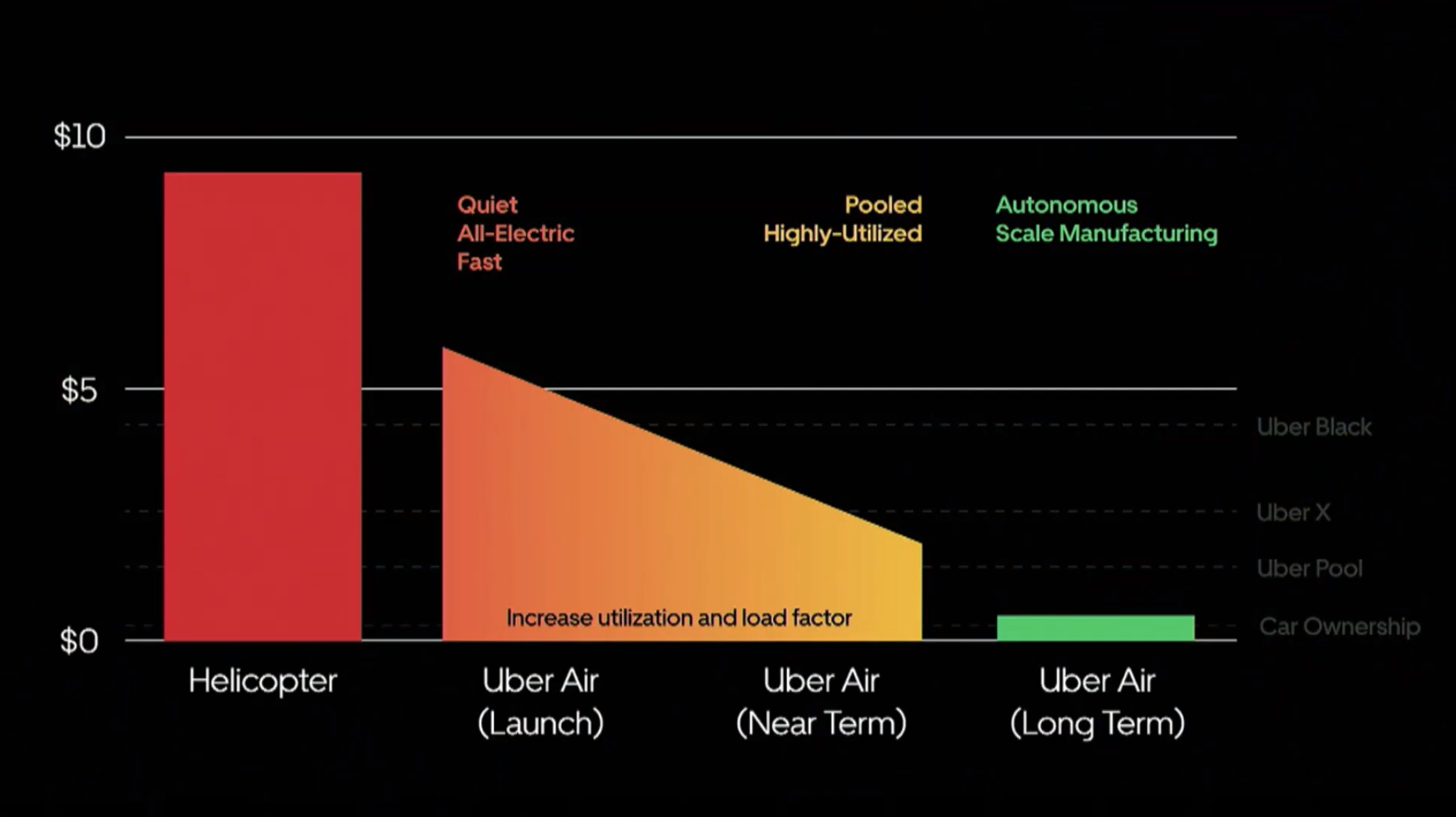
Uber has big dreams for Uber Air, the flying taxi service it’s wanting to launch in 2023. At the third annual Uber Elevate, head of Elevate Eric Allison said the company expects Uber Air to be cheaper than driving a car. It surely won’t be that way on day one, but once Uber deploys fully electric, autonomous shared vehicles, Allison said it will be more economical than driving a car.

“Our vision is that on a daily basis it’ll be more economically rational for you to fly than for you to drive,” he said.

At launch, Uber Air will be cheaper than a helicopter ride. This is a worthy comparison, given Uber unveiled its costly Uber Copter service last week as phase one of Uber Air. In the near term, Uber predicts Air will be comparable to the cost of Uber X and Uber Pool. Long term, which is probably at least more than five years from now, Uber Air will be more economical than owning a car, Allison said.

This, of course, is Uber’s best-case scenario for Air. In order for Uber Air to become a reality, it needs approval from the Federal Aviation Administration, the cities where it wants to land its electric vertical take-off and landing vehicles, help from real estate developers, customer trust and so much more. If all goes according to Uber’s plan, it will start testing this service next year and deploy it to the public in 2023.


from TechCrunch https://tcrn.ch/31kYJIR
via IFTTT

Embraer’s new EmbraerX eVTOL concept is accessible, autonomous and courteous

Short-distance commuter air travel has come a long way in the past few years — at least when it comes to concepts. The latest vision from Embraer of how we’ll get around in the city skies of the (near?) future involves some of what we’ve already seen, and highlights a few things that make clear where it’s focusing its priorities — namely, on community adoption and acceptance.

The concept created by EmbraerX, which is aircraft maker Embraer’s market acceleration and innovation arm, features electric power, as well as vertical take-off and landing (the “eVTOL” piece of the puzzle). It’s optimized for a ridesharing model, and is focused on “user experience” as well as “making the aircraft easily accessible to everyone,” according to the company.

It includes redundant flight systems for safety, as well as an intentional effort to reduce overall noise output with an eight rotor system that distributes lift across the span of the vehicle’s body. The introductory video highlights how the concept vehicle can accommodate passengers who user wheelchairs, and there’s both fly-by-wire control for today, as well as all the technology on board needed for autonomous operation once the tech is ready.

No word on target timelines for bringing these to the actual skies, but this looks a lot more technically feasible when compared to existing aircraft, beyond maybe an electric drivetrain that can provide the kind of lift needed for transporting what looks like up to four passengers, and doing so reliably and consistently.


from TechCrunch https://tcrn.ch/31tEdWD
via IFTTT