This is default featured slide 1 title

Go to Blogger edit html and find these sentences.Now replace these sentences with your own descriptions.This theme is Bloggerized by Lasantha Bandara - Premiumbloggertemplates.com.

This is default featured slide 2 title

Go to Blogger edit html and find these sentences.Now replace these sentences with your own descriptions.This theme is Bloggerized by Lasantha Bandara - Premiumbloggertemplates.com.

This is default featured slide 3 title

Go to Blogger edit html and find these sentences.Now replace these sentences with your own descriptions.This theme is Bloggerized by Lasantha Bandara - Premiumbloggertemplates.com.

This is default featured slide 4 title

Go to Blogger edit html and find these sentences.Now replace these sentences with your own descriptions.This theme is Bloggerized by Lasantha Bandara - Premiumbloggertemplates.com.

This is default featured slide 5 title

Go to Blogger edit html and find these sentences.Now replace these sentences with your own descriptions.This theme is Bloggerized by Lasantha Bandara - Premiumbloggertemplates.com.

Local governments that embrace digital services during challenging times can make real change happen

It has been a hard year. We wake up every morning to new developments in the tragedies of the moment spanning a pandemic, the greatest unexpected loss of life since 9/11, national civil unrest, natural disasters and a looming economic collapse.

In the face of these developments, a completely understandable message from government agencies to the public might be: We can’t serve you right now. Please take a number and we’ll get back to you as soon as possible.

But as we know now, this is an unacceptable path to successfully, and proactively, addressing the increasing needs of citizens facing public health risk and economic uncertainty. In fact, in the past few months, Americans have exhibited an unquenchable thirst for fast, effective government services and information. Resident demands of local government and community organizations are rising. Their voices are louder than ever before. People are bringing a new civic experience to the forefront of local governments that’s delivered on their terms — and aligned with growing demand for always-on, 24/7 information and services.

A hallmark of 2020 (so far) has been global developments impacting people at a very local level. For instance, a pandemic sparked a massive shift in American civic engagement around issues like public health and racial equality. The past few months have reinforced what the real power of local government is: To efficiently offer services and information that directly impact people’s lives. For cities and municipalities, the question now becomes: How can local leaders embrace this new era of civic engagement in the world of COVID-19 to deliver digital solutions that help everyone meet the moment?

Build a digital public square for the people

In the United States, the COVID-19 pandemic has literally closed city halls and forced government agencies at all levels to rethink modernizing public sector work to digitally and equitably deliver citizen services. Mayors, city council members and local agency officials, in particular, need to embrace this complex moment in time as an opportunity to cultivate a more vibrant, straightforward, inclusive and participatory municipal experience. One way to do that is to invest in digital tools, technologies and talent that can help local governments develop online civic engagement and citizen service outlets. Platforms that not only offer needed government services, but also prioritize input from residents and encourage community dialogue guided by clarity, trust and accountability.

Service has always been at the core of local government. However, a main challenge facing public sector leaders today is how to transfer critical services online. More specifically, developing online services that allow people who no longer have the luxury of waiting in lines for in-person interactions to remotely register to vote, obtain or renew a permit, report downed power lines and more.

A recommended path toward solution(s): At the end of the day, citizens are consumers. They want around-the-clock access to government services and options for ways to interact with service providers that meet their needs while taking their personal comfort into account. For local government agencies in the midst of digital transformation, building convenience into in-house digital government offerings and solution procurements is crucial. Digital government service solutions must be designed — by agencies or contracted vendors — to be platform and device agnostic (or, at least, interchangeable) on the back end; taking an omnichannel approach that addresses the needs of citizens and agencies through web, mobile, social media and offline options on the front end.

Bring the value of local government home

An increased online presence of community members and remote workers during the pandemic offers municipalities a fresh and cost-effective opportunity to advance local government digital service. Until recently, seemingly table stakes actions like producing photos for identification cards, scanning important documents, digitizing forms and streamlining workflows and case management were only plausible if large government teams had the budget to purchase required technologies separately, then stitch them together. Budget and capacity-constrained communities were largely left in the dark.

The good news is that today’s cloud-based solutions are complete, affordable and scalable to communities of all sizes. The market features solutions that are purpose-built for local governments to integrate with legacy IT systems while transitioning traditionally in-person services to digital interactions. And it’s possible to tap these solutions to fuel America’s new, more active brand of civic engagement and service citizens rapidly.

Further, the advent of accessible and affordable (or free) digital engagement platforms now complements an expanding recognition among American society that truly impactful things can come from government sources. The shift in thinking has produced civic engagement defined not by a sprint to profits, as is the case in the private sector, but by the ability for a representative community to actually influence policy and shape citizen services delivery.

A recommended path toward solution(s): In addition to always-on capabilities, digital government platforms need to be able to deliver goods and services to citizens directly and without friction. Whether accessing a government assistance application or applying for a park permit, citizens want their requests fulfilled without complications or inefficiencies plaguing the process — and going all-virtual or mostly remote during COVID-19 has made this more important than ever. In response, agencies should invest in the creation of digital forums for two-way communication to capture feedback that accurately reflects the demands and needs of the local community at the individual household level.

Boost digital forum accountability and representation moving forward

Today’s elevated energy around civic engagement is a direct result of the pandemic, expanding consumer activism and recent protests against systemic injustice. This confluence of factors offers local governments a fleeting opportunity to move beyond simply observing vocal citizen activity across the country. There’s now an opening to build upon, and actively grow, levels of civic engagement and community trust over time.

It’s now possible for local governments to reach more citizens by expanding their networks of interested subscribers and combat misinformation while keeping every resident informed. Agencies can advance on both fronts by providing civic leaders a two-way forum that encourages them to share progress being made in policy and procedures. After all, interacting with governments should be as simple and transparent for everyone as checking a bank account balance or reordering coffee pods from Amazon.

A recommended path toward solution(s): Municipalities should jump at this chance to really listen to diverse community voices pushing for change — especially as some powerful people in government and society seek to quiet or ignore them. They should consider developing long overdue digital solutions that amplify diverse community voices, deliver critical services and help to inform people broadly. Citizens, for their part, should be able to easily provide feedback, share ideas and voice their pressing needs to public sector officials or representatives who can help residents feel secure, listened to and taken care of. Expanded civic engagement impact entails reaching more people through their preferred channels, whether that’s email, text or snail mail, and establishing a dialogue that converts to action.

I’m confident that local governments throughout the country can rise to today’s unprecedented challenges by providing digital civic engagement outlets built to elevate individual perspectives on policy issues and surface life experiences that, in turn, inform inclusive civic action and real change.


from Social – TechCrunch https://ift.tt/2F0TTcZ
via IFTTT

Tinder’s interactive video event ‘Swipe Night’ will launch in international markets this month

Tinder’s “Swipe Night” is going global. The dating app announced today that its interactive video series will be available in Asia and other international markets starting on September 12, giving users another way to connect as they continue to stay at home because of the COVID-19 pandemic.

As in the United States, where “Swipe Night” first launched last October, the international version of “Swipe Night” will be broadcast on the weekend. For audiences outside the U.S., three consecutive episodes are planned, starting with the first one on September 12 from 10 a.m. to midnight, and airing on consecutive Saturdays at the same time.

Similar to Netflix’s “Black Mirror: Bandersnatch” and other interactive entertainment, “Swipe Night” presents viewers with a “choose-your-own-adventure” narrative, but each of its episodes is only seven minutes long and users’ choices are added to their profile, giving them another way to figure out if someone is a good match.

“Swipe Night” is not the first in-app event that Tinder has introduced over the past couple of years to increase user engagement as it competes with other dating apps for younger users. Other examples, held last year before the pandemic, included Spring Break mode and Festival Mode, which helped members in the United States find other people who were headed to the same vacation destinations or events.

Now that COVID-19 has made in-person meetups less safe, “Swipe Night” has become an important part of Tinder’s business strategy as it, and its competitors, focus on organizing more virtual events and hangouts. In today’s announcement, Tinder said during stay-at-home orders and social distancing, 52% more messages have been sent through the app globally, peaking on April 5, and “swipe volume” by users under 25 (or “Gen Z”) increased by 34%.

As a user engagement experiment, “Swipe Night” proved successful enough in the U.S. to warrant a second season even before stay-at-home orders started there. When it launched last fall, Tinder’s monthly usage was climbing, but users were opening the app less on a daily basis. By the time Tinder announced the second season of “Swipe Night” in February, Tinder said millions of users had tuned into the series and matches and conversations had increased by 26% and 12%, respectively.

“When lockdowns began, we saw an immediate increase in our members’ engagement on Tinder, so we know we play an important role in their stay-at-home experience. While the global health crisis continues, we believe ‘Swipe Night’ can bring a welcome change of pace to our members around the world,” said Tinder chief executive officer Jim Lanzone in today’s announcement.

Now Tinder will find out if audiences in the rest of the world, where its competes with a large roster of other dating apps, will respond to “Swipe Night” with the same level of enthusiasm. Tinder doesn’t break down its member numbers by country, but its APAC head of communications Papri Dev told TechCrunch that more than 50% of its members worldwide are Gen Z, the main audience for “Swipe Night,” and storylines are designed to provoke conversations.

“Having a high stakes story such as an apocalyptic themed event, felt like a strong forcing mechanism to make your choices or decisions really count,” she said. “Our members who are stuck at home are hungry for content, and based on what we’ve seen take off on other platforms, people seem to be open to a wide range of tones and topics. So we wanted to make Swipe Night available to our members in Asia, and around the world, as soon as we felt it would be appropriate.”

Content in Asian markets including Korea, Taiwan, Japan, Thailand, Vietnam and Indonesia will have subtitles in local languages.


from Social – TechCrunch https://ift.tt/32YKKtB
via IFTTT

Facebook to warn third-party developers of vulnerable code

Facebook has announced a policy change that will see the company notify third-party developers if it finds a security vulnerability in their code.

In a blog post announcing the change,Facebook said it “may occasionally find” critical bugs and vulnerabilities in third-party code and systems. “When that happens, our priority is to see these issues promptly fixed, while making sure that people impacted are informed so that they can protect themselves by deploying a patch or updating their systems.”

Facebook has previously notified third-party developers of vulnerabilities, but the policy shift formally codifies the company’s policy toward disclosing and revealing security vulnerabilities.

Vulnerability disclosure programs, or VDPs, allow companies to set the rules of engagement for finding and disclosing security bugs. VDPs also help guide the disclosure and publication of vulnerabilities once a bug is fixed. Companies often use a bug bounty to pay hackers who follow the company’s reporting and disclosure rules.

The policy change is not entirely altruistic. Facebook, like many other tech companies, relies on a ton of third-party code and open-source libraries. But by putting the change in writing, it also puts third-party developers on notice if they don’t fix vulnerabilities in a timely fashion.

Casey Ellis, founder and chief technology officer at vulnerability disclosure platform Bugcrowd, said the policy shift was becoming increasingly popular for companies with a “large, user-centric, third-party attack surface,” and echoes similar efforts by Atlassian, Google and Microsoft.

Facebook said when it finds a vulnerability, it will give third-party developers 21 days to respond and 90 days to fix the issues, a widely accepted time frame to report and remediate security issues. The company says it will make a reasonable effort to find the right contact for reporting a vulnerability, including, but not limited to, emailing security reporting emails, filing bugs without confidential details in bug trackers or filing support tickets. But the company said it reserves the right to disclose sooner if the vulnerability is actively being exploited by hackers, or delay its disclosure if it’s agreed that more time is needed to fix an issue.

Facebook said it will generally sign a non-disclosure agreement (NDA) specific to the security issues it reports.

Katie Moussouris, founder of Luta Security, told TechCrunch that the “devil will be in the details.”

“The test will be the first time they have to pull the trigger and drop a zero-day — with mitigation guidance — on a competitor,” she said, referring to unpatched vulnerabilities where companies have zero days to patch them.

The new policy is focused specifically on how Facebook handles disclosure of issues in third-party code. If researchers find a security vulnerability on Facebook, or within its family of apps, they will continue to report it through the existing Bug Bounty Program.

As part of the policy change, Facebook said it would also disclose vulnerabilities once they are fixed. In a separate blog post, Facebook, which owns WhatsApp, disclosed six vulnerabilities in the messaging app — since fixed.


from Social – TechCrunch https://ift.tt/3lLjM1j
via IFTTT

Twitter and Facebook wrestle with Trump telling Americans to vote twice

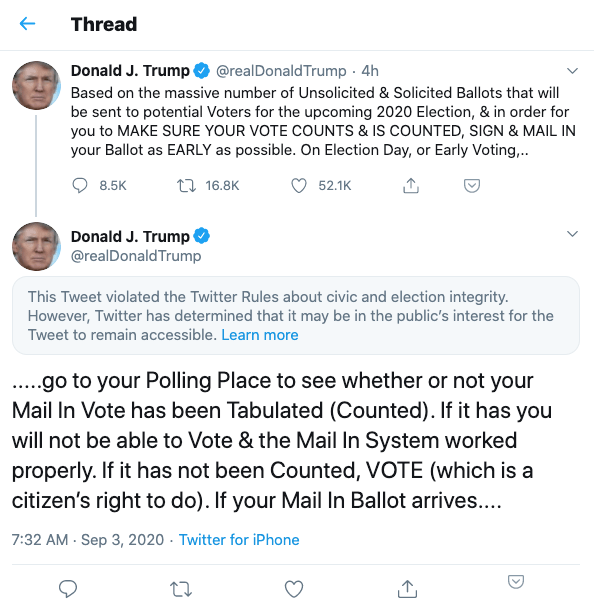
President Trump’s recent suggestion that North Carolina voters should cast multiple ballots has run afoul of Twitter’s election integrity rules. In a series of tweets Thursday morning, the president elaborated on previous statements in which he encouraged Americans to vote twice to “check” vote-by-mail systems.

Trump made the initial comments in a local television interview Wednesday. “They will vote and then they are going to have to check their vote by going to the poll and voting that way because if it tabulates then they won’t be able to do that,” Trump said.

“So let them send it in, and let them go vote. And if the system is as good as they say it is, then they obviously won’t be able to vote.”

Twitter added a “public interest notice” to two tweets related to those comments Thursday, citing its rules around civic and election integrity. The tweets violated the rules “specifically for encouraging people to engage in a behavior that could undermine the integrity of their individual vote,” according to Twitter spokesperson Nick Pacilio. Twitter has limited the reach of those tweets and restricted its likes, replies and retweets without comment.

Trump’s latest attack on vote-by-mail also crossed a line for Facebook. The company will remove any video of Trump’s recent voting comments that are shared without context or those that support the president’s statements, though it has yet to identify any so far.

“This video violates our policies prohibiting voter fraud and we will remove it unless it is shared to correct the record,” Facebook Policy Communications Director Andy Stone said.

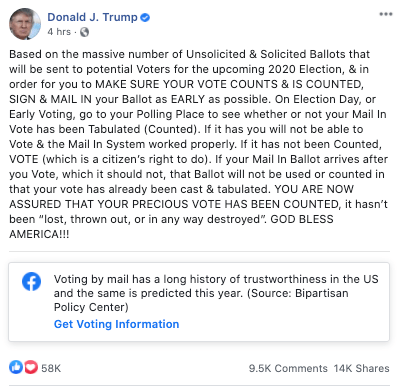
Facebook added its own fact-checking notice to the same statement that Twitter deemed in violation of that platform’s rules. Now, a label at the bottom of Trump’s Facebook post contradicts the president’s suggestion that Americans try to vote twice to make sure “the mail in system worked properly.”

The fact-checking label, which reads “Voting by mail has a long history of trustworthiness in the US and the same is predicted this year,” is more specific than the generic voting info label the platform attaches to other election-related content.

The president’s comments were his latest attempt to cast doubt on the vote-by-mail systems that the U.S. will rely on in November’s election. In recent months, Trump has made many unfounded or outright false claims criticizing the safety of mail-in voting, a system that the U.S. already relies on for absentee voting. As November gets closer, those claims have voting rights organizations concerned.

“While this is a step in the right direction, the fact remains that Facebook refuses to enforce its own Terms of Use where Donald Trump is concerned,” VoteAmerica founder Debra Cleaver said.

“Yesterday, Trump outright urged voters in North Carolina to commit voter fraud. This is part of a larger and dangerous pattern of Trump using social media and other platforms to distribute disinformation, with what appears to be the goal of undermining faith in US elections.”

While the COVID-19 crisis means that more Americans than ever will be using mail-in voting to cast a ballot, the voting method is widely regarded as safe and reliable by experts.

In response to Trump’s remarks, North Carolina’s Board of Elections issued a statement clarifying that voting twice is a Class I felony in the state.

“It is illegal to vote twice in an election,” said Karen Brinson Bell, executive director of the North Carolina State Board of Elections.

“… Attempting to vote twice in an election or soliciting someone to do so also is a violation of North Carolina law.”


from Social – TechCrunch https://ift.tt/3i09HLF
via IFTTT

As it awaits its US fate, TikTok doubles down on its revenue funnel with marketing partners

There’s a big question mark hanging over the future of TikTok right now, in the form of what exactly will happen to its US business come September 20, when President Trump said he plans to shut down the Chinese-owned app over security concerns.

But in the meantime, it seems to be business as usual for the app.

Today, TikTok — which has 100 million users in the US — announced a slate of marketing partners to help brands create and measure the impact of campaigns on the app. The company, owned by ByteDance in China, is kicking off the program with 20 partners that include companies for campaign management (eg, Sprinklr and Bidalgo); for creative development (eg, QuickFrame and Shuttlerock); branded effects around VR and AR (eg, Bare Tree Media and Byte); and measurement (Kantar). The full list is below.

This is the latest expansion of TikTok for Business, the company’s advertising platform, which launched officially in June to bundle together TikTok’s existing marketing products alongside a new AR product it launched to rival Snapchat’s.

TikTok confirmed to us that this is a global initiative — that is, it’s set up to create marketing campaigns for wherever TikTok is available.

And I’m going to be honest. It feels a little like an alternate TikTok reality, like the kind you might see in a split-screen meme on the app itself.

On one side, adding in marketing partners is very, very standard for a social media app that’s doubling down on making money through adtech based on its growing and engaged (and young) audience. Facebook (and the apps in its stable like Instagram) did it. Twitter did it. Snapchat did it.

And now TikTok is doing it. It speaks to the company’s ambition to expand its platform to work with the biggest brands and at scale, leveraging its strong audience growth to build advertising units to sell brands and products to them in innovative and sticky ways that are uniquely “TikTok.”

One the other side, of course, TikTok is having anything other than a standard growth trajectory right now.

It’s in the middle of a messy bidding process for ByteDance to sell TikTok’s US assets (along, potentially, with others) to US owners. The company has had to deal with the abrupt departure of its US head. And now the situation seems to be spilling over into speculation over what might happen in other parts of the world, such as India. All of this means that it’s unclear what will happen to marketing relationships, and where advertisers and partners will be left if and when the app has to splinter.

Or indeed, how ad products and other IP would be passed on in a potential sale. (Right now, reportedly, one of the sticking points for a deal has been the possibility that China might limit which algorithms, which form the basis of how TikTok works, would be passed on in a sale.)

“With the launch of TikTok For Business, we’re building new opportunities for marketers to be creative storytellers and meaningfully engage with the TikTok community,” said Melissa Yang, Head of Ecosystem Partnerships, TikTok, noted in the blog post. “We’re thrilled to collaborate with some of the most strategic and trusted leaders in the advertising industry and continue giving marketers access to more tools to successfully create, measure and optimize ad campaigns on TikTok. We can’t wait to collaborate with partners to bring a creative and joyful experience to our brand partners and the broader TikTok community.”

We have asked TikTok if it can comment on how marketing programs like these would be affected if and when the company does split up into regional operations, and it declined to comment specifically:

“Unfortunately we’re not able to comment on speculation,” said a spokesperson. “In general we along with our partners are excited to kick off these partnerships and continue bringing more solutions to the marketing community.”

Here’s the full list of partners in the meantime, per TikTok:

Campaign Management to plan, create, optimize, and measure marketing campaigns

  • Bidalgo – Bidalgo drives growth and reduces user acquisition complexity for mobile marketers,  leveraging AI to generate actionable insights and powerful automation capabilities for creative production and media buying.
  • Bidshake – Empowers fast, efficient and reliable campaign management by enabling real-time, automated cross-channel actions based on aggregated data all from one platform.
  • Sprinklr – The world’s leading Customer Experience Management (CXM) platform.
  • WinClap – The marketing company that provides advanced AI analytics, expertise, and creative production to boost the performance of your campaigns
  • MakeMeReach – Multi-channel ads management platform optimized for scale.

Creative Development to build assets like videos that work on TikTok

  • QuickFrame – More than a marketplace connecting brands to video creators. We help businesses grow by transforming the way they produce video content at scale.
  • Shuttlerock – Transforms existing brand assets into stunning handcrafted video ads.
  • VidMob – Leading creative analytics & post-production platform that uses data to understand your creative, improve your ads and increase marketing performance.
  • Vidsy – Helping brands achieve their business goals with effective digital ad creative.
  • Cohley – Helps brands and agencies cost effectively scale the creation of UGC videos for ads.

Branded Effects for AR and VR content

  • Bare Tree Media – A full-service creative agency enabling brands to reach, engage and entertain consumers through the creation and digital publishing of augmented reality (AR), emojis, messaging stickers, and GIFs within popular messaging platforms.
  • Byte – Global specialists in branded AR, Byte is a martech agency that combines technology and creativity to  help solve brands’ challenges.
  • Happy Finish – Global creative production collective studio, creating realities. We specialise in cross-platform services including Retouch, CGI, Animation, VFX, VR, AR & Mixed Reality and Creative AI, and craft experiences for some of the biggest brands and agencies in the world.
  • IgniteXR – Ignite XR is an end-to-end creative solutions group for augmented reality, creating integrated AR campaigns for brands and translating ideas into engaging immersive creative experiences.
  • Poplar Studio – A global creative platform that makes the creation of 3D and AR campaigns easier, faster, affordable and fun — including face filters, world effects, mini-games, portals and image trackers.
  • Subvrsive – Subvrsive is an immersive innovation studio focused on creating content, software, and experiences that transform businesses on a global scale.
  • Tommy – A modern communications agency that uses technology, strategy, and award-winning design to help brands earn the attention of their audiences.
  • Unit9 – A production studio focusing on AR/VR, Digital, Experiential, Gaming, Innovation and Film projects.

Measurement to target and analyse campaigns

  • Kantar –  The world’s leading data, insights and consulting company.

TikTok is opening the program to other interested partners, it said.


from Social – TechCrunch https://ift.tt/32PkkKW
via IFTTT

Facebook Watch is getting 1.25B visitors each month

Facebook is sharing some new growth numbers around its video destination — namely, that Facebook Watch is now receiving more than 1.25 billion visitors every month.

The company isn’t saying specifically how those numbers have changed during the pandemic (when video services like Netflix have seen dramatic growth), but product lead Paresh Rajwat said there was “a really big surge” at the beginning of lockdown and social distancing, and that the surge has not subsided as society begins to reopen.

Facebook Watch launched in 2018. Back in June of last year, the company said that 720 million people were watching at least one minute of Watch content every month.

Rajwat noted that while Watch is built on “the social layer of Facebook,” with videos shareable across Facebook’s many products, the views are happening on Watch itself.

“It is super critical for us to have a destination,” he said, keeping videos from popular creators and publishers separate from the core Facebook experience of interacting with friends and family. “The moment we mix them together, it becomes a completely different product for people.”

Rajwat added that the company isn’t just looking at overall audience size. He argued that when you look at “the reactions and comments and shares” you can see that “the content we have is working.” (Advertisers have wondered about the true extent of audience engagement on Facebook Watch.)

Last year, as tech and media companies were all investing heavily to launch their own streaming services, we argued that Facebook’s efforts with unscripted shows and older content seemed pretty lackluster in comparison. But it sounds like the content that’s working on Watch isn’t the kind of thing that you’d find on Netflix or Disney+ — as Rajwat put it, “The angle we’ve taken is to focus more on content that is around social topics to drive conversations.”

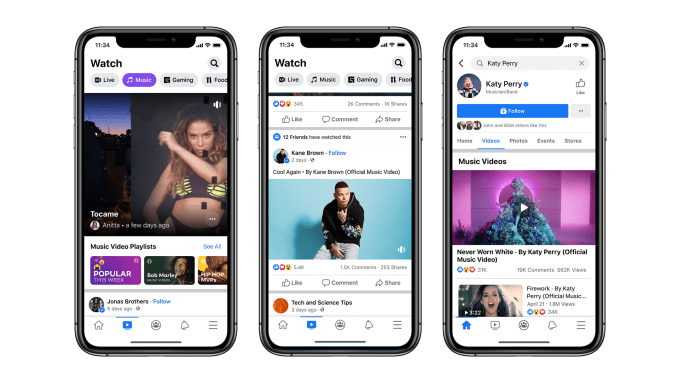
Image Credits: Facebook

For example, there’s “Red Table Talk” from Jada Pinkett Smith and family, a talk show that made headlines over the summer for bringing Will Smith and Jada together to discuss their marital issues. Facebook plans to launch another version of Red Table talk in October, “Red Table Talk: The Estefans,” with Gloria Estefan, her niece Lily and her daughter Emily.

As another example of a successful original Facebook Watch show, Rajwat pointed to “Returning the Favor,” an Emmy-winning program where host Mike Rowe showcases everyday heroes.

Rajwat said that live programming has increased significantly during the pandemic. That includes live sports, with 13.7 million people watching the UEFA Champions League final, making it the most popular football broadcast ever on Facebook Watch. And Facebook recently announced that publishers and other businesses will be able to charge for access to live online events, with Facebook taking no fees for the next year.

The site also added licensed music videos over the summer, with Katy Perry premiering her music video for “Smile” exclusively on Facebook Watch, where it was watched by “millions” of fans.

The company highlighted successful publishers on Facebook Watch include organizations like UFC, large publishers like BuzzFeed and individual creators like Benito Skinner and Brandi Guice, a.k.a. Braannxo, who’s making 98% of her revenue from Facebook Stars and fan subscriptions.

Looking forward, Rajat said that a big priority is making “more and more investment in showing people what they really are interested in.” To that end, users have already spotted that Facebook Watch is now allowing users to customize their feed by exploring and subscribing to different topics.


from Social – TechCrunch https://ift.tt/2QTf8Ad
via IFTTT

Facebook to block new political ads 1 week before Nov 3, adds more tools and rules for fair elections

We’re now 61 days away from the US Presidential election, and Facebook is once more ramping up its efforts to level the playing field and attempt to keep its platform from being manipulated to influence how people vote.

CEO Mark Zuckerberg today announced a series of new measures, including the news that it will block new political and issue ads in the final week of the campaign — although campaigns can still run ads to encourage people to vote, and they can still run older political ads. Other announcements today detailed more work to counter misinformation, and stronger rules to counter voter suppression, including misleading references to COVID-19 at the polls.

The news today is significant not just because it’s a sign of how Facebook continues to work on more proactive measures around the election, but that it is definitely past the point of trying to present itself as an innocent bystander to forces that would have been in play even if Facebook didn’t exist.

“This election is not going to be business as usual,” he wrote in the post. “We all have a responsibility to protect our democracy. That means helping people register and vote, clearing up confusion about how this election will work, and taking steps to reduce the chances of violence and unrest.”

Other measures will include placing its Voter Information Center — a hub for voting information, with deadlines and guides on how to vote by mail and other related details that it announced in August — at the top of Facebook and Instagram “almost every day until the election.” (Originally, the hub was going to be accessible — and somewhat hidden — in the menu; now it’s being moved it into a more prominent slot.)

Zuckerberg said that the political ad blocking is being put in place because Facebook — another admission — doesn’t believe that there would be enough time to contest any new claims that might come in the ads.

But while blocking those last-minute political ads is an important move, it’s not a complete block of all political ads. Facebook said that political ads posted more than a week before the election can still stay up, and targeting for those ads can still be adjusted (that is — they can essentially be run as new campaigns).

Zuck’s explanation is that the older ads have time to be researched. “Those ads will already be published transparently in our Ads Library so anyone, including fact-checkers and journalists, can scrutinize them,” he noted.

The company said that its efforts so far have driven 24 million clicks to voter registration sites, but how those translate into actual registrations is not clear. The company has set a goal of helping 4 million people register and vote, and Zuckerberg himself has donated $300 million to organizations working on that effort.

Other efforts announced today include a number of moves to try to combat misinformation — one of the key ways that Facebook has been leveraged in past elections to influence voting.

Specifically, Facebook said it is extending the window beyond 72 hours — its original timescale — where it’s going to try to identify and remove false claims about polling conditions, given that many may try to vote early this time around.

And given how a lot of misinformation is also shared through direct channels off Facebook itself, it’s also going to limit how things can be forwarded on Messenger to stem how content goes viral on there. “You’ll still be able to share information about the election, but we’ll limit the number of chats you can forward a message to at one time,” Zuckerberg noted. This will, of course, cut both ways (those trying to put out accurate information might also get dinged) but ultimately is a direct result of how Facebook has altered forwarding on WhatsApp around elections in other countries, such as India.

One of the other issues that has been highlighted by many has been how the high percentage of people voting by mail might be exploited to the advantage of candidates that take strong early leads in live voting: the worry is that the live results get called as early victories, before other votes are tallied, which could, for example, dissuade people from going to polling stations and voting. Facebook now says that it will be adding labels to candidates and campaigns that try to declare victory before the official calls (but won’t be removing those posts). It’s working with Reuters and the National Election Pool to determine more accurate results, it said.

Another big theme in misinformation has been around COVID-19 and how scare tactics around this are used to dissuade people from voting. Facebook said it will “remove posts with claims that people will get Covid-19 if they take part in voting”, with links to more accurate information. The rule will also include ads with this message.

Misinformation also comes through Facebook by way of sending false details about how polling stations or how voting works, for example not just trying to discourage people from going to polls, but also intentionally giving specific groups of voters the wrong information about how to vote, for example telling them that it’s okay to send in their ballots past the deadline.

All of these policies will work in tandem with how Facebook deals with a completely different threat, coming not from candidates and their campaigns but other actors intent on destabilising how democratic processes work, or simply to influence how they go.

Just this week, Facebook took down a network of 13 accounts and 2 pages sending out misleading claims about political candidates. The company says that it’s investing more into its security to continue fighting this but it’s a huge problem, stretching back years now to the previous US Presidential election, and apparently not going away anytime soon. While originally the threats were identified as coming from countries like Russia, Zuckerberg now admitted that “We’re increasingly seeing attempts to undermine the legitimacy of our elections from within our own borders.”

It’s going to be a long 61 days….


from Social – TechCrunch https://ift.tt/31WnDkq
via IFTTT