This is default featured slide 1 title

Go to Blogger edit html and find these sentences.Now replace these sentences with your own descriptions.This theme is Bloggerized by Lasantha Bandara - Premiumbloggertemplates.com.

This is default featured slide 2 title

Go to Blogger edit html and find these sentences.Now replace these sentences with your own descriptions.This theme is Bloggerized by Lasantha Bandara - Premiumbloggertemplates.com.

This is default featured slide 3 title

Go to Blogger edit html and find these sentences.Now replace these sentences with your own descriptions.This theme is Bloggerized by Lasantha Bandara - Premiumbloggertemplates.com.

This is default featured slide 4 title

Go to Blogger edit html and find these sentences.Now replace these sentences with your own descriptions.This theme is Bloggerized by Lasantha Bandara - Premiumbloggertemplates.com.

This is default featured slide 5 title

Go to Blogger edit html and find these sentences.Now replace these sentences with your own descriptions.This theme is Bloggerized by Lasantha Bandara - Premiumbloggertemplates.com.

LinkedIn’s Career Explorer helps you identify new kinds of jobs based on the skills you have

One of the key side-effects of the Covid-19 pandemic has been how it has played out in the economy. There are currently 12.6 million people out of work in the U.S. alone, with estimates from the International Labour Organization noting that globally number some 245 million full-time jobs have been impacted.

To meet some of that challenge, today, LinkedIn is launching a new Career Explorer tool to help people find new jobs. Out in beta today in English (and adding further languages soon), this is not another job search engine. It’s a tool that matches a person’s skills with jobs that she or he might not have otherwise considered, and then provides pointers on what extra skills you might want to learn to be even more relevant.

Alongside this, LinkedIn is launching a new skills portal specifically to hone digital skills; subtle profile picture “frames” to indicate when you’re looking for work, or when you are hiring; and interview prep tools.

The Career Explorer tool is perhaps the most interesting of the new features.

Built with flexibility in mind, LinkedIn is leaning on its own trove of data to map some career paths that people have taken, combining that with data it has on jobs that are currently in higher demand, and are extrapolating that to help people get more creative about jobs they could go for.

This would be especially useful if there are none in their current field, or if they are considering using the opportunity of a job loss to rethink what they are doing (if Covid-19 hasn’t done the rethinking for them).

The example that LinkedIn gives for how this works is a notable one. It notes that a food server and a customer service specialist (an in-demand job) have a 71% skills overlap.

Neither might be strictly considered a “knowledge worker” (interesting that LinkedIn is positioning itself in that way, as it’s been a tool largely dominated by the category up to now), but both interface with customers. LinkedIn uses the Explorer to then suggest what training you could undertake (on its platform) to learn or improve the skills you might not already have.

The Career Explorer is a development on the skills assessment tool that LinkedIn launched last year, which were tests that people could take to verify what skills they had and what skills they still needed to learn for a particular role.

In the midst of a pandemic, that effort took on a more pointed recovery role, with skills training developed in partnership with Microsoft (which owns LinkedIn) specifically to address digital gaps in the employment market, which when filled could help the economy rebuild. LinkedIn said that to date, around 13 million people have used the those tools to learn new skills for the most in-demand jobs.

The idea with these new tools is that while people may be losing their jobs, there is still work out there. LinkedIn itself says it has more than 14 million positions open right now, with close to 40 million people coming to the site to search for work every week, and three people getting hired each minute. So the aim is to figure out how best to connect people with the opportunities around them.

And given that LinkedIn, now with 722 million users, has long made recruitment and job searches a central part of its business — both in terms of traffic and in terms of the revenue it makes from those services; I often think of it as the place where professionals go to network and look for work — launching these tools not only can help LinkedIn be a more useful partner in the job-search process. It helps keep that jobs business evolving at a time when it otherwise might feel somewhat stagnant. And after all, despite the activity on LinkedIn, unemployment remains high and some believe will get worse before it gets better again.


from Social – TechCrunch https://ift.tt/2TB2o2m
via IFTTT

We need new business models to burst old media filter bubbles

Access to information in the United States is fragmenting along social lines. This goes beyond the fuzzy, qualitative feeling many of us have that people can’t agree on key issues anymore — data show that people are increasingly breaking into disconnected ideological camps. While this is commonly viewed as a left/right issue, the reality is much more pernicious: It is a rich/poor issue.

Americans today are exposed to fundamentally different facts based on their news sources. Data are often arranged to fit narratives rather than the other way around. This effect spans the political spectrum: It is as relevant to The New York Times as it is to Fox News. One of the contributors to this information split is the rise of site-wide paywalls, which divide access to information along socio-economic lines.

As one magazine editor eloquently puts it, “The truth is paywalled but the lies are free.”

It’s time for us to think critically about how we can build business models that reunite information bubbles, so that people consistently get access to all sides of the story.

Ringing the division bell

Media polarization is not a new phenomenon. Studies have shown for over a decade that, when it comes to news, people have been dividing themselves into information camps. Social media platforms — quickly replacing publishers as the “front end” of news — act as an accelerant, using likes and reads to pattern-match content to readers. However, these studies often address the left-right split; little is said about the more fundamental difference in beliefs driven by a difference in ability and willingness to pay for news.

The pivot by major publishers to erect site-wide paywalls is a recent phenomenon, an answer to the “grand ad-supported content bargain.” These paywalls have grown in popularity, driving people to subscriptions as an alternative to ads revenue. In doing so, they have undoubtedly helped stem (and maybe reverse?) the decline in news revenues driven by the internet.

How bad has this decline been? Just see this OECD visualization of how circulation, titles and revenues have dropped over time.

As Rupert Murdoch said, “… sometimes rivers dry up.” From 2007-2009 alone, the U.S. saw a 30% decline in newspaper publishing. Staff layoffs have become the norm for smaller and midmarket news services, which find themselves driven to consolidate into larger news orgs in order to bring down prices and expand the reach necessary to attract ad spend.

The message is clear: If people want to continue consuming news, they and media companies need to work together to develop a business model that can support it. Yet, as news bookmarking service favor.it notes, “There is now a real cost to the user associated with acquiring accurate, insightful and well-produced news. [ … ] Exacerbating the problem is the fact that there is now serious competition to real news. Free, less-reliable news sources and aggregators that can push articles into a [F]acebook Newstream that go viral in a matter of seconds whether they are completely true, or properly researched, or not.” The data bear this out: an MIT study across 126,000 stories found that fake stories proliferate on average 6x quicker than true ones.

The new iron curtains

Across six European countries and the United States, the average price for paywalled news is about $15.75 per month. In a time where half of Americans are working low-wage jobs and many are experiencing a severe savings crisis, most don’t have the available funds to shell out for a $15 monthly news subscription — much less a subscription for each outlet they want to access. Free news and clickbait headlines on social media, much like fast food, are the easiest and most freely available options to a swathe of people who have neither the resources nor the energy to do the fact-checking for themselves.

A perennial suggestion is that outlets syndicate their content into a “Netflix for news” bundle. Indeed, aggregator initiatives like Apple News have grown to over 100 million users. Yet this still doesn’t solve a fundamental problem, which is that, in an age of instantly available free online media, most people are not willing to pay even for bundled news.

As Don Richard, senior PM at Shopify, puts it, “I just don’t think the mass appeal for a text-content bundle is as high as many tech folks believe it is [ … ] most people view text content as a less-valuable medium than TV and music  —  valuable being defined as worth paying for based on your personal needs and preferences. And when people have other expenses they have to pay for, paying for a text-content bundle will be hard to justify. Since a text-content bundle doesn’t exist today, the money for a text-content bundle has to come from somewhere else in the monthly budget for most people. That means the bundle price has to take share-of-wallet over something else. Basic needs (food, shelter, utilities) aren’t being reduced for a text-content bundle.”

So we end up with two fundamentally different types of media: On the one hand, free media, supported by independent journalists, freelancers and threadbare content teams; on the other, paywalled media, supported by more robust fact-checking teams and editors. As Robinson puts it, “It costs time and money to access a lot of true and important information, while a lot of bullshit is completely free.”

Coming back to the accelerating polarization of the American public, this media divide is not without consequence. People can always reasonably disagree about beliefs and ideas, so long as they have the shared context of facts. They cannot have productive debates if the facts are in-question.

This is where claims of “fake news” originate: Dividing the world into free facts versus paywalled facts means we are increasingly talking past each other. As favor.it puts it, we’re “moving toward a situation where there will be haves and have-nots in the very critical area of having basic, accurate information about what is going on in the world.”

Where do we go from here?

It is clear that the internet media model predicated on paywalls needs to be revisited due to these shortcomings. But what are the alternatives? Targeted ads have been shown to have their own disadvantages and provoke reader ire.

While this is not a comprehensive answer, here are a few suggestions:

Free facts, upsold details. Pull the key facts out of news stories and make them freely available to people, upselling the deeper and richer storylines. TechCrunch has found an elegant middle-ground of this format: The core news stories on the website are free, while the value-added analysis, investigative deep-dives and richer opinion content are available to subscribers.

The New Paper is another, newer service experimenting with a condensed version of news headlines to combat newsletter and information fatigue (albeit one that still plans to charge $5 monthly). This is something being spearheaded by the rise of platforms like Substack today for independent journalists; content producers with a good following or smart coverage can create self-sustaining businesses.

Could newspapers take a page from Scandinavian ticketing practices and charge based on income? A tiered subscription price adjusted to payroll could allow wealthier readers to create a public good for poorer ones.

Yet, when people pay for news, they should not just be paying for stories — they should be paying for the knowledge that an army of editors, fact-checkers and investigative journalists uncovered the truth behind a story. That is a good that Substack likely cannot provide.

Develop a publicly available, consensus-driven score for fact-based news outlets and prioritize this score in algorithms. The way we access information has changed; aggregators now sit at the top of the news funnel. This has created a significant user surplus — people are able to locate information by story, without being constrained by outlet. However, it has also created an ad-revenue-driven model that prioritizes unique views, which are in turn driven by people’s search for sensationalism and confirmation bias in media. Search engines, social media platforms, and aggregators should come together to develop a public, transparent scoring mechanism for information quality in news and implement that to drive more viewers to more trustworthy sources. An independent rating for factuality that becomes a key input into search and social rankings could significantly help curb the virality of fake news stories, but it would need to take into account the sometimes long half-life of the truth.

Public initiatives. The government needs to re-enter the business of protecting the quality of journalism.

One step is for the FCC to reintroduce the Fairness Doctrine, which required journalists to represent both sides of a given story.

Another is to increase funding for public news sources of all stripes: liberal, conservative, etc., and for those sources to submit to routine information quality audits. Every area in which we’ve taken public institutions and allowed people to pay their way out of the default option — healthcare, education — has led to wild underinvestment in the public option; news is no different.

The library model is surprisingly effective for those who select it as an option: well-funded and maintained public libraries still provide an amazing, information-rich resource to those who avail of their services. Digitizing library resources and allocating partial budget to make information not just available, but also surfaced at the right contextual moment could combat misinformation.

A last option would be to implement information quality scores, similar to public health and safety standards. A score could be as simple as an A-F grade on a restaurant or a calorie count on a fast food menu.

Micropayments and stories a la carte. As long as news media has been dealing with internet-related pressure, technologists have proposed micropayments as the answer. The desire to read an individual news story is stochastic, while media subscriptions are continuous. Few people, myself included, have the willingness to submit to a monthly or annual news subscription just to access the content in one article. Publishers should offer individual stories, sold in exchange for micropayments of, for example, $0.10 per story (10x the payout of some publishers to their content creators). Digital wallets embedded into browsers (see Metamask and Brave Browser as examples) can support these micropayments fluidly, either with opt-ins for each story or working in the background, to allow readers to move seamlessly around the internet, so that readers aren’t asked to pay for each story. As futurist Jaron Lanier noted 10 years ago, “Digital technology … unsettled the so-called ‘creative class’ — journalists, musicians, photographers” when access to information became free; micropayments (and royalties) could help rebuild that class of jobs. With that said, there’s a discrepancy between the amount that periodicals spend to publish a story (e.g., $100) and people’s propensity to pay (e.g., $0.10); unlike songs and movies, people only consume news stories once.

Alternative revenue streams. Media companies should again explore whether events, classifieds, paid editorials, in-depth research and other information-related services could allow them to offer “just the facts” as a loss leader. The New York Times, famously, launched The Daily podcast and spun off its cooking and crossword products into standalones. Publications should reinvest in hyperlocal journalism with local sponsorship.

The truth is that, as site-wide paywalls continue to be erected, there will be a real divide of news into haves and have-nots. There is no silver bullet solution to this problem. The public benefits from open news; factual reporting creates positive externalities. Yet we have not found a commercial structure to support these organizations. The answer is probably a combination of the above along with other revenue streams (including, yes, ads). But it is paramount to the strength of our social fabric that we continue to search for that answer.

We should ask ourselves what surplus is created by good news coverage, by deep investigative research and honest reporting? Who benefits? At this critical juncture when the stress fractures in our fragile democracy are beginning to show, it is obvious that all of us benefit from that surplus as a society. So let’s work together to support it, for the sake of society.

Thank you to Danny Crichton, Danny Zuckerman, Jason Wardy and Orion de Nevers for reviewing this piece.


from Social – TechCrunch https://ift.tt/3e37BcS
via IFTTT

True, the social networking app that promises to ‘protect your privacy,’ exposed private messages and user locations

True bills itself as the social networking app that will “protect your privacy.” But a security lapse left one of its servers exposed — and spilling private user data to the internet for anyone to find.

The app was launched in 2017 by Hello Mobile, a little-known virtual cell carrier that piggybacks off T-Mobile’s network. True’s website says it has raised $14 million in seed funding, and claimed more than half a million users shortly after its launch.

But a dashboard for one of the app’s databases was exposed to the internet without a password, allowing anyone to read, browse and search the database — including private user data.

Mossab Hussein, chief security officer at Dubai-based cybersecurity firm SpiderSilk, found the exposed dashboard and provided details to TechCrunch. Data provided by BinaryEdge, a search engine for exposed databases and devices, showed the dashboard was exposed since at least early September.

More on Extra Crunch

After we reached out, True pulled the dashboard offline.

Bret Cox, chief executive at True, confirmed the security lapse but did not answer our specific questions, including if the company planned to inform users of the security lapse or if it planned to disclose the incident to regulators under state data breach notification laws.

The dashboard contained daily server logs dating back to February, and included the user’s registered email address or phone number, the contents of private posts and messages between users, and the user’s last known geolocation, which could identify where a user was or had been. The dashboard also exposed the email and phone contacts uploaded by the user, which True uses to match with known friends in the app.

None of the data was encrypted.

TechCrunch confirmed the dashboard was returning real user data by creating a test account and asking Hussein to provide data that only we would know, such as the phone number used to register the account.

Hussein said that the dashboard was also leaking account access tokens, which could be used to hack into and hijack any user’s account. These account access tokens look like a line of random letters and numbers, but keep the user logged into the app without having to enter their login details every time. Using our test account, Hussein found our access token from the dashboard, and used it to access our account and post a message on our feed.

The dashboard also exposed one-time login codes, which True sends to an account’s associated email address or phone number instead of storing passwords.

True says deleting an account “will immediately remove all of your content from our servers,” but deleting our test account did not remove our private messages, posts and photos, and could still be searched from the dashboard.

“This is another example of how mistakes can happen at any organization, even those that are privacy-centric,” Hussein told TechCrunch. “It highlights the importance of not only building secure applications and websites, but also ensuring that proper data security measures are embedded within their internal procedures.”

A spokesperson for Hello Mobile could not be reached.

Last year, Hussein found an exposed database dashboard belonging to Blind, the “anonymous social network,” favored by employees to publicly disclose malfeasance and wrongdoing at their companies.


You can contact the author with tips securely using Signal and WhatsApp to: +1 646-755-8849.


from Social – TechCrunch https://ift.tt/3mwuJDz
via IFTTT

Instagram extends time limits on live streams to 4 hours, will soon support archiving

Instagram is adapting to the way creators have been using its service during the coronavirus pandemic. With individuals and businesses now limited from hosting in-person events — like concerts, classes, meetups, and more — users have turned to Instagram to live stream instead. Today, the company says it’s significantly expanding the time limit for these streams, from 1 hour to now 4 hours for all users worldwide.

The change, the company explains, is meant to help those who’ve had to pivot to virtual events, like yoga and fitness instructors, teachers, musicians, artists and activists, among others. During the height of government lockdowns in the U.S., Instagram Live became a place for people to gather as DJ’s hosted live sets, artists played their music for fans, celebs hosted live talk shows, workout enthusiasts joined live classes, and more. Live usage had then jumped 70% over pre-coronavirus numbers in the U.S. as people connected online.

Many of these Instagram Live creators had wanted to extend their sessions beyond the 60 minute time limit without an interruption.

The change puts Instagram on par with the time limits offered by Facebook for live streams from mobile devices, which is also 4 hours. (If live streaming from a desktop computer or via an API, the Facebook time limit expands to 8 hours.)

While the longer time limit is opening up to all creators worldwide starting today, Instagram says the creator’s account has to be “good standing” in order to take advantage. That means the account can’t have a history of either intellectual property or policy violations.

Related to this change, Instagram will also update the “Live Now” section in IGTV and at the end of live streams to help direct users to more live content.

Instagram also today pre-announced another feature which has yet to arrive.

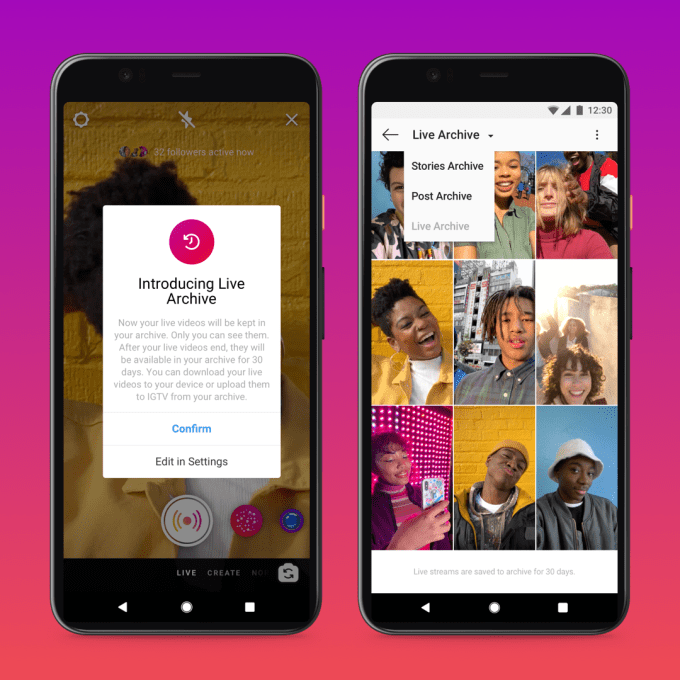
It says that it will “soon” add an option that will allow creators to archive their live streams for up to 30 days.

Image Credits: Instagram

Before, users could archive their Feed posts or their Stories to a private archive, but the only way to save a live stream was to publish it to IGTV immediately after the stream, through a feature introduced in May. 

The company says the new option to archive live broadcasts will mirror the existing archive experience for Stories and Feed Posts.

The difference is that archived live videos will be permanently deleted after 30 days.

But up until that time, the creator has the option to return to the video to save it or download it. This would allow the creator to publish the video on other social platforms, like Facebook or YouTube, or even trim out key parts for short-form video platforms, like TikTok. The Archive feature also means if a creator’s Live stream crashes for some reason — or if the creator forgot to download it in the moment — it can still be downloaded later on.

The news follows another recent Instagram update which introduced a new way for creators to monetize their Live streams.

The company earlier this month began rolling out badges in Instagram Live to an initial group of over 50,000 creators who will test the feature by selling badges at price points of $0.99, $1.99, or $4.99. These badges help fans’ comments stand out in busy streams, allow fans to support a favorite creator, and places the fan’s name on the creator’s list of badge holders.


from Social – TechCrunch https://ift.tt/3e1R20G
via IFTTT

Upstream aims to be the new home for your professional social life

Last fall, social analytics startup SocialRank sold its product and business to Trufan, allowing the team to focus on something new: a professional social network. Today, they’re officially unveiling Upstream to the public.

To be clear, CEO Alex Taub told me that he’s not trying to replace LinkedIn — he acknowledged that thanks to network effects,”If you want to go and try to take down LinkedIn, you’re not going to be able to take them down.”

Instead, the goal is to create something that fulfills a different need. Where LinkedIn works primarily as an online résumé and rolodex, Upstream aims to help users build the connections and relationships that are important to their careers — something that’s sorely needed at a time when large-scale meetups and conferences aren’t really possible (though we’re certainly trying to create the virtual equivalent at TechCrunch).

“This is the place for your professional social life,” Taub said.

Upstream’s first product focused on professional groups and communities, allowing users to post what the company called Professional Asks, like if they’re looking to hire someone for a certain position or need an introduction at another company.

Taub suggested that things really took off with Upstream’s next product, Upstream Events, with a guest speaker followed by a period where  attendees were matched up for five-minute, one-on-one video chats with the other people at the event.

Upstream

Image Credits: Upstream

Upstream says it’s already hosted more than 100 events, with 72% of people who who attend one event subsequently attending another.

While the team has been pretty busy, today is the first time it’s talking publicly about the product and vision. And it’s launching some new features.

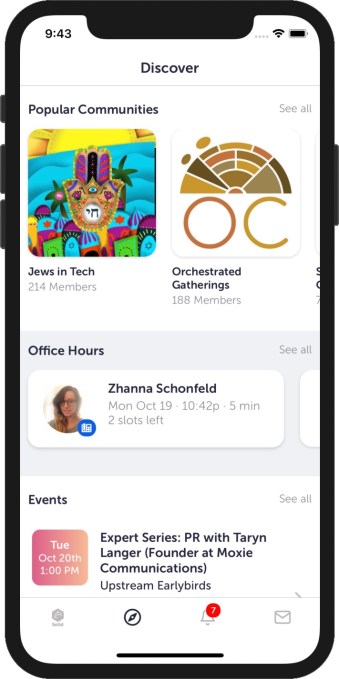
For one thing, while communities were previously shared via a private, unlisted link, you can now browse all the different communities in a Discovery section. At the same time, community organizers will be still be able to control who joins with the ability to approve or reject new members.

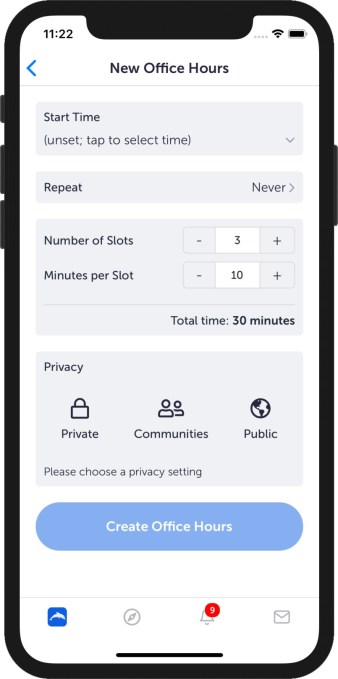
There’s also a new spin on Events called Office Hours, allowing users to set aside structured time for one-on-one virtual sessions with anyone who’s interested in speaking to them. These sessions can be listed publicly, or they can be unlisted, so that you only share them via email or within a certain community.

Upstream screenshot

Image Credits: Upstream

In a blog post, Taub noted that he met his SocialRank/Upstream co-founder and CTO Michael Schonfeld via Ohours.org, and they’re trying to replicate that experience here:

Let’s say you are the CMO of a large company and you want to give your people the opportunity to meet 1:1. The thought of coordinating the individual scheduling of ten minute blocks using your Outlook calendar and email is not attractive. But with Upstream, you are able to choose the 30min block you want to offer and how long you want the sessions to be. You decide you want to run your office hours every other Friday at 2pm ET for the rest of the year. The event is built and able to be shared seamlessly to whoever you choose to offer the Office Hours to.

In fact, Taub’s blog post lists more than 30 different people who are already offering office hours on Upstream, including New York Times reporter Taylor Lorenz, Foursquare co-founder/Expa partner Naveen Selvadurai and Amazon Photo Head of Product Nate Westheiemer.

Upstream is also announcing that it has raised an undisclosed amount of pre-seed funding from 8-Bit Capital, Human Ventures, Basement Fund, NYVP and various angel investors.

Looking ahead, Taub said that the next big priority is launching a web version of Upstream (which is currently available via mobile app), and to continue building live experiences, asynchronous experiences and features that provide real utility.

“We imagine a future when professionals come to Upstream for an event or Ask, and stay for the compelling opportunities that make Upstream an energizing and beneficial experience for them,” he wrote.


from Social – TechCrunch https://ift.tt/2HHueap
via IFTTT

Top Facebook India executive Ankhi Das leaves the company

Ankhi Das, a top Facebook executive in India, is leaving the company on Tuesday months after she was alleged to interfere in the company’s hate speech policy in the country to show favoritism to the ruling Bharatiya Janata Party.

Facebook has denied the allegations, and people close to Das (pictured above) said her departure was not related to recent stories in the press. Das, who served as the Public Policy Director for Facebook India, South and Central Asia, said she was leaving the company to pursue her interest in public service.

In a message to her colleagues, Das recounted the earlier days of Facebook and internet ecosystem in India when she joined the company in 2011. “We were a small unlisted startup back then guided only by our mission and purpose to connect people in India. After nine long years, I feel that mission has largely been met. There is an enormous amount I have learnt from incredibly smart and talented people in the company, particularly from people on the policy team. This is a special company and a special group of people. Thank you, Mark for creating something beautiful for the world. I hope I have served you and the company well. I know we will be in touch on Facebook,” she wrote.

In a statement, Ajit Mohan, the head of Facebook India, said, “Ankhi was one of our earliest employees in India and played an instrumental role in the growth of the company and its services over the last 9 years. She has been a part of my leadership team over the last 2 years, a role in which she has made enormous contributions. We are grateful for her service and wish her the very best for the future.”

According to reports from WSJ, Das shielded politicians affiliated to the ruling party in India from Facebook’s hate speech policy because she thought it could hurt the company’s business prospects in India, Facebook’s biggest market by users. Facebook, which reaches more than 400 million internet users in India, has spread its tentacles in several categories in the country in recent years including startup investments.

In the days following the publication of WSJ’s report, both top political parties in India accused Facebook of showing favoritism to one another. Ravi Shankar Prasad, India’s IT minister, accused Facebook of suppressing right-leaning pages.

This is a developing story. More to follow…


from Social – TechCrunch https://ift.tt/35SZsEj
via IFTTT

TikTok partners with Shopify on social commerce

TikTok is further investing in social commerce with today’s announcement of a new global partnership with e-commerce platform Shopify. The deal aims to make it easier for Shopify’s over 1 million merchants to reach TikTok’s younger audience and drive sales. The partnership will eventually expand to include other in-app shopping features, as well, the companies said.

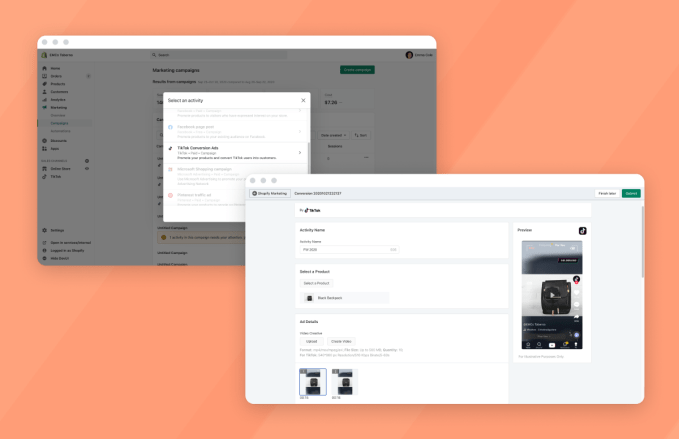
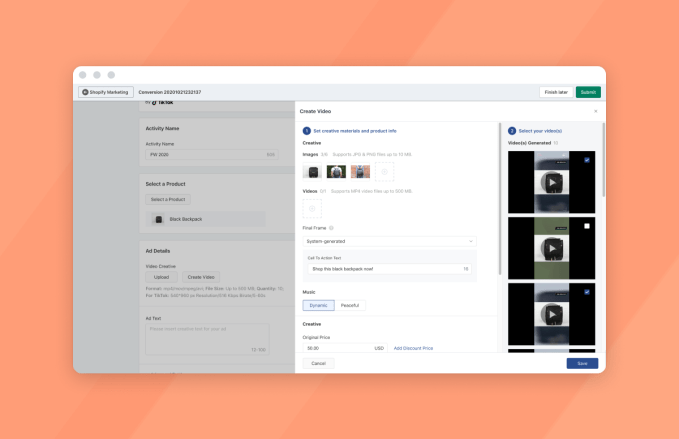
At launch, the agreement allows Shopify merchants to create, run and optimize their TikTok marketing campaigns directly from the Shopify dashboard by installing the new TikTok channel app from the Shopify App Store. Once installed, merchants will have access to the key functions from the TikTok For Business Ads Manager at their disposal.

These ad tools allow merchants to create native, shareable content that turns their products into In-Feed video ads that will resonate with the TikTok community. Merchants will be able to target their audiences across gender, age, user behavior, and video category, and then track the campaign’s performance over time. The campaigns’ costs will vary, based on the merchant’s own business objectives and how much they want to spend.

As a part of this effort, Shopify merchants can also install or connect their “TikTok Pixel” — a tool that helps them to more easily track conversions driven by their TikTok ad campaigns.

Currently, e-commerce merchants can track user actions like a user browsing their page, a registration on a website, adding items to their cart, placing an order, and completing the payment.

Image Credits: Shopify

Shopify tells TechCrunch a small number of merchants previously gained access to these features as part of a beta test. But as of today, Oct. 27, the product is being made available to all merchants across the U.S.

“TikTok is one of the world’s fastest growing entertainment platforms with over 100 million highly engaged users in the U.S. alone,” said Satish Kanwar, Vice President of Product at Shopify, in a statement about the new partnership. “The TikTok channel means Shopify merchants—even those without a strong TikTok following of their own yet—can connect with these new audiences using content that feels authentic and genuine to the TikTok experience,” Kanwar added.

Image Credits: Shopify

To get started with the new features, merchants who want to advertise on TikTok will first install the TikTok channel app, then create and connect their TikTok For Business account and install the one-click pixel. They can then deploy In-Feed shoppable video ads by selecting the product they want to feature using ad templates specifically designed for commerce. Because these templates use existing imagery or videos, the TikTok channel can work for merchants of any size, Shopify notes.

To kick off the partnership, merchants are being offered a $300 ad credit to get started with their first TikTok campaign.

In addition, the two companies have partnered on their first co-branded Hashtag Challenge Plus campaign, #ShopBlack, to celebrate Black-owned businesses. Shopify had earlier featured Black-owned businesses in its own app, Shop. But from Nov. 10 through Nov. 15, the TikTok community will be able to browse videos from over 40 Shopify merchants via the new hashtag and its accompanying branded effect within TikTok, too.

Shopify and TikTok had been working together to test various social commerce initiatives ahead of today’s announcement.

The companies, for example, had been spotted trialing a new shopping button that allowed TikTok creators to link their Shopify storefront from their videos. (Teespring was also testing this with TikTok). TikTok had offered a TikTok Ads Pixel for Shopify merchants before today, as well.  But the partnership makes the pixel integration a 1-click install, so merchants don’t have to manipulate code.

Image Credits: Shopify

“We are delighted to partner with Shopify and provide a channel for their merchants to reach new audiences and drive sales on TikTok,” said Blake Chandlee, Vice President, Global Business Solutions at TikTok, in a statement. “As social commerce proliferates, retailers are recognizing that TikTok’s creative and highly engaged community sets it apart from other platforms. We’re constantly exploring new and innovative ways to connect brands with our users, and Shopify is the perfect partner to help us grow and expand our commerce capabilities globally,” he said.

TikTok and Shopify’s partnership won’t be limited to the new TikTok channel app, however. That’s just the first step.

We understand the deal will soon expand to other shopping features, too.

TikTok says it plans to start testing new in-app features that will make it easier for users to discover Shopify merchants and their products by expanding their reach through video and on their account profiles. These features will also “let users browse merchant’s products and shop directly through the TikTok app,” a spokesperson said. They didn’t offer specific details about the features or how the payments portion would work, saying that more information would be available when the new tools launched.

However, the features will launch to a limited beta group of testers soon, a TikTok spokesperson confirmed.

Image Credits: TikTok

Shopify isn’t the first to recognize TikTok’s potential as a new type of social shopping platform. Its ability to drive merchant traffic and sales was a key reason for Walmart’s participation in the TikTok-Oracle deal — a deal whose current status is still unknown, of course, given the ongoing TikTok lawsuit and the upcoming Presidential election whose outcome could impact the Trump Administration’s TikTok ban.

TikTok itself has been steadily ramping up its tools for merchants and other social shopping features. To date, it has  experimented with allowing users to add e-commerce links to their bios; launched “Shop Now” buttons for brands’ video ads; and introduced shoppable components to hashtags with the e-commerce feature (soon to be used for #ShopBlack), known as the Hashtag Challenge Plus.

Shopify, meanwhile, has been working to deliver more tools that give smaller businesses the ability to compete against Walmart and Amazon, while at the same time partnering with Walmart to give its merchants broader reach.

The TikTok-Shopify partnership could help the video platform better compete against other sources of social commerce, including the growing number of live stream shopping apps as well as efforts from Facebook and its family of apps. The social giant has recently rolled out a bevy of shopping-focused updates across Facebook, Instagram, and — just last week — WhatsApp, with the goal of directing users to shop in its apps, then check out seamlessly with Facebook Pay.

TikTok’s advantage is that it’s a video-based social network, more like YouTube, rather than a platform whose roots were in editorial-quality imagery, like Instagram. On Instagram, video features have been added in over time. Now, a number of Instagram products include video — like  Feed posts, Stories, Instagram Live, IGTV, and, finally, Instagram’s TikTok rival, Reels. But overall, the impact is that Instagram has started to feel overcrowded.

TikTok says the new TikTok channel for Shopify merchants is available today in the U.S. It will roll out to other markets next year, including elsewhere in North America, Europe and Southeast Asia.


from Social – TechCrunch https://ift.tt/2HzLtuq
via IFTTT