This is default featured slide 1 title

Go to Blogger edit html and find these sentences.Now replace these sentences with your own descriptions.This theme is Bloggerized by Lasantha Bandara - Premiumbloggertemplates.com.

This is default featured slide 2 title

Go to Blogger edit html and find these sentences.Now replace these sentences with your own descriptions.This theme is Bloggerized by Lasantha Bandara - Premiumbloggertemplates.com.

This is default featured slide 3 title

Go to Blogger edit html and find these sentences.Now replace these sentences with your own descriptions.This theme is Bloggerized by Lasantha Bandara - Premiumbloggertemplates.com.

This is default featured slide 4 title

Go to Blogger edit html and find these sentences.Now replace these sentences with your own descriptions.This theme is Bloggerized by Lasantha Bandara - Premiumbloggertemplates.com.

This is default featured slide 5 title

Go to Blogger edit html and find these sentences.Now replace these sentences with your own descriptions.This theme is Bloggerized by Lasantha Bandara - Premiumbloggertemplates.com.

TikTok tests a Learn tab to showcase education and how-to videos

How-to videos have been some of the most popular content on YouTube over the years, and now, to grow engagement and the pool of users that it appeals to, the upstart video app TikTok is getting in on the action, too.

After launching a dedicated “Learn On TikTok” hashtag (#LearnOnTikTok) earlier this summer with a slate of premium creators producing videos for it, multiple users and social media watchers (thanks Matt) are reporting sightings of a new menu item called “Learn.”

Featured prominently alongside “For You” and “Following” at the top of the homescreen, TikTok describes Learn as a place to discover how-to and informative videos posted by users that take viewers through making food, producing art, how scientific processes work, and more.

The Learn feed seems to have disappeared overnight: from what we understand it’s still being tested.

Image Credits: Lena Koppova (opens in a new window)(opens in a new window)In any case, its emergence coincided with the company yesterday launching a new promotional campaign for educational content discoverable through the #LearnOnTikTok hashtag.

(And in the original announcement for Learn On TikTok content, TikTok noted that it is “exploring additional ways to showcase the rich offering of instructional content that’s thriving on the platform,” which includes “building a creator learning portal that will provide insights, tools, and best practices on how to create quality content on TikTok,” so the Learn tab may have been a test of how that will look and work.)

These are not TikTok’s first or only efforts in the realm of education.

Aside from its self-referential audience-created educational videos — it’s the best platform for learning TikTok dances, for learning about the latest song-based memes, watching comedic mishaps as people try to explain something, etc. — the company has been cultivating an image as a go-to platform for learning more serious things, not just messing around.

It’s been pushing that even harder this year than ever, both as TikTok itself faces ire from authorities for having a more potentially harmful influence; and as more people turn to their screens during the Covid-19 pandemic.

This has included formal efforts like partnering up with institutions, and encouraging students to create educational content.

@cambridgeuniversityCan #cars talk to each other? #learnontiktok #cambridgeuniversity #cambridge #artificialintelligence #driverless♬ HAPPY SUMMER ADVENTURE – Sergey Wednesday

It’s also included dedicating $50 million specifically to a creator fund to promote educational videos; and reportedly a whopping $5 billion educational fund as part of a deal to keep from getting shut down in the US over national security concerns (Bytedance, the owner of TikTok, has disputed the idea of the fund).

This has also included soft diplomacy, where teachers are using TikTok as a way of being more relatable to their audience of TikTok-loving students.

At its heart, doing more in education is a natural move for TikTok. Video is a huge learning tool, as YouTube and many others have demonstrated, and it connects with the app’s younger audience while also creating more reasons for why others might also want to use it — but also somewhat opportunistic.

Education is a good look, and its push in India was coming at a time when the company was first starting to face backlash over its content (it didn’t help: it’s currently banned there).

Meanwhile, its US Creative Learning Fund and those reports of a $5 billion education fund — accurate or not — emerged just as the company was working on hammering out a deal — which might include its Chinese owner Bytedance ceding control of the app — to keep it from getting banned outright in the US over national security concerns. (That story is still ongoing.)

Learn On TikTok — which officially was announced this summer — is heavy on user-generated content from TikTok’s wider base, with videos ranging pretty widely, from pottery making to make-up tips, and learning pig Latin to folding origami pigs.

But alongside this, TikTok is now populating the hashtag with a lot of premium content. Working with publishers like Self and WWD, professional organizations, non-profit institutions, and influential personalities (Bill Nye and Neil deGrasse Tyson in the science arena, chef José Andrés, Lilly Singh and Tyra Banks), TikTok is also curating and cultivating content made specifically for TikTok to broaden people’s minds and experiences.

“I’m excited to partner with TikTok,” Nye said at the time that his deal was announced. “Looking forward to doing some science on the small screen— the real small screen— the one on your phone…”

All of this is to say that there is a lot of opportunity, but probably some more growing pains to come for TikTok and the people using it to teach and learn.

We will update this story as we learn more ourselves…


from Social – TechCrunch https://ift.tt/362tTI2
via IFTTT

WhatsApp now lets you post ephemeral messages, which disappear after 7 days

Facebook recently announced that WhatsApp passed the whopping milestone of 100 billion messages sent per day, but not everyone wants those chats to stick around forever. Now, Facebook’s wildly popular messaging app with 2 billion users is adding a feature to give people more control on how their words and pictures live within the app. From today, messages — including photos and videos — can now be marked to disappear after 7 days.

The feature is being rolled out globally across Android and iOS starting today, WhatsApp said. While it’s starting with a 7 day lifespan, it is already looking at playing around with the time limits.

“We will keep an eye on feedback about how people are using it and liking it and see if it needs adjusting in the future,” a spokesperson said. “For now we are starting with seven days, because it feels like a nice balance between the utility you need for global text based conversations and the feeling of things not sticking around forever.”

And just to be clear, the 7-day limit will exist regardless of whether the message gets read or not. (The clock starts counting when the message is sent, as it does on other apps like Telegram.)

“The way it’s currently designed is to give the sender confidence that after 7 days their message is gone. The messages have no concept of being seen, for them to disappear, so they will disappear regardless of read status,” said the spokesperson.

Users can turn on the feature for direct messages, but in groups it’s the admin that has to enable disappearing messages for it to work.

Although today is the “official” announcement, eagle-eyed WhatsApp watchers had spotted the company posting FAQs on the feature some days ago. And tests of the feature actually first started to appear — and,  fittingly, disappear — as early as March of this year.

This isn’t WhatsApp’s first rodeo with disappearing content.

In 2017, the company first dabbled in the idea with the launch of Status — an encrypted clone of Snapchat’s Stories feature, which let people set up short updates on themselves — in the form of some text and/or a GIF — as essentially a “profile” for all of their contacts to see for a set period of 24 hours, with the Statuses existing in their own tab in the app separate from your chats.

It’s not clear how popular the Status feature is these days: we’ve reached out to ask. Anecdotally, I’ve seen younger people using it a lot, where it lives as a proxy, pared-down version of updating your status on Facebook or Snapchat, older people less so.

WhatsApp said that one of the reasons it’s taken its developers so long to bring the ephemeral feature to the wider chat experience is in part because of the encrypted aspect of the app:

“[End-to-end encryption] was partly why it took us so long to implement this feature, because we wanted to retain the e2e capabilities that WhatsApp users expect and love,” the spokesperson said.

But in any case it’s a very long time in coming.

Ephemerality has been one of the most radical and sticky features in messaging in years — it has now been around for close to a decade. And it has arguably been the defining feature for one of the runaway, viral hits of the genre, Snapchat — so much so that clones of the feature have popped up in a number of other apps, from those focused first and foremost on privacy like Signal and Telegram, through to those that are aimed at more casual consumer audiences, like WhatsApp today.

And there could be signs that Facebook is may be looking to roll this out in other apps in its stable, too. Earlier this year it tested disappearing messages in Instagram, which now works officially. However in Messenger the most recent tests for disappearing text seem to be from 2015, but it does have a “secret” messaging feature (launched in 2016) that lets the sender control how long a message remains. This however is not quite the same as something baked into the main messaging experience.

The new disappearing messaging feature is coming amid some other notable additions in the app that appear to be in aid of the general purpose of giving more control to users.

Earlier this week, WhatsApp announced that it would enable a new storage feature in the app: specifically, an easier way to control how and where photos and other media that you are sent live. This is especially important for active (but perhaps not deep) users of the app, who find their storage is getting gobbled up by innocuous GIFs, photos and videos sent over the app by friends and acquaintances.

At the same time, it has also been beefing up the services it offers to businesses, and testing out business models for charging them, one way to stick to their commitment not to put ads into the service. The acceleration we’re seeing in adding more features to the app in recent times is notable, too, given how Facebook didn’t do much to update the features for years at a time before this, possibly to its detriment as the app faced a string of controversies over how it got abused by some.

As with the storage changes, the new disappearing feature will not be switched on for users by default: you have to proactively change the settings.


from Social – TechCrunch https://ift.tt/2I6UaMS
via IFTTT

Twitter restricts Trump’s tweet claiming that foes would ‘steal’ the election

With key wins notched in a few states, Trump didn’t quite declare victory prematurely on social media as platforms had feared — but he did baselessly raise the specter of voter fraud.

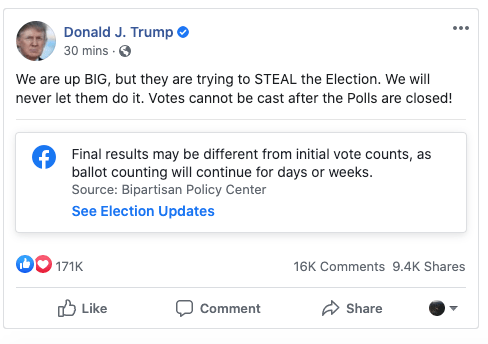
“We are up BIG, but they are trying to STEAL the Election,” Trump tweeted. “We will never let them do it. Votes cannot be cast after the Polls are closed!”

Twitter took action against the tweet quickly, placing it behind a warning and adding a misinformation label. The company explained its actions in a tweet, stating that the president’s message contained a “potentially misleading claim about an election.” As of 12AM PT the result of the presidential election remained far from clear, with both candidates holding potential paths to the presidency.

While Trump’s wording is left a bit ambiguous, the president’s tweet again appears to be attacking the integrity of vote-by-mail ballots. With mail-in ballots expected to come in slowly in some states, lagging votes may play a big part in the election outcome. That scenario was expected and does not raise any concerns over the integrity of vote tallying.

Due to a huge spike in mail-in voting related to the pandemic, results were expected to be more ambiguous on election night in 2020 than in past years, and so far that’s proven true. Social media companies began crafting new policies for the unusual circumstances of the 2020 election and its worrisome misinformation ecosystem in the months leading up to November.

Twitter also said in a September policy announcement that it would remove or label any tweets that incite unlawful activity and threaten a “peaceful transfer of power or orderly succession.” While tweets that Twitter restricts remain online, they’re placed behind a warning message that users must first click through in order to view their content. Restricted tweets also have their retweets, likes and comments disabled, reducing their reach.

On Facebook, where much of Trump’s Twitter content is reposted, his message earned a label reminding users that election night results and final results may differ, but the post was not otherwise restricted. In an email, Facebook spokesperson Tom Reynolds said that Facebook labeled the post shortly after it went up “in accordance with the policies we shared ahead of Election Day.”

The company attached a similar label to another late-night Trump post declaring “I will be making a statement tonight. A big WIN!” Facebook previously said it planned to label any posts claiming premature victory with an informational message pointing users to official election results.

Update – 12:10AM PT: 

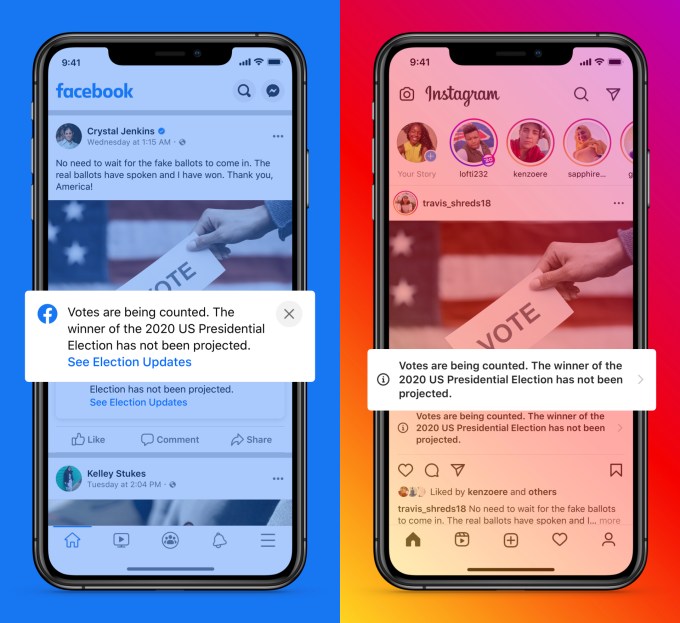
Following spoken remarks in which Trump falsely claimed that he had won the election, Facebook said it would begin running messages to users across Facebook and Instagram noting that “votes are still being counted and a winner is not projected.”


from Social – TechCrunch https://ift.tt/3jVdVoa
via IFTTT

Facebook and Instagram notifications warn U.S. users there’s no winner yet in Presidential Election

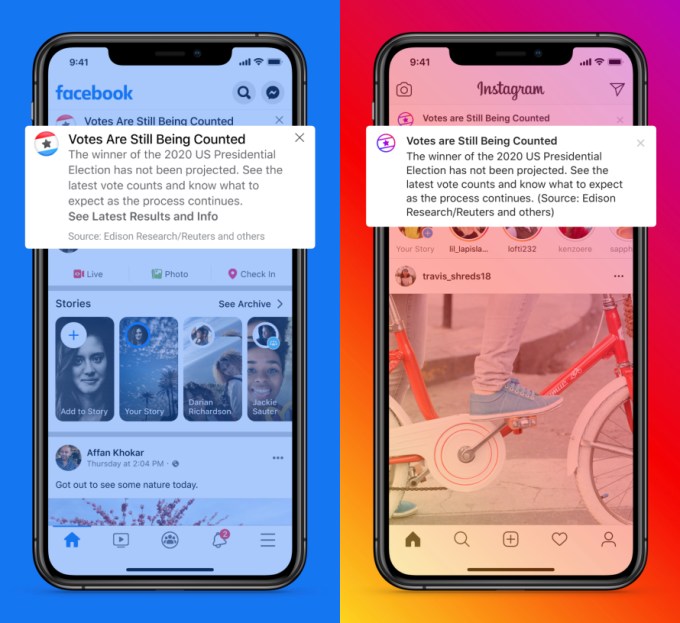
Facebook and Instagram are running notifications in their respective apps informing U.S. users that the winner of the 2020 U.S. Presidential Election has not yet been determined. In large pop-ups appearing at the top of the Facebook and Instagram News Feeds, the notification states that “Votes Are Being Counted” and directs users to other in-app election resources.

Both apps are using the same language for their respective notifications:

“The winner of the 2020 U.S. Presidential Election has not been projected yet. See more updates and learn what to expect as the election process continues.”

Critically, Facebook and Instagram have also added a timestamp to the notification to indicate its recency. As of Nov. 4 at 9:57 AM EST, for example, the notification read that it was last updated at 9:00 am EST.

Image Credits: Facebook

The addition of a timestamp is useful not only because election results are still being counted — and will be for days to come, most likely — but also because President Trump prematurely claimed election victory early Wednesday morning before all votes were counted.

Facebook tells TechCrunch it began showing these notifications at the top of Facebook and Instagram feeds shortly after Trump posted to Facebook that he had won. The company also began labeling posts from both Trump and Vice President Biden in accordance with the policies it shared ahead of Election Day, it says.

On Facebook, Trump’s message earned itself a label which reminded users that election night results and final results may differ, but Facebook didn’t otherwise restrict the post.

As we noted at the time of the labeling, Facebook had begun displaying the notifications about there being no projected winner.

Having a timestamp on these posts is also important in the case that either app faces any sort of caching issues that would allow users to see out-of-date data, temporarily, until the app was refreshed.

This was an issue on Instagram yesterday, Nov. 3, when a caching issue had led to some users seeing a notification that read, vaguely, “Tomorrow is Election Day,” when in fact Election Day had already arrived.

Similarly, some users may not immediately see the notification appearing at the top of their Feed on Facebook or Instagram, until their app refreshes. But there are no widespread complaints about this sort of issue today.


from Social – TechCrunch https://ift.tt/3k0uK0K
via IFTTT

Twitter hides Trump tweet attacking Supreme Court’s decision on Pennsylvania ballots

In an election eve preview of what to expect in the coming days, President Trump pushed the limits on Twitter’s election-specific policies Monday night.

In a tweet, Trump railed against the Supreme Court’s decision to allow Pennsylvania officials to count ballots postmarked by Election Day. The Republican Party has waged a brazen legal onslaught against voting rights throughout key states in recent weeks, a cynical effort designed to better the sitting president’s reelection chances.

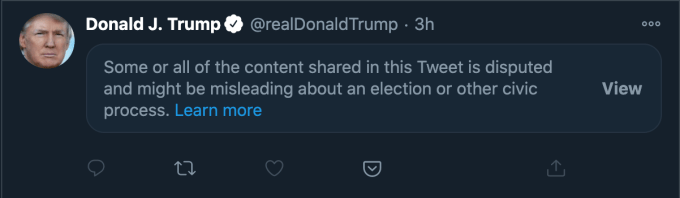
Twitter pushed back on the president’s false claim about Pennsylvania mail-in ballots, hiding it behind a misinformation warning that calls the tweet “disputed.” Twitter also disabled non-quote retweets, likes and replies for the hidden tweet, which remains viewable but restricted.

Image Credits: Twitter

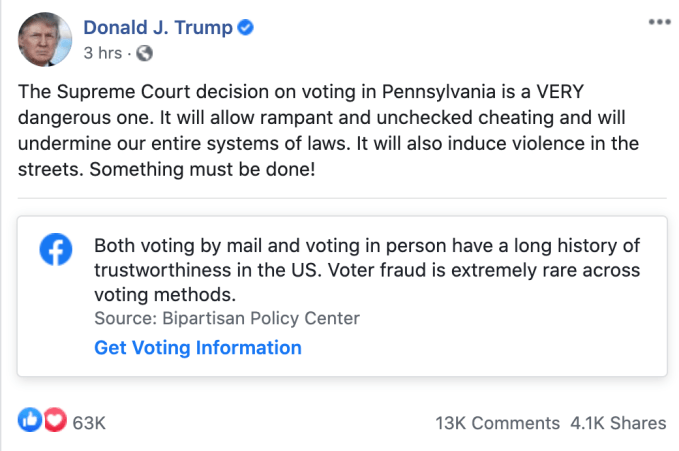
“The Supreme Court decision on voting in Pennsylvania is a VERY dangerous one,” Trump tweeted. “It will allow rampant and unchecked cheating and will undermine our entire systems of laws. It will also induce violence in the streets. Something must be done!”

Facebook did not remove the reposted message, but did add a label emphasizing the trustworthiness of voting systems. Three hours after it was published, Trump’s Facebook post had collected 63,000 likes and 13,000 comments.


from Social – TechCrunch https://ift.tt/3eiYNzL
via IFTTT

What social networks have learned since the 2016 election

On the eve on the 2020 U.S. election, tensions are running high.

The good news? 2020 isn’t 2016. Social networks are way better prepared to handle a wide array of complex, dangerous or otherwise ambiguous Election Day scenarios.

The bad news: 2020 is its own beast, one that’s unleashed a nightmare health scenario on a divided nation that’s even more susceptible now to misinformation, hyper-partisanship and dangerous ideas moving from the fringe to the center than it was four years ago.

The U.S. was caught off guard by foreign interference in the 2016 election, but shocking a nation that’s spent the last eight months expecting a convergence of worst-case scenarios won’t be so easy.

Social platforms have braced for the 2020 election in a way they didn’t in 2016. Here’s what they’re worried about and the critical lessons from the last four years that they’ll bring to bear.

Contested election results

President Trump has repeatedly signaled that he won’t accept the results of the election in the case that he loses — a shocking threat that could imperil American democracy, but one social platforms have been tracking closely. Trump’s erratic, often rule-bending behavior on social networks in recent months has served as a kind of stress test, allowing those platforms to game out different scenarios for the election.

Facebook and Twitter in particular have laid out detailed plans about what happens if the results of the election aren’t immediately clear or if a candidate refuses to accept official results once they’re tallied.

On election night, Facebook will pin a message to the top of both Facebook and Instagram telling users that vote counting is still underway. When authoritative results are in, Facebook will change those messages to reflect the official results. Importantly, U.S. election results might not be clear on election night or for some days afterward, a potential outcome for which Facebook and other social networks are bracing.
Facebook election message

Image via Facebook

If a candidate declared victory prematurely, Facebook doesn’t say it will remove those claims, but it will pair them with its message that there’s no official result and voting is still underway.

Twitter released its plans for handling election results two months ago, explaining that it will either remove or attach a warning label to premature claims of victory before authoritative election results are in. The company also explicitly stated that it will act against any tweets “inciting unlawful conduct to prevent a peaceful transfer of power or orderly succession,” a shocking rule to have to articulate, but a necessary one in 2020.

On Monday, Twitter elaborated on its policy, saying that it would focus on labeling misleading tweets about the presidential election and other contested races. The company released a sample image of a label it would append, showing a warning stating that “this tweet is sharing inaccurate information.”

Last week, the company also began showing users large misinformation warnings at the top of their feeds. The messages told users that they “might encounter misleading information” about mail-in voting and also cautioned them that election results may not be immediately known.

According to Twitter, users who try to share tweets with misleading election-related misinformation will see a pop-up pointing them to vetted information and forcing them to click through a warning before sharing. Twitter also says it will act on any “disputed claims” that might cast doubt on voting, including “unverified information about election rigging, ballot tampering, vote tallying, or certification of election results.”

One other major change that many users probably already noticed is Twitter’s decision to disable retweets. Users can still retweet by clicking through a pop-up page, but Twitter made the change to encourage people to quote retweet instead. The effort to slow down the spread of misinformation was striking, and Twitter said it will stay in place through the end of election week, at least.

YouTube didn’t go into similar detail about its decision making, but the company previously said it will put an “informational” label on search results related to the election and below election-related videos. The label warns users that “results may not be final” and points them to the company’s election info hub.

Foreign disinformation

This is one area where social networks have made big strides. After Russian disinformation took root on social platforms four years ago, those companies now coordinate with one another and the government about the threats they’re seeing.

In the aftermath of 2016, Facebook eventually woke up to the idea that its platform could be leveraged to scale social ills like hate and misinformation. Its scorecard is uneven, but its actions against foreign disinformation have been robust, reducing that threat considerably.

A repeat of the same concerns from 2016 is unlikely. Facebook made aggressive efforts to find foreign coordinated disinformation campaigns across its platforms, and it publishes what it finds regularly and with little delay. But in 2020, the biggest concerns are coming from within the country — not without.

Most foreign information operations have been small so far, failing to gain much traction. Last month, Facebook removed a network of fake accounts connected to Iran. The operation was small and failed to generate much traction, but it shows that U.S. adversaries are still interested in trying out the tactic.

Misleading political ads

To address concerns around election misinformation in ads, Facebook opted for a temporary political ad blackout, starting at 12 a.m. PT on November 4 and continuing until the company deems it safe to toggle them back on. Facebook hasn’t accepted any new political ads since October 27 and previously said it won’t accept any ads that delegitimize the results of the election. Google will also pause election-related ads after polls close Tuesday.

Facebook has made a number of big changes to political ads since 2016, when Russia bought Facebook ads to meddle with U.S. politics. Political ads on the platform are subject to more scrutiny and much more transparency now and Facebook’s ad library emerged as an exemplary tool that allows anyone to see what ads have been published, who bought them and how much they spent.

Unlike Facebook, Twitter’s way of dealing with political advertising was cutting it off entirely. The company announced the change a year ago and hasn’t looked back since. TikTok also opted to disallow political ads.

Political violence

Politically motivated violence is a big worry this week in the U.S. — a concern that shows just how tense the situation has grown under four years of Trump. Leading into Tuesday, the president has repeatedly made false claims of voter fraud and encouraged his followers to engage in voter intimidation, a threat Facebook was clued into enough that it made a policy prohibiting “militarized” language around poll watching.

Facebook made a number of other meaningful recent changes, like banning the dangerous pro-Trump conspiracy theory QAnon and militias that use the platform to organize, though those efforts have come very late in the game.

Facebook was widely criticized for its inaction around a Trump post warning “when the looting starts, the shooting starts” during racial justice protests earlier this year, but its recent posture suggests similar posts might be taken more seriously now. We’ll be watching how Facebook handles emerging threats of violence this week.

Its recent decisive moves against extremism are important, but the platform has long incubated groups that use the company’s networking and event tools to come together for potential real-world violence. Even if they aren’t allowed on the platform any longer, many of those groups got organized and then moved their networks onto alternative social networks and private channels. Still, making it more difficult to organize violence on mainstream social networks is a big step in the right direction.

Twitter also addressed the potential threat of election-related violence in advance, noting that it may add warnings or require users to remove any tweets “inciting interference with the election” or encouraging violence.

Platform policy shifts in 2020

Facebook is the biggest online arena where U.S. political life plays out. While a similar number of Americans watch videos on YouTube, Facebook is where they go to duke it out over candidates, share news stories (some legitimate, some not) and generally express themselves politically. It’s a tinderbox in normal times — and 2020 is far from normal.

While Facebook acted against foreign threats quickly after 2016, the company dragged its feet on platform changes that could be perceived as politically motivated — a hesitation that backfired by incubating dangerous extremists and allowing many kinds of misinformation, particularly on the far-right, to survive and thrive.

In spite of Facebook’s lingering misguided political fears, there are reasons to be hopeful that the company might avert election-related catastrophes.

Whether it was inspired by the threat of a contested election, federal antitrust action or a possible Biden presidency, Facebook has signaled a shift to more thoughtful moderation with a flurry of recent policy enforcement decisions. An accompanying flurry of election-focused podcast and television ads suggests Facebook is worried about public perception too — and it should be.

Twitter’s plan for the election has been well-communicated and detailed. In 2020, the company treats its policy decisions with more transparency, communicates them in real time and isn’t afraid to admit to mistakes. The relatively small social network plays an outsized role in publishing political content that’s amplified elsewhere, so the choices it makes are critical for countering misinformation and extremism.

The companies that host and amplify online political conversation have learned some major lessons since 2016 — mostly the hard way. Let’s just hope it was enough to help them guide their roiling platforms through one of the most fraught moments in modern U.S. history.



from Social – TechCrunch https://ift.tt/2HYsrxQ
via IFTTT

Twitter explains how it will handle misleading tweets about the US election results

Twitter recently updated its policies in advance of the U.S. elections to include specific rules that detailed how it would handle tweets making claims about election results before they were official. Today, the company offered more information about how it plans to prioritize the enforcement of its rules and how it will label any tweets that fall under the new guidelines.

In September, Twitter said it would either remove or attach a warning label to any premature claims of victory, with a focus on tweets that incite “unlawful conduct to prevent a peaceful transfer of power or orderly succession,” the company had explained.

This morning, Twitter added that it will prioritize labeling tweets about the presidential election and any other “highly contested races” where there may be significant issues with misleading information.

The company says tweets are eligible to be labeled if the account has a U.S. 2020 candidate label, including presidential candidates and campaigns — meaning the Trump and Biden campaigns will not be immune to the new policies.

Tweets can also be labeled if the account is U.S.-based with more than 100,000 followers or if they have significant engagement with the tweet — the threshold is either 25,000 Likes or 25,000 Quote Tweets plus Retweets, the company says. This latter guideline aims to clamp down on allowing misinformation to go viral, even if the tweet in question was initiated by a smaller account.

Twitter also explained how it will determine if an election result is considered “official,” saying that the result will need to be announced by a state election official. Alternately, Twitter may consider an election result official if at least two of a select list of national news outlets make the call. These outlets include ABC News, The Associated Press, CBS News, CNN, Decision Desk HQ, Fox News, and NBC News.

If a tweet is labeled as being “misleading information” under this new policy, users will be shown a prompt pointing them to credible information before they’re able to retweet or further amplify the post on Twitter. However, Twitter won’t stop retweets from being posted.

Twitter, however, recently made it more difficult to blindly retweet, by forcing retweets to go through “Quote Tweet” user interface instead. This change aims to slow people down from quickly retweeting posts without adding their own commentary.

In addition to labeling tweets with misleading information, Twitter says if it sees content “inciting interference with the election, encouraging violent action or other physical harms,” it may take additional measures, including adding a warning or even removing the tweet.

Issues around a contested election have been of increased concern, following reports that said President Trump has a plan to declare victory on Tuesday night if it looks like he’s ahead. Trump denied these claims on Sunday, but added he thinks it’s a “terrible thing when states are allowed to tabulate ballots for a long period of time after the election is over,” Axios reported.


from Social – TechCrunch https://ift.tt/2HRNaDE
via IFTTT