This is default featured slide 1 title

Go to Blogger edit html and find these sentences.Now replace these sentences with your own descriptions.This theme is Bloggerized by Lasantha Bandara - Premiumbloggertemplates.com.

This is default featured slide 2 title

Go to Blogger edit html and find these sentences.Now replace these sentences with your own descriptions.This theme is Bloggerized by Lasantha Bandara - Premiumbloggertemplates.com.

This is default featured slide 3 title

Go to Blogger edit html and find these sentences.Now replace these sentences with your own descriptions.This theme is Bloggerized by Lasantha Bandara - Premiumbloggertemplates.com.

This is default featured slide 4 title

Go to Blogger edit html and find these sentences.Now replace these sentences with your own descriptions.This theme is Bloggerized by Lasantha Bandara - Premiumbloggertemplates.com.

This is default featured slide 5 title

Go to Blogger edit html and find these sentences.Now replace these sentences with your own descriptions.This theme is Bloggerized by Lasantha Bandara - Premiumbloggertemplates.com.

Twitter may slow down users’ ability to ‘like’ tweets containing misinformation

Twitter is working to expand the use of its “misinformation” labels on misleading tweets. The company has developed a new feature, not yet live, that would pop up a “misleading information” label when a user tries to “Like” a tweet that’s been labeled as misinformation.

The feature was discovered by reverse engineer Jane Manchun Wong in the Twitter app code. She confirms the addition doesn’t prevent a user from continuing to “Like” the tweet, however — it just slows you down.

A similar warning appears today when users attempt to retweet posts labeled as containing misinformation.

This new feature would fall in line with other measures Twitter has been taking to slow the spread of misinformation on its service, including a recent change to how retweets work. On October 20, 2020, Twitter began to prompt anyone who goes to retweet something to share a quote tweet instead.

The added bit of friction is meant to help users pause and think about what they’re amplifying, as did the change which pushed users to click through and actually read the content they’re sharing.

In addition, Twitter also rolled out a series of new policies ahead of Election Day in the U.S., to further guide its handling of misleading tweets. Beyond just labeling misinformation, it applied more aggressive warnings and restrictions on tweets from U.S. political figures, including candidates and campaign accounts, as well as other U.S.-based accounts that met certain thresholds in terms of followers, or tweet engagements.

Warnings were placed over tweets claiming premature victory, and had been designed largely in response to Trump’s broad hints that he would not easily concede. But use of these aggressive warnings may dwindle in the weeks and months ahead, given that Trump’s legal challenges do not look promising.

Though the election may have highlighted the problem with misinformation to a greater degree than usual, it remains a significant problem for today’s social platforms to address. There are now a number of users who don’t want to deal in facts, resorting to even calling fact-checking organizations biased against them. It’s unclear that any user interface tweaks at this point can help solve this problem.

Twitter says it tries to deamplify misinformation today by not allowing those labeled, misleading tweets to appear in Search or injected into users’ Timelines (if they don’t follow the account). But those tweets can still be replied to, liked and retweeted.

Twitter confirmed the feature spotted by Wong is in development, but did not have a time frame to its rollout.

“Our goal is to give people the context and tools necessary to find credible information on our service — no matter the topic or where they are seeing the Tweet,” a Twitter spokesperson said. “This is an iterative process, and we’re continuing to explore features and policies to help people on Twitter make their own informed decisions.”


from Social – TechCrunch https://ift.tt/3eHFakY
via IFTTT

‘Free speech’ social network Parler tops app store rankings following Biden’s election win

Chafing at new misinformation safeguards and a lost election, dejected Trump supporters flocked to the alternative social network Parler over the weekend.  Parler’s homepage promises that users can “Speak freely and express yourself openly, without fear of being ‘deplatformed’ for your views.”

Parler shot up the charts across Apple’s App Store and the Google Play Store in the days following official election results. An Android app called “Parlor” was also trending Monday, likely due to misspelled searches for Parler.

Joe Biden prevailed on Saturday, picking up the critical state of Pennsylvania to become president-elect. Biden’s win followed a tense five days of vote tallying, as Trump repeatedly attacked the U.S. election process.

Parler sat at #7 in the App Store on Saturday, November 7, according to mobile app market analysis from Sensor Tower. By the next day, it shot up to #1 — a first for the app. It remains in the top slot now, in contrast to its position a week ago as the 1023th most downloaded app.

The story is similar in Google’s own app marketplace, where Parler climbed from #51 on Saturday to #5 on Sunday, topping out in the #1 slot today. The Fox News competitor Newsmax TV and the self-described “next-gen social network” MeWe also sat in Google’s top 5.

Parler’s ascent is notable but not totally new. Accounts anticipating a ban have been pointing their followers toward Parler and other far-right havens with every new platform policy change that Twitter and Facebook make. Gab, which describes itself as “the free speech social network” is also vying for Trump loyalists.

“It’s crazy to believe that only a handful of Silicon Valley companies will have complete control over the flow of information, communication, and news forever,” Gab CEO Andrew Torba wrote in a blog post Sunday.  Torba was booted from Y Combinator’s alumni network for threatening comments and harassment shortly after the 2016 election.

But in spite of calls for a mass exodus, many prominent conservative figures accusing Twitter and Facebook of censorship have maintained their presences on the platforms, knowing that their reach would be dramatically limited on the alternative social networks.

Fox News contributor and Trump enthusiast Dan Bongino called for his own supporters to move to Parler last week, warning that “Fakebook” might act against his page. On Facebook, Bongino’s content regularly ranks in the top performing posts on the platform and his page has nearly four million followers. Notably, Bongino announced an ownership stake in Parler earlier this year.

Over on Parler, the Trump campaign is raising donations for an “election defense task force,” but according to the fine print half of every donation will go toward existing debt. The campaign doesn’t appear to have made much original content on the niche social network lately, instead reposting very similar messages over and over.

For the many Trump supporters pushing dangerous false claims about the election, the writing was on the wall. Facebook made a rapid-fire series of policy changes in the months preceding the election, banning QAnon, cracking down on violent militias and introducing new tools to slow the spread of misinformation, which metastasized on the social network over the last four years.

As it became clear that Trump’s effort to delegitimize the election was picking up steam, Facebook cracked down. The company began hiding search results for the #StopTheSteal hashtag and removed one of its popular groups over “calls for violence” made by some members.

In spite of his loss, President Trump has refused to concede the election. But by Monday, Biden’s transition team had already kicked into high gear, announcing members of a coronavirus task force that will seek to rein in the deadly virus where Trump has failed.

With election results settled, the vast machinery of the U.S. government moved steadily toward January’s transfer of power, as it has in every other election.


from Social – TechCrunch https://ift.tt/36neMsG
via IFTTT

Steve Bannon’s show pulled off Twitter and YouTube over calls for violence

Former presidential advisor and right-wing pundit Steve Bannon had his show suspended from Twitter and an episode removed by YouTube after calling for violence against FBI director Christopher Wray and the government’s leading pandemic expert, Dr. Anthony Fauci.

Bannon, speaking with co-host Jack Maxey, was discussing what Trump should do in a hypothetical second term. He suggested firing Wray and Fauci, but then went further, saying “I’d actually like to go back to the old times of Tudor England, I’d put the heads on pikes, right, I’d put them at the two corners of the White House as a warning to federal bureaucrats.”

This may strike one at first as mere hyperbole — one may say “we want his head on a platter” and not really be suggesting they actually behead anyone. But the conversation continued and seemed to be more in earnest than it first appeared:

Maxey: Just yesterday there was the anniversary of the hanging of two Tories in Philadelphia. These were Quaker businessmen who had cohabitated, if you will, with the British while they were occupying Philadelphia. These people were hung. This is what we used to do to traitors.

Bannon: That’s how you won the revolution. No one wants to talk about it. The revolution wasn’t some sort of garden party, right? It was a civil war. It was a civil war.

Whether one considers this only nostalgia for the good old days of mob justice or an actual call to bring those days back, the exchange seems to have been enough for moderators at YouTube and Twitter to come down hard on the pair’s makeshift broadcast.

Twitter confirmed that it has “permanently suspended” (i.e. it can be appealed but won’t be restored automatically) the account for violating the rule against glorifying violence.

YouTube removed the episode from “Steve Bannon’s War Room” channel Wednesday afternoon after it was brought to their attention. A representative for the platform said “We’ve removed this video for violating our policy against inciting violence. We will continue to be vigilant as we enforce our policies in the post-election period.”

Online platforms have struggled with finding the line between under and over-moderation. Facebook, Twitter, YouTube, TikTok, Instagram and others have all taken different measures, from preemptively turning off features to silently banning hashtags. Facebook today took down a group with more than 300,000 members that was acting as an amplifier for misinformation about the election.

While the platforms have been vigorous in at least some ways in the labeling and isolation of misinformation, it’s more difficult for video platforms. Just minutes ago Trump took to YouTube to detail a variety of unfounded conspiracy theories about mail-in voting, but the platform can’t exactly do a live fact-check of the president and shut down his channel. More than with text-based networks, video tends to spread before it is caught and flagged due to the time it takes to review it.


from Social – TechCrunch https://ift.tt/3l1y0KQ
via IFTTT

Facebook takes down ‘Stop the Steal 2020’ group organizing around false claims of election chicanery

Facebook has taken down a group that had amassed more than 300,000 members and was sharing misinformation and organizing around false allegations of impropriety during the 2020 elections.

The group, called “Stop the Steal 2020,” was organizing protests targeting the election officials currently counting ballots cast in Michigan, Pennsylvania, Phoenix and Las Vegas.

“In line with the exceptional measures that we are taking during this period of heightened tension, we have removed the Group ‘Stop the Steal,’ which was creating real-world events,” said a Facebook spokesperson in a statement emailed to TechCrunch. “The group was organized around the delegitimization of the election process, and we saw worrying calls for violence from some members of the group.”

Facebook’s action was first noticed by Ryan Mac of BuzzFeed, who reported the move in a tweet.

Protestors advocating for votes to be counted and for vote counting to cease are cropping up across the country as Republican Party organizers and campaign officials try to derail the count of mail-in ballots and absentee votes cast in the 2020 race and Democratic supporters organize counter-protests.

Social media election takedowns

While the organizers may be tapping supporters of President Trump across the country, their messaging is different depending on the state.

In Phoenix, protestors are calling for all votes to be counted, as presidential candidate and former Vice President Joe Biden hangs on to a slim lead in Arizona.

Meanwhile, the messaging is the opposite in Georgia, Michigan, Pennsylvania and Nevada, where President Donald Trump is trying to preserve the slim margins that have him ahead or reverse the counts that had put him behind in the polls. In Detroit, for instance, Trump supporters held up signs that said “stop the steal” and “stop the cheat” according to news reports.

Conservative advocates across the Twittersphere have had their tweets amended by the company to indicate that they were sharing election misinformation.

Facebook has also added “labels” to election posts that break the rules, though they are designed to mostly point users to contextual, factual information rather than to offer explicit warnings about false claims.

In fact, as a direct response to Trump’s premature claims of victory, Facebook also rolled out an eye-catching set of messages across Facebook and Instagram reminding users that votes were still being counted.

Facebook has also instituted changes to its policies about groups that organize real-world events in the wake of 2016’s election disinformation campaign carried out by Russian agents and the recent shooting in Kenosha, Wisconsin in which two men were killed after a local self-declared militia group organized a response to protests against the shooting of Kenosha resident, Jacob Blake.


from Social – TechCrunch https://ift.tt/3ex5fD3
via IFTTT

TikTok’s parent company, ByteDance, is reportedly looking for $2B before its Hong Kong public offering

ByteDance, the company behind the social media sensation TikTok, is in talks to raise another $2 billion before the initial public offering of a large chunk of its international businesses on the Hong Kong StockExchange, according to a Bloomberg report.

The new financing would give the Chinese tech powerhouse a valuation of $180 billion, according to people cited by Bloomberg.

Investors, including ByteDance’s existing backers like Sequoia, are in the running to finance the new investment, the Bloomberg report said.

Sequoia had emerged as one of the drivers behind a now-stalled deal touted by the Trump administration to have Oracle take some sort of control over the American operations of ByteDance’s most valuable international asset — TikTok.

Both Sequoia and Oracle have significant ties to President Trump through Republican mega-donors Doug Leone, a managing partner at Sequoia, and Safra Catz and Larry Ellison, Oracle’s top leadership and founder.

ByteDance has long planned a public offering for some of its largest Asian assets Douyin and Toutiao, which are huge drivers for the company’s revenues.

TechCrunch previously reported that ByteDance last year generated 120 billion yuan ($17.2 billion) in revenue, citing an investor with knowledge of the company’s finances. Around 67% of that revenue was derived from ads sold on its domestic apps Douyin, TikTok’s Chinese version, and popular news aggregator Toutiao. Live streaming targeted at users of Douyin and another app in the family made up about 17%. Nascent businesses, including games, e-commerce and TikTok, accounted for 20 billion yuan, or roughly another 17%.

The company projected its 2020 revenue at 200 billion yuan ($28.7 billion), with TikTok and other emerging businesses contributing 30 billion yuan, or 15%, according to the investor. Previous reports by Reuters and Bloomberg cited similar revenue figures.

ByteDance is already the most valuable privately held, venture-backed technology company in the world, but at least some of that value is tied up in the revenue-generating potential of the company’s TikTok assets. And it appears that any new investment (at the valuations being reported) would be an indication that investors are shrugging off previous concerns about how a TikTok spin-off might affect the company.

Much of what happens next will hinge on the presidential elections in the U.S. and various court battles that remain underway. A Biden administration could scuttle the planned deal between TikTok, Oracle and Walmart — and a timeline for a separate TikTok public offering within the U.S.

There’s also internal confusion among the TikTok deal’s participants over who will own what when the dust finally settles and a deal moves forward.

As we reported in September:

… our assumption, that Oracle is taking 12.5% in TikTok Global, and Walmart will take 7.5%. The deal terms would value TikTok at about $60 billion by some estimates.

That’s a simple story, but apparently not the full one, because now there is another wrinkle happening here.

In a new statement attributed to its executive vice president Ken Glueck, Oracle said that “Upon creation of TikTok Global, Oracle/Walmart will make their investment and the TikTok Global shares will be distributed to their owners, Americans will be the majority and ByteDance will have no ownership in TikTok Global.”

President Donald Trump has spoken out about the deal himself in places like CNBC, arguing that TikTok must be completely controlled by Americans.

The U.S. government’s trouble with TikTok stems from a few different sources. For one, users on the platform managed to troll a deeply vindictive president and turn one of his planned marquee campaign events into a farce. And more importantly to the nation, but apparently less so to the administration, the company’s ties to China could expose U.S. citizens’ data to the CCP and its users to the potential for manipulation through TikTok’s decisions on what to post or not post on the app.

Sequoia and ByteDance had not responded to a request for comment at the time of publication.


from Social – TechCrunch https://ift.tt/3618Xkw
via IFTTT

TikTok takes down some hashtags related to election misinformation, leaves others

As social media platforms struggle to get U.S. election misinformation under control with varying degrees of success, TikTok has taken new actions to stop people from searching and browsing select hashtags associated with misinformation and conspiracies related to the U.S. election results.

The video app has redirected some hashtags — including #RiggedElection, #SharpieGate and others — where users have been publishing election misinformation. And it has taken down various videos making claims of “election fraud.

However, based on our scans of the app and other election-related hashtags today, it’s clear that it’s still an uphill battle for TikTok in terms of getting a handle on violating content.

Because of TikTok’s size and scale, even smaller videos from unknown publishers can rack up thousands of views before they disappear.

Media Matters, for example, reported yesterday it was able to identify 11 examples of election misinformation spreading across TikTok, with more than 200,000 combined views. The videos shared conspiracies that ranged from unfounded “magic ballot” narratives to the completely untrue allegations that Arizona poll workers handed out markers to Trump voters so their votes wouldn’t count.
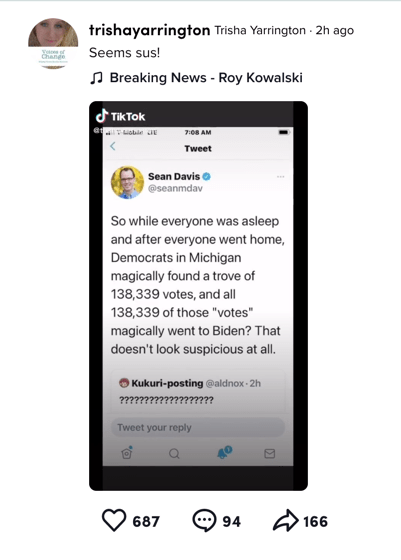
Image Credits: TikTok screenshot via Media Matters

TikTok says all the videos Media Matters reported have since been removed except one where a user made a premature declaration of victory. That one was shadowbanned — meaning its discoverability on the platform was reduced. It also has a banner pointing to authoritative information about the election results.

These individual takedowns are a drop in the bucket compared to the number of videos that are still out there making claims of election fraud. And, so far, TikTok has only removed a small number of hashtags on this subject.
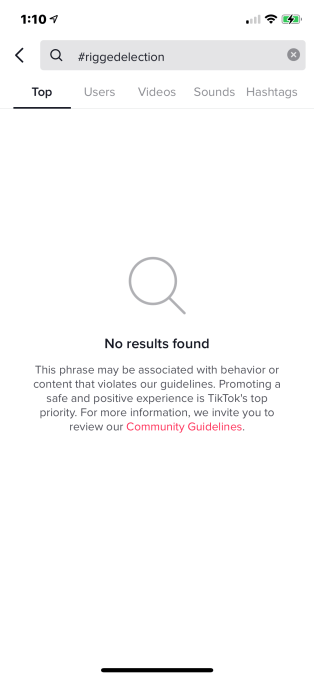
Image Credits: TikTok screenshot via TechCrunch

TikTok confirmed it has removed content and redirected searches for the hashtag #RiggedElection as of yesterday. Now, when you try to find videos flagged with this term in the app, you’ll get to a blank page with a notification that says the search term “may be associated with behavior or content that violates our guidelines.” The page also provides a link to TikTok’s Community Guidelines.

“Promoting a safe and positive experience is TikTok’s top priority,” the message reads.

This is the same playbook that TikTok recently used to address the spread of QAnon-related content on its platform. By redirecting searches and hashtags, it makes misinformation harder to find.

While TikTok declined to share an exhaustive list of hashtags it has taken action on during the elections, we found a few hashtags that returned either no results — like #RiggedElection and #SharpieGate — as well as those that returned only a small handful videos, or what TikTok considers “counter speech.”

The TikTok community will often create videos with counter speech or other content related to a misinformation-related hashtag. In these videos, they’ll provide factual information or will dispute the claims being made in another video. TikTok says this sort of counter speech doesn’t violate its policies. That’s why you may see videos listed under hashtags that would otherwise be associated with misinformation, as opposed to seeing the hashtag entirely silenced.

We also found some lesser-used hashtags like #RepealtheSteal and #VeritasArmy, which have been seen on Twitter, were not showing on TikTok at all. (However, upon reaching out to TikTok, the company chose to redirect these hashtags, too.)

A popular misinfo hashtag, #StoptheSteal, was also not available, but its variation, #StoptheStealing, had seven videos.

Many other hashtags were being used, too, as of the time of writing, including #VoterFraud (and its misspelling #VoterFruad), #DemsCheat, #CorruptElection, #ElectionCorruption, #StoptheStealing, #ElectionFraud (and misspelling #ElectionFruad), #CrookedJoeBiden, #CrookedDems, #Fraud (and its misspelling #Fruad), #Rigged, #Rigged2020, #MailinBallots, #CoupdEtat, #ElectionMeddling, #DemocratsAreDestroyingAmerica and #BallotHarvesting, to name a few.

While some hashtags had little content, many were filled with videos that weren’t just expressing their political views — they were making claims of election fraud. Combined, these hashtags have tens of millions of views, or even more.
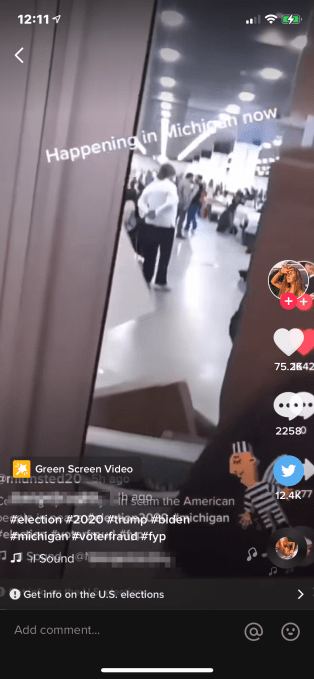
Image Credits: TikTok screenshot, video republished previously removed content; screenshot via TechCrunch

For example, when we searched for the hashtag #VoterFraud (20.9 million views), we first encountered videos posted in the months leading up to Election Day that were responding to the Republican-driven claims of voter fraud associated with mail-in ballots.

But many videos under this hashtag have been published by Trump supporters this week, and are videos where the supporters are directly disputing the election results.

Among the videos we found were those reposting videos TikTok had already taken down. These included videos featuring Trump supporters’ protests against or for the counting of ballots in various states, calling them proof of election fraud.

In other videos, users opine about how Trump’s lawsuits will prove fraud took place and win him re-election. They sometimes use screenshots of website vote tallies as their “proof.”
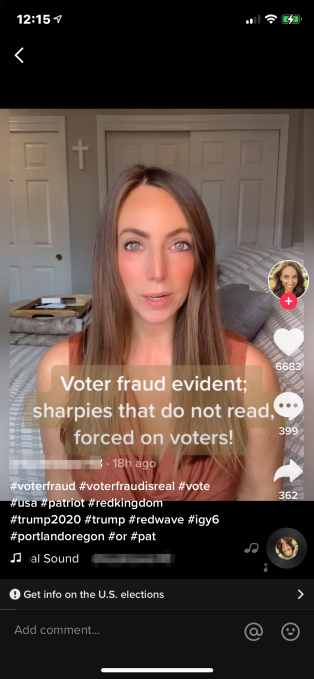
Image Credits: TikTok app screenshot via TechCrunch

We also saw videos using text labels overtop their video footage. The text was used to make their claims of election fraud, while the video itself may have them talking in more measured terms about their disappointment with the election results. (It’s unclear if this is a viable workaround to avoiding rule enforcement, however.)

TikTok says its list of blocked hashtags continually grows as new terms and phrases emerge and it’s able to determine how the terms are being used on its platform. It also said it block more election misinformation hashtags in the hours, days and weeks to come.

To be clear, TikTok’s decision to keep this sort of content online doesn’t make it much different from other social networks.

During election season, Facebook and Twitter have taken to labeling election misinformation from high-profile accounts (like Trump’s). Facebook even ran in-app notifications to inform users that votes are still being counted. But both platforms today still easily allow users to click through on a wide range of hashtags that promote this idea of election fraud or rigged results.

TikTok may not much be doing much better, overall, in addressing the sizable amount of content promoting election misinformation on its video network. But TikTok’s ban of top election misinformation hashtags works differently from hashtag bans on other social networks.

Once TikTok has made the decision to ban a term like “SharpieGate,” for example, the content won’t be surfaced whether you use the hashtag symbol (#) itself or not. Facebook, on the other hand, may ban the hashtag specifically, but not the term entirely. That means you can still find content about SharpieGate on its platform — even if it’s largely posts and videos from news organizations.

#SharpieGate was also among the hashtags Facebook began blocking today related to election misinformation. It also blocked #StoptheSteal and a related group.



from Social – TechCrunch https://ift.tt/32gRnbb
via IFTTT

Facebook blocks hashtags for #sharpiegate, #stopthesteal election conspiracies

Facebook today began to block select hashtags which were being used to share misinformation related to the 2020 U.S. presidential election.

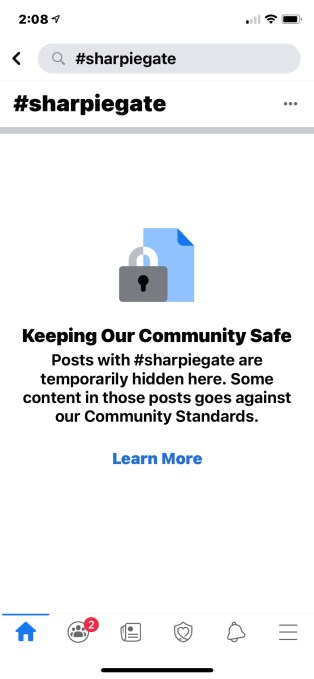
Now, searches for the hashtags #SharpieGate is being blocked on the social network. Another election conspiracy hashtag #stopthesteal is also blocked on Facebook, with a note saying some of its content goes against the platform’s community standards. The #stopthesteal hashtag has been promoted by Donald Trump Jr. and other Trump campaign associates on Twitter.

Instead of taking users to search results for the hashtag in question, Facebook presents a page where it explains that posts with the hashtag are being “temporarily hidden.” This message also explains that “some content in those posts goes against our Community Standards,” and offers to direct users to its guidelines under a “Learn More” link.

Image Credits: Facebook screenshot via TechCrunch

Though TechCrunch found select election misinformation hashtags had been banned, there were still many others that would direct users to content that pushed conspiracies disputing the election results or outright calling them fraudulent.

For example, hashtags like #RiggedElection, #Rigged, #ElectionFraud, #ElectionMeddling and others still worked, and even directed users to content associated with QAnon conspiracies, at times — despite Facebook’s earlier ban on QAnon content, which extended to many associated hashtags.

Given that Facebook allowed QAnon content to spread for years, it’s notable that the company moved to block election misinformation hashtags in a matter of days. That indicates Facebook is capable of addressing viral misinformation somewhat quickly — it just has historically chosen not to do so.

As for the hashtags themselves, Sharpiegate had already been thoroughly debunked, both by news outlets and election officials. In a letter posted to Twitter, the Maricopa County Board of Supervisors debunked the claims that the use of sharpies would invalidate ballots. Because the ballots are printed with offset columns, the use of sharpies is allowed and would not cause bleed-through or other issues.

The claim was first made Tuesday in a video posted to Facebook in which a woman claims poll workers were encouraging some voters to use sharpies in order to invalidate their ballots. That video is now flagged on Facebook with a “false information” label and requires users to click through to watch it.

In addition to its hashtag bans, Facebook today also removed a group, “Stop the Steal 2020,” BuzzFeed’s Ryan Mac first reported. The group was tied to real-world protests by Trump supporters, which have erupted around the country as key states continue to tally votes. Some protesters, inspired by misinformation, have even swarmed voting sites where counting is still underway.

“In line with the exceptional measures that we are taking during this period of heightened tension, we have removed the Group ‘Stop the Steal,’ which was creating real-world events,” Facebook spokesperson Andy Stone told TechCrunch. “The group was organized around the delegitimization of the election process, and we saw worrying calls for violence from some members of the group.”

As he has signaled he would for months, President Trump is leaning heavily into a false narrative that suspicious polling place behavior and late-arriving ballots are part of a Democratic plot to thwart his reelection chances. In a speech from the White House early Wednesday morning, Trump declared premature victory, raising baseless concerns that mail-in ballots, which were expected to lean heavily Democratic, were somehow improper as they erased some of his early gains. “We were getting ready to win this election,” Trump said. “Frankly, we did win this election.”

On Twitter, many of Trump’s recent tweets promoting unfounded election conspiracies have been hidden from view and placed behind a misinformation warning. Those hidden tweets also have likes, retweets and comments restricted in order to limit their ability to spread in a viral way. On Facebook, the president’s posts alleging fraud at voting sites are not called out directly as misinformation. Instead, Facebook pairs them with informational labels reminding users that vote-by-mail ballots are trustworthy or noting that election officials follow “strict rules” around processing and counting ballots. The company also disabled the “recent” page for Instagram hashtags in the lead-up to the election, a precaution designed to limit the spread of viral election misinformation.

Facebook so far has not responded to a request for comment about its new hashtag bans, but they’re observable within the Facebook app on both the desktop and mobile app as of the time of writing.


from Social – TechCrunch https://ift.tt/2GxaoP3
via IFTTT