This is default featured slide 1 title

Go to Blogger edit html and find these sentences.Now replace these sentences with your own descriptions.This theme is Bloggerized by Lasantha Bandara - Premiumbloggertemplates.com.

This is default featured slide 2 title

Go to Blogger edit html and find these sentences.Now replace these sentences with your own descriptions.This theme is Bloggerized by Lasantha Bandara - Premiumbloggertemplates.com.

This is default featured slide 3 title

Go to Blogger edit html and find these sentences.Now replace these sentences with your own descriptions.This theme is Bloggerized by Lasantha Bandara - Premiumbloggertemplates.com.

This is default featured slide 4 title

Go to Blogger edit html and find these sentences.Now replace these sentences with your own descriptions.This theme is Bloggerized by Lasantha Bandara - Premiumbloggertemplates.com.

This is default featured slide 5 title

Go to Blogger edit html and find these sentences.Now replace these sentences with your own descriptions.This theme is Bloggerized by Lasantha Bandara - Premiumbloggertemplates.com.

Twitter expands API features for developers tracking the public conversation

Twitter is rolling out new features to its developer community with an update to its recently rebuilt Twitter API. One addition to the now expanded collection of API v2 endpoints will allow app developers to eventually better support Twitter’s newer conversation controls — the feature that allows users to specify who can reply to their tweets. Other endpoints allow developers to track tweets by particular accounts, those mentioning a certain account, or retrieve a list of of accounts who follow a particular user.

The new endpoints are a continuation of Twitter’s work on version 2 of its developer API, first introduced this June. The API was rebuilt for the first time since 2012 with a goal of including features that had been missing from the earlier version, like polls, pinned tweets, and spam filtering, for example, while also rolling out improvements to areas like search and stream filtering.

But Twitter’s API continues to be a work in progress, as Twitter adds endpoints and further fleshes out its tiered access plans.

In this release, Twitter is adding some support for the conversation settings introduced earlier this year. This feature allows users to choose who can respond to their tweets. On Twitter, users can opt to allow everyone to reply, or they can limit replies only to those they follow or even just the people mentioned in the tweet. These conversation controls are now partially supported in the new API as well, through a field in the Tweet object called reply_settings. The addition will allow developers to tell if the conversation reply settings have been set for a tweet, and if so, who can reply. However, Twitter has not yet write support for these fields, which Twitter says it coming “in the future.”

Eventually, a feature like this may allow third-party apps to better mimic the first-party experience on Twitter.com and in Twitter’s own native apps. It could also help developers build out social listening apps that only pull in those tweets a social media manager is able to reply to, noted SocialOpinions developer Jamie Maguire, in a Twitter post. Twitter also suggests it could be useful for researchers looking to learn more about the public conversation.

The feature is fully rolled out to v2, Twitter says.

Another set of endpoints, user tweet timeline and user mention timelines, return a collection of tweets either composed by or those mentioning a specific Twitter user. Now, these endpoints can also specify the start_time and end_time parameters, meaning they can be used to collect tweets during a certain window of time. The “user mention timeline” endpoint also now supports application-only authentication, which Twitter says will make it easier for developers or researchers analyzing a given account.

The company notes these had been two of the most heavily used endpoints in the first version of the API, as they allow for tools in areas like customer support, brand analysis, and those that measure a Twitter user’s sentiment over time.

At launch, developers can request up to 100 tweets per request. The user tweet timeline endpoint is limited to the 3200 most recent tweets, and the user mention timeline is limited to the 800 most recent tweets. Both will count towards the monthly tweet cap on Standard Basic access, which is 500,000.  This limit is not permanent —  Twitter has said before it plans to offer Elevated access to the Twitter API v2 in the Standard product track sometime next year, and businesses can sign up for that free beta here.

These are available in Early Access to the Twitter API v2.

Twitter also this week launched two new follows lookup endpoints, also in Early Access, that allow developers to retrieve a list of accounts who follow a particular person, or pull the list of accounts that someone follows. These are often used by developers who want to understand how accounts on Twitter are linked for the purpose of network analysis or in the examination of the spread of information or misinformation.

Developers had told Twitter they wanted to be able to pull rich information about an account’s relationships without having to make additional calls to look up that account data. These endpoints allow developers to pull the profile information about an account’s follows in just one request, instead of numerous calls using prior versions of the Twitter API.

These endpoints are often used alongside the endpoints that allow you to follow and unfollow accounts, as well as block and mute accounts. However, that functionality is not yet available.

Twitter committed to more transparency around its API changes and updates this time, but developers may still be wary of building on the platform because of Twitter’s history. The company in past years repeatedly pulled the rug out from developers building Twitter apps, even cutting off access to partners and canceling its developer conference. These moves aren’t easily forgotten.

Twitter had announced the API changes through tweets and forum posts late last week. The company’s longer-term developer platform roadmap is also available publicly here.


from Social – TechCrunch https://ift.tt/3rhNe1M
via IFTTT
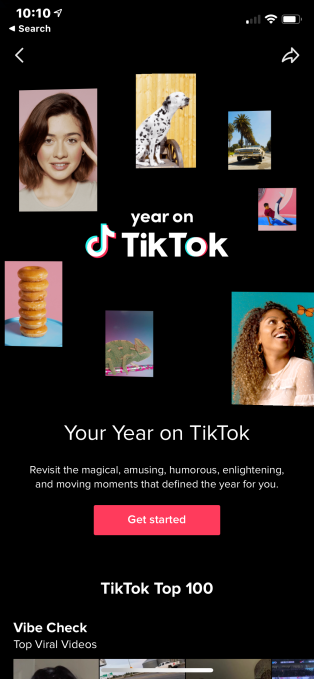
TikTok launches its first personalized annual recap feature, ‘Year on TikTok’

Spotify users have Wrapped and Instagram users have their Top 9. And now TikTok users will have their own year-in-review feature, too. The company today announced the launch of its first personalized annual recap feature with the launch of “Year on TikTok,” a video highlight reel that showcases individual users’ own top TikTok moments. This includes things like how long you’ve been on TikTok, what sort of videos you watched most, your favorite tracks and creative effects, metrics on how often you commented and shared videos, and more.

The feature will also identify your favorite “vibes” — meaning, the sort of videos you like best, such as crafts, cooking, animals, travel, cottagecore, or any of the now numerous communities that have sprung up on the social video platform.

If users haven’t been on TikTok long enough to have developed their own “vibe,” TikTok says their “Year on TikTok” will include other top videos from its “Year on TikTok: Top 100” list instead.

Image Credits: TikTok

The content for the recap is presented in a familiar way. You’ll vertically scroll down through a video that details your 2020 interests and activities. You then have the chance to share that video directly to your own TikTok profile in order to receive a special profile badge that puts a “2020” on top of your profile photo.

The app’s “Year on TikTok” page also includes other TikTok highlights to browse through, including top memes, top creators, top viral videos, most impactful creators, top celebs, top songs, and other year-end trends.

TikTok users can access their “Year on TikTok” by tapping the icon on their For You feed — a prominent placement — or by scrolling to the banner at the top of the app’s Discover page.

The accuracy of TikTok’s recap is debatable. For example, even though every other video in my For You feed is related to politics and news (go figure!), TikTok informed me my top “vibes” were things like home, travel, and animal videos. That’s true too, but it’s an incomplete list and doesn’t match up with the majority of my past “likes.” It seems that TikTok may be curating the experience to focus on more positive “vibes” — and political videos and themes didn’t make the cut.

Regardless of its attempts at spin, social features that offer users a personalized retrospective of how they engaged with an app through the year have proven to be fairly popular — and a good marketing mechanism, as well.

Spotify’s Wrapped, for instance, has been so well-received that people began to complain that people’s Wrapped shares were dominating and overwhelming their social feeds at year-end. Spotify this year partially addressed this problem by offering new customization options for its 2020 Wrapped that let users adjust the color of their Wrapped card before sharing. This way, the flood of Wrapped shares wouldn’t look quite as homogenous as in prior years, and may be perceived as less of an annoyance.

The “Year on TikTok” feature will likely do well, too, though it’s hard to track. The hashtag #YearOnTikTok is up to 5.4 billion views, thanks to users who are adopting the tag in hopes of propelling their videos to a wider audience or getting on the For You page. The real test will be how many creators end up with the 2020 badge stuck on their profile in the days to come.

While TikTok’s feature is fun, if you find it somewhat lacking there are third-party alternatives.

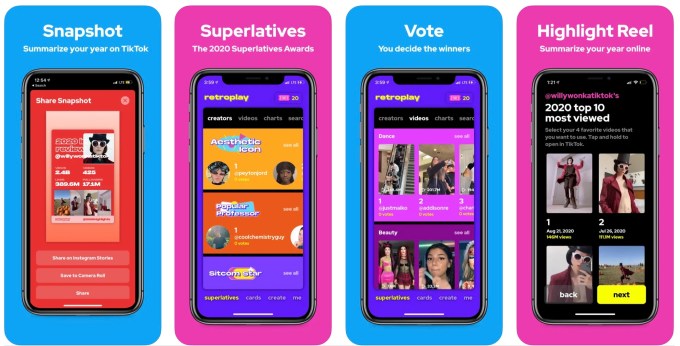
One app, Retroplay, launched its own 2020 TikTok Year in Review this month. The app does more than just round-up your own stats and metrics. Users can also vote for their favorite creators and videos through Retroplay’s “Superlatives” awards, collect cards from favorite creators, and customize their own highlight reel. But the app is brand-new and struggling with bugs — the highlight reel is currently down while it’s being fixed, for instance, and the app couldn’t resolve a username that began with a period instead of a letter, we found.

Image Credits: Retroplay

But the app’s design is catchy and the interactive features are engaging, so hopefully the developer can address the other issues soon — and before year-end!


from Social – TechCrunch https://ift.tt/3h5tEBf
via IFTTT

Unfold launches lightweight, link-centric profiles called Bio Sites

Unfold, the social media startup acquired by Squarespace last year, is launching a new tool for users to share all the links that are important with them.

This is the first step Unfold has taken beyond its story-format authoring tools. Co-founder Andy McCune told me that the team has a bigger vision now — just as Squarespace has become “the all-in-one platform for your web presence,” Unfold aims to become “the all-in-one platform for your social presence.”

“We’re both playing in very saturated spaces with a lot of competitors,” McCune said. “We both stand out because we appeal to the person that cares about design. That’s always been the North Star.”

In the case of the new Bio Sites, he said one of the goals is to help Unfold users — whether they’re individuals or large brands — become less reliant on a single social media platform. After all, he noted that when you build a following on Instagram, you’re building on “borrowed territory,” and “you don’t really own your audience.”

Unfold Bio Sites

Image Credits: Unfold

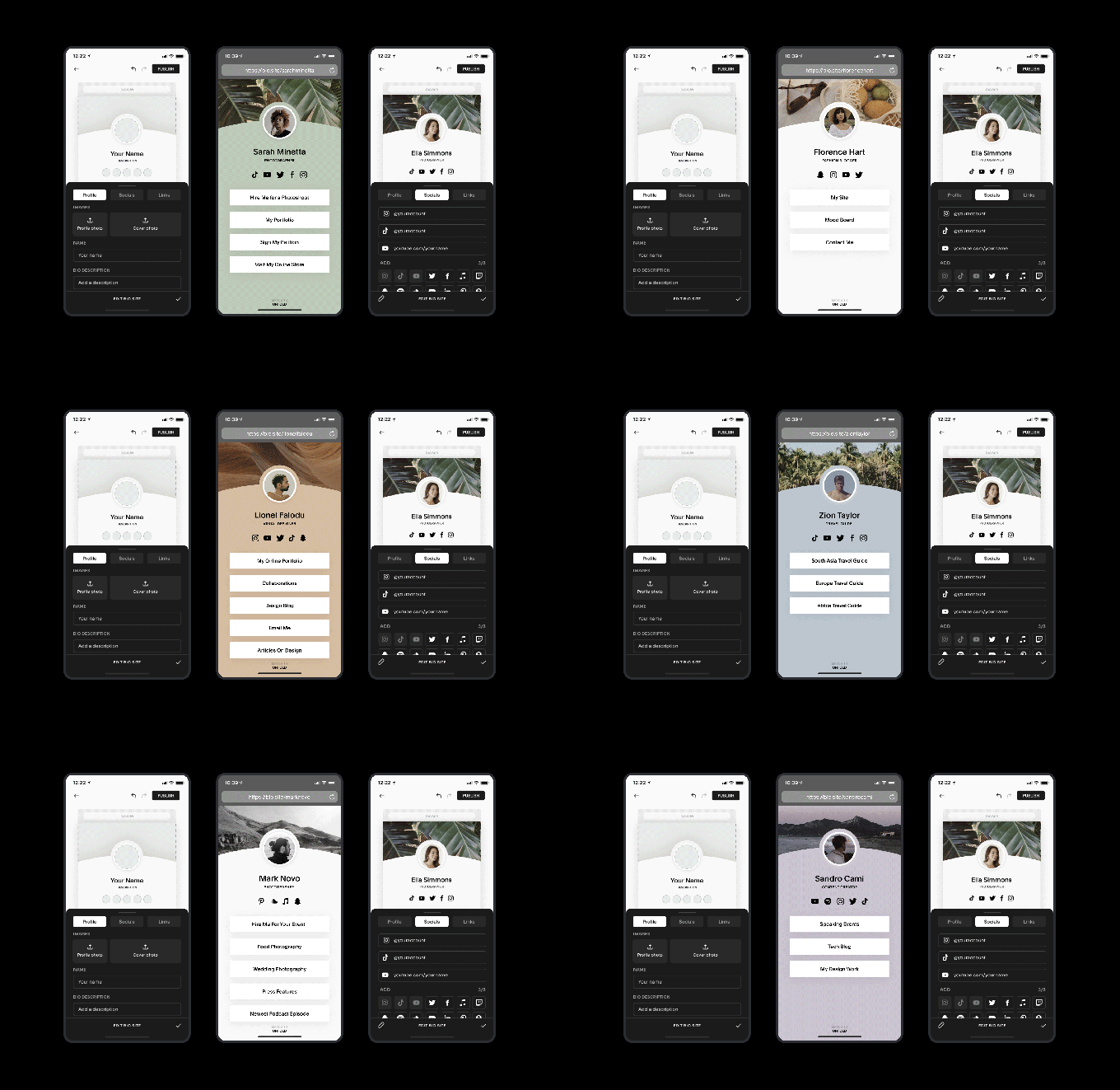
By creating a simple profile that highlights the links of your choice, then by linking your Instagram and other social profiles to your Bio Site, you can then point audiences to other channels where you have more control — or at least diversify the platforms that you’re relying on.

McCune and his co-founder Alfonso Cobo aren’t the first ones to think of this idea. For example, Linktree raised funding earlier this year, and there are other startups creating similar products. But Cobo said Bio Sites benefit from Unfold’s design-centric approach, allowing users to create simple profiles that aren’t just functional, but also looks great and reflect their personality.

Cobo also noted that Bio Sites are created from the Unfold native app — it’s launching on Android today, with plans for iOS in January. The feature will be available available to all Unfold users, including free users, but subscribers to the premium Unfold+ and Unfold for Brands tiers get additional features like custom URLs.

“We’re really going to be expanding in the next few weeks with presence and expressibility tools to help users stand out in different ways,” Cobo said. “We’re also very interested in commerce and will be exploring that route in the future, too.”


from Social – TechCrunch https://ift.tt/3gXTwPr
via IFTTT

Twitter bots and memorialized users will become ‘new account types’ in 2021

After a period of public feedback, Twitter adjusted some its plans for a new verification process, set to roll out next year. The company suspended public verification applications in 2017 and since appears to have rethought a few aspects of what information the platform should signal to its users, blue checks and beyond.

One big verification-adjacent change around the corner: Twitter plans to add a way of distinguishing bots and other automated accounts.

“… It can be confusing to people if it’s not clear that these accounts are automated,” the company wrote in a blog post. “In 2021, we’re planning to build a new account type to distinguish automated accounts from human-run accounts to make it easier for people to know what’s a bot and what’s not.”

Of course, not all bots are good bots, but automated accounts have flourished on the platform since its early days and bots remain some of the most useful, whimsical and otherwise beloved sources of tweets.


The company is also working on a better way to handle accounts for users who have died, and plans to introduce a memorialization process in 2021. Twitter says that memorialized accounts, like bots, will become “a new account type” making them distinct from normal users. The idea grew out of the same spirit as Twitter’s labels for political figures, which sought to provide contextual info about users that can be seen at a glance.

Taking more than 22,000 pieces of feedback on the new verification process into account, Twitter will no longer require a profile bio or header picture to verify users, calling its former thinking “too restrictive.” It’s also redefined a few of its eligible verification categories, expanding “sports” to include esports and adding more language around digital content creators into the entertainment category.

Twitter also apparently received a lot of suggestions calling for additional verification categories for scientists, academics and religious figures. Until it spins out more categories, those users can seek verification under the “activists, organizers, and other influential individuals” catch-all category.

Verification applicants will need to apply under a particular category and provide links or other information supporting their application. The new “self-serve” verification process will be available through account settings on both mobile and desktop.

Twitter will implement the new account verification policy on January 20, 2021, three years after freezing the process. The company did not specify when public verification applications will be accepted again, but it sounds like the wait won’t be too long and the company plans to share more soon. Starting on the 20th, Twitter will begin sweeping out inactive verified accounts and others that don’t meet its new bar for a “complete account.”

In the adjusted policy, a complete account — and one eligible for verification — must have a verified email or phone number, a profile image and a display name. Anyone who’s verified but doesn’t meet those criteria will receive notifications of the required changes, which must be made before January 20.

Twitter’s new policy also lays out the company’s right to revoke verification for accounts in “severe or repeated violation” of the platform’s rules. It sounds like new policy could lay a clearer path for the company to take against users who break the rules, though that ultimately will come down to enforcement rather than written policies.

“We will continue to evaluate such accounts on a case-by-case basis, and will make improvements in 2021 on the relationship between enforcement of our rules and verification,” Twitter wrote in the post.

Twitter paused the verification process in November, 2017 following a public outcry over its decision to verify Jason Kessler. Kessler infamously organized the Unite the Right event in Charlottesville, Virginia that gathered neo-Nazis and white supremacists, ultimately leaving one peaceful counter protester dead. The pause was extended the next year as the company decided to direct more resources toward election integrity.

With the midterms and the general U.S. election behind it, Twitter has returned to its effort to rethink the verification process and what it symbolizes for users on the platform. The company is also experimenting with new features that could dial down harassment, toxicity and misinformation.

Twitter recently added friction to the retweet process in an effort to slow the spread of misinformation, though it rolled the change back after the election. Twitter’s latest test: A new pop-up that displays shared interests and a profile bio when a user goes to reply to someone they don’t follow.


from Social – TechCrunch https://ift.tt/3amyd8U
via IFTTT

Daily Crunch: Discord raises $100M

Discord announces a big funding round, Google gets European approval to acquire Fitbit and Twitter launches a new voice-based feature. This is your Daily Crunch for December 17, 2020.

Discord raises $100M

The popular gaming chat platform confirmed today that it has raised $100 million and also announced that it has 140 million monthly active users, twice as many as a year ago.

“We are humbled and honored by the growth we’ve seen among so many incredible and diverse communities that have made Discord their place to hang out,” said CEO Jason Citron in a statement. “As we look to 2021, we are excited about what we have in store and plan to use this funding to help make Discord even better — both for our free service and our Nitro subscribers.”

The confirmation comes after TechCrunch reported that the company was raising up to $140 million at a valuation that could be as high as $7 billion.

The tech giants

Europe clears Google-Fitbit with a ten-year ban on using health data for ads — Under the terms of the EU’s clearance for the deal, Google has committed to not use Fitbit user data in the European Economic Area for ad targeting purposes for a 10-year period.

Twitter launches its voice-based ‘Spaces’ social networking feature into beta testing — During this initial testing period, the product will be limited to select individuals, largely from underrepresented backgrounds, Twitter says.

Google slammed for ‘monopoly power’ in new antitrust lawsuit from 35 states — Compared to the Texas-led suit against Google announced yesterday, the second lawsuit represents a broader coalition of 35 states.

Startups, funding and venture capital

Coinbase files to go public confidentially and we’re hyped — To be clear, I don’t consider myself part of the “we” that’s hyped, but Alex Wilhelm definitely is.

Spryker raises $130M at a $500M+ valuation to provide B2Bs with agile e-commerce tools — Spryker offers a platform to bring a company’s inventory online, as well as tools to analyze and measure how that inventory is selling and where.

Health insurer Oscar adds another $140M in what’s likely a pre-IPO round — The new capital means that Oscar has raised what would be the equivalent of $1 million a day for the entirety of 2020.

Advice and analysis from Extra Crunch

Virgin Orbit, Relativity Space and Astra dish on the economics and efficiencies of space launches — Relativity Space CEO Tim Ellis, Astra CEO Chris Kemp and Virgin Orbit’s VOX Space President Mandy Vaughn all joined us at TC Sessions: Space to discuss their approaches to the small spacecraft launch market.

Just how bad is that hack that hit US government agencies? — Spoiler: It’s a nightmare scenario.

2020’s top 10 enterprise M&A deals totaled a staggering $165B — It was a blockbuster year for enterprise M&A.

(Extra Crunch is our membership program, which aims to democratize information about startups. You can sign up here.)

Everything else

HBO Max finally lands on Roku devices — “Finally” gets overused in headlines, but it absolutely applies here.

You can now securely submit tips to TechCrunch using SecureDrop — We’re making it easier and more secure for you to contact TechCrunch reporters and editors.

The Daily Crunch is TechCrunch’s roundup of our biggest and most important stories. If you’d like to get this delivered to your inbox every day at around 3pm Pacific, you can subscribe here.


from Social – TechCrunch https://ift.tt/3r6y8vL
via IFTTT

Adobe brings over 10,000 design assets to Spark

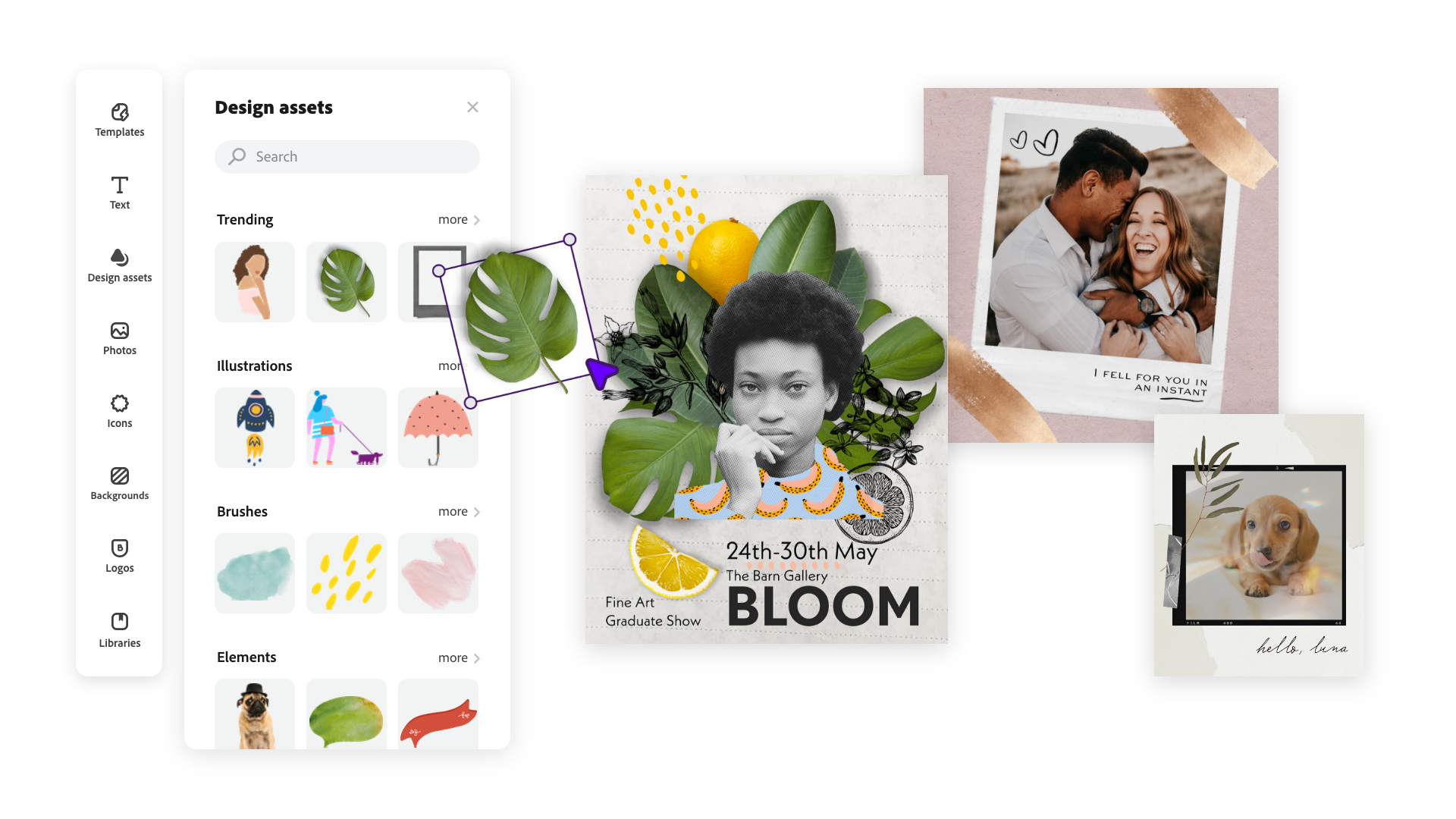
Adobe is launching an update to its Spark social media design tool today that will bring more than 10,000 new design assets to the service. This update, which follows the launch of animations in Spark in September, also brings a small UI change with it to accommodate this new feature, but for the most part, you can think of design assets as an extension to what a lot of users were already doing with icons in Spark.

Image Credits: Adobe

“For our users, who are everyday entrepreneurs and marketers, they want to create professional-looking content — and they certainly don’t have design experience,” Adobe Spark product manager Justin Church told me. “The rollout of these tens of thousands of new design assets that we’re coming up with will really empower them to create standout social posts and things like Instagram stories that are more original and creative than they’ve ever been able to so far.”

As Church noted, a lot of users opt for working with Spark’s templates to get started, but there’s also a large set of users who start from scratch and they will especially benefit from the ability to quickly pull in frames, illustrations, brushes and more.

Image Credits: Adobe

Adobe has a large in-house content design team that designed some of its own assets and curated others from outside resources. Those assets were all tagged, to make them discoverable, which now makes it easy to find them in Spark’s search feature. As of now, these results are not personalized yet — or set to match with what’s already in your current design — but the team is exploring how to use AI to help users find the right assets for their specific designs.

Unsurprisingly, given the broad range of users, Adobe opted for a very broad range of assets (and styles) with which to start. The plan is to expand this set of assets over time, of course, and the team will look closely at which categories are popular, but the company also plans to release new assets in time for specific holidays and around special events.


from Social – TechCrunch https://ift.tt/38asIHH
via IFTTT

Walmart to pilot test live-streamed video shopping on TikTok

Walmart and TikTok announced this morning they will be partnering on the first pilot test of a new shoppable product experience on TikTok’s social video app. Walmart, as you may recall, had planned to invest in TikTok when the app was being threatened with a ban from the U.S. market unless it sold its U.S. operations to an American company, per a Trump administration executive order —  a ban that’s now on pause after multiple legal challenges. Walmart’s interest in TikTok, however, has not waned. The retailer, though seemingly an odd fit for a social network, had seen the potential to attract a younger online consumer through video and, in particular, live streamed video.

This is what the new test on TikTok will involve, as well.

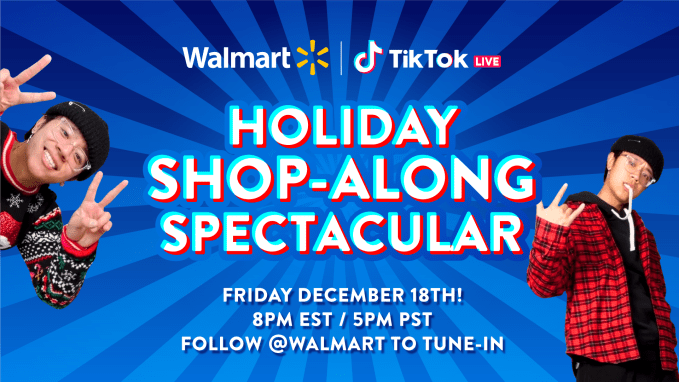
During a Walmart live stream, TikTok users will be able to shop from Walmart’s fashion items without having to leave the TikTok app, in a pilot of TikTok’s new “shoppable product.” The fashion items themselves will be featured in content from ten TikTok creators, led by host Michael Le, whose TikTok dances have earned him 43+ million fans. Other creators will be more up-and-coming stars, like Devan Anderson, Taylor Hage, and Zahra Hashimee.

All will be participating in a special event hosted on TikTok called the “Holiday Shop-Along Spectacular,” which will take place on Friday, Dec. 18 at 8 PM ET on Walmart’s TikTok profile.

Image Credits: Walmart

During this special, the creators will show off their favorite Walmart fashion finds in their own unique ways. For some, that will mean giving fans a peek inside their closet. Others may do a living room runway or even a fashionable “dance off,” Walmart says.

There are two ways TikTok users can shop for the fashion items featured.

As products are shown on screen, pins will pop-up which users can tap to add the item to their cart. They’re then directed to a mobile checkout experience. Alternately, customers can choose to tap on a shopping cart pin at the end of the event to look through all the items featured and select what they’d like to purchase.

And for anyone who misses the event, they’ll still be able to shop the items from Walmart’s TikTok profile when the Shop-Along event is over.

“We’re constantly looking for ways to innovate the shopping experience for our customers,” said Walmart’s U.S. Chief Marketing Officer, William White, in an announcement. “We’re moving faster than ever to find new and improved ways to better serve our customers and meet them where they are. We created this event for, about, and by our community, reflecting the lives, passions and styles of a diverse set of creators so everyone watching will feel represented, no matter who they are or how they outfit their closet,” he added.

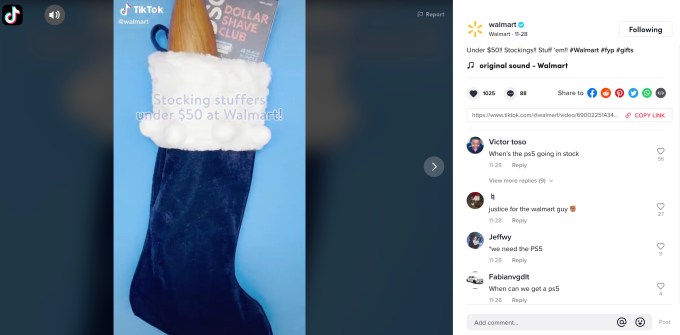
Walmart said the idea to partner on mobile shopping didn’t emerge as a result of the recent deal talks, as it’s been an active brand on the platform for over a year. (In fact, it’s even tasked its employees with making TikTok videos, a recent report from ModernRetail detailed.)

The retailer also told TechCrunch there’s not a revenue share with TikTok on the sales it makes through the app, nor any fees, as this is considered a joint test.

Image Credits: Walmart’s profile on TikTok

This is not TikTok’s first foray into shoppable video.

The company has been exploring this space for some time, including with last year’s launch of the Hashtag Challenge Plus which added a shoppable component to a hashtag, directing video viewers to shop a site from within TikTok. This year, brands like Levi’s leveraged TikTok’s “Shop Now” buttons that allowed consumers to make purchases through links posted on TikTok. And in a significant deal just this fall, TikTok formally partnered with Shopify on social commerce by allowing Shopify merchants to create, run and optimize their TikTok marketing campaigns directly from the Shopify dashboard.

Live-streamed shopping is also a fast-growing and lucrative market, as younger users are turning to influencers and online video to both be entertained and to shop.

All the major tech companies have invested in this space as well, to varying degrees, including not only Facebook (in an aggressive push across Facebook and Instagram), but also Google through its R&D arm, Amazon through its QVC-like Amazon Live, Alibaba through AliExpress, JD.com, Pinduoduo, WeChat, and even TikTok’s Chinese sister app, Douyin.

The trend is also fueling startups, like Bambuser and Popshop Live, which have raised new rounds in 2020 for their own live-streamed shopping products.

For TikTok, however, is more of a natural evolution of its product where influencers are already showing off their favorite items, their fashion and style.

“At TikTok, we’re constantly exploring new ways to inspire creativity, bring joy and add value for our community,” said Blake Chandlee, Vice President, Global Business Solutions at TikTok. “Creators and brands have found a creative outlet to connect with audiences through TikTok Live, and we’re excited to further innovate on this interactive experience to enable our community to discover and engage with the brands they love,” he continued.

“Brands have had an incredible impact on the community throughout this year, and we’re thrilled to see Walmart embrace the creativity of TikTok and this first-of-a-kind experience to meaningfully engage with their community,” Chandlee said.


from Social – TechCrunch https://ift.tt/38gIHUm
via IFTTT