This is default featured slide 1 title

Go to Blogger edit html and find these sentences.Now replace these sentences with your own descriptions.This theme is Bloggerized by Lasantha Bandara - Premiumbloggertemplates.com.

This is default featured slide 2 title

Go to Blogger edit html and find these sentences.Now replace these sentences with your own descriptions.This theme is Bloggerized by Lasantha Bandara - Premiumbloggertemplates.com.

This is default featured slide 3 title

Go to Blogger edit html and find these sentences.Now replace these sentences with your own descriptions.This theme is Bloggerized by Lasantha Bandara - Premiumbloggertemplates.com.

This is default featured slide 4 title

Go to Blogger edit html and find these sentences.Now replace these sentences with your own descriptions.This theme is Bloggerized by Lasantha Bandara - Premiumbloggertemplates.com.

This is default featured slide 5 title

Go to Blogger edit html and find these sentences.Now replace these sentences with your own descriptions.This theme is Bloggerized by Lasantha Bandara - Premiumbloggertemplates.com.

Twitter acqui-hires creative agency Ueno to help design new products

Twitter this morning announced it’s bringing the full-service creative agency Ueno in-house to work alongside Twitter’s own design and research teams. The move, an acqui-hire of sorts, is one where Twitter is essentially buying the agency with which it already had a close working relationship, as Ueno had previously partnered with Twitter on various design and product experiences in the past.

The agency itself was founded by Haraldur Thorleifsson in Reykjavik, Iceland in 2014. Today, it has dozens of employees working in Reykjavik, San Francisco, New York and LA.

Over the years, Ueno has worked on a number of projects for large brands and startups alike, including Google, Facebook, Reuters, Uber, ESPN, Sotheby’s, Walmart, Visa, NYT, Apple, Slack and others. Startups that contracted the agency include Zero, Checkout.com, Superhuman, Tagomi, Strava, Cruise, Credit Karma, Boosted and many more. (Ueno also worked on Clubhouse per its website, but not the same Clubhouse that’s competing with Twitter Spaces.)

Also among its clients were those that had other Twitter ties: Medium and Jelly. The former is the publishing platform from Twitter co-founder Evan Williams, and the latter was a Q&A app created by Twitter co-founder Biz Stone, which later sold to Pinterest.

Twitter Chief Design Officer Dantley Davis announced the news of Ueno’s joining on Twitter this morning, saying Ueno has a “highly experienced and innovative team of designers, strategists, and producers.”

He also said the team will help Twitter to “accelerate the quality and execution of Twitter’s product experiences.”

Ueno’s founder, meanwhile, also announced the news, then teased Twitter CEO Jack Dorsey about the edit button.

Twitter tells TechCrunch that Ueno will wind down its agency and will complete its existing projects for other clients over the weeks ahead.

The company also said it will be meeting with Ueno’s 50 global employees over the weeks ahead to learn more about their professional backgrounds and goals — essentially, to determine if they can fit inside Twitter’s design and research orgs. That means Twitter may or may not end up hiring all 50.

Twitter isn’t publicly sharing what projects it has in mind for Ueno, but we understand the Ueno staff will end up embedded across key teams within the design and research organizations so they can work on top of product initiatives, including “conversational tools” and other upcoming features. Reading between the lines, this seems to indicate that Twitter Spaces, the company’s new audio-based conversations tool, will benefit from the acqui-hire.

The company also noted it will continue to be on the lookout for other talent to help it accelerate its work in a similar way, so this may not be the last acqui-hire deal to come.

The news of Ueno’s acqui-hire follows that of Twitter’s acquisition of social podcasting app Breaker, announced just this week, also with the goal of staffing up on Twitter’s new audio-based networking project and Clubhouse rival (the audio app), Twitter Spaces.

Deal terms were not shared.


from Social – TechCrunch https://ift.tt/3pZR26p
via IFTTT
Facebook redesigns Pages with a more simplified layout and no ‘Like’ button

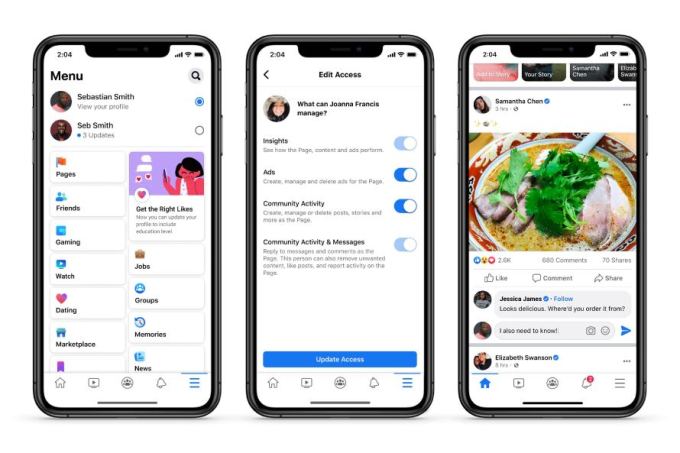
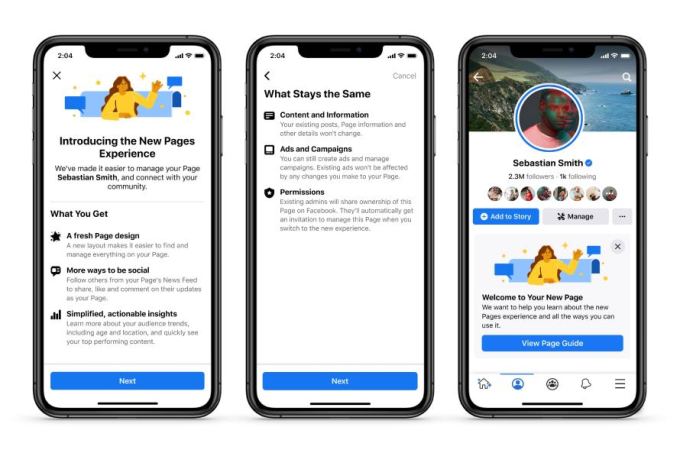
Facebook Pages are being redesigned. The social network announced today a significant change to the Facebook Page experience for creators and public figures, which includes a new look-and-feel, updated navigation, the introduction of a dedicated News Feed, a new Q&A format for engaging fans, and other tools and insights. Notably, the redesign will also do away with the “Like” button to instead focus on Followers — a more direct measurement of how many people a Page is currently reaching.

TechCrunch first reported the company’s plans to overhaul Facebook Pages this past summer, when it began to test the updated look with a select number of high-profile individuals, including actors, authors, creators, followed by English-language business Pages.

Today, Facebook says the new experience will officially begin to roll out to all Facebook Pages over the months ahead.

One of the biggest changes about the new Page design is that it does away “Likes.” This came about because Likes were misrepresenting a Page’s true popularity. Many Facebook users had once “Liked” a Page, but later unfollowed the Page to remove its updates from their News Feed as they outgrew their interest. Or they had “Liked” a Page as a favor to a friend after receiving a request, but declined to receive its updates.

Facebook now says Followers of a Page will be the metric at the forefront of the new experience, as it’s a better indication of how many people are fans who are receiving updates from the Page.

Another notable change is that Pages will get their own News Feed. That means the Page itself can participate in conversations as the public figure or the brand, follow trends, and interact with their fans. This dedicated News Feed will also suggest other public figures, Pages, Groups and trending content for the Page or the public figure to interact with, as well.

When you follow a Page, you’ll see their comments on others’ posts bumped up to the top of the comments section, giving them better visibility, alongside a more visible blue-check that indicates the Page is verified. The posts they’ve commented on may also be more visible in users’ News Feeds, too.

Other people will be able to follow Pages directly from the comments and recommendations posts, Facebook says.

Facebook is also introducing a new Q&A format that allows Pages to better engage with fans. This is somewhat inspired by the Instagram trend, where creators would take questions from fans and answer them in Stories. In this case, however, followers can ask the Page questions about a topic and when the Page answers, those become a stack of questions that people can swipe through to learn more. This could be particularly useful for businesses who want to answer common questions in a fun way for fans to get to know a creator they like, among other things.

In addition to these handful of major changes, there are a few updates on the backend which are aimed at those who manage Facebook Pages. For example, Page admins will be able to assign access permissions more granularly, to focus on giving people varying levels of access to perform specific tasks across Insights, Ads, Content, and Community Activity, and Messages.

Based on feedback Facebook received during the testing phase, it built a set of new admin tools interface that now has a direct entry point for managing permissions, adding new admins and accessing insights for Page admins. This is available from the “manage” button on the Page. It also launched full support for the Creator Studio mobile app.

Moderation is also being improved, Facebook says, as it’s updated its ability to detect and filter “hate speech comments, violent, sexual, spammy content, impersonator accounts, and phishing.” Other improvements in this area are still in the works, Facebook notes, but declined to provide specifics when asked for details.

Since the launch of the test, Facebook heard from users they liked the new, more simplified user interface, as well as the ease of switching between their public and private profiles and Pages, as well as the better ways to engage fans.

Facebook says the updated Pages will roll out in the “coming months.”


from Social – TechCrunch https://ift.tt/2XdvGpN
via IFTTT

YouTube reverses ban on UK’s TalkRadio for COVID-19 policy breaches

YouTube has reversed a controversial ban on the account of TalkRadio, a News Corp-owned UK national radio station that covers news and current affairs.

The station revealed yesterday its channel had been removed from YouTube but said it had not been provided with an explanation for the suspension.

The decision to suspend the account of a high profile national broadcaster appears to have been related to its policies on COVID-19 misinformation. Reuters reports that some of its presenters have been critical of government measures to slow the spread of coronavirus as excessive or ill-targeted.

However the tech giant’s decision to ban a national broadcaster was quickly criticized by cabinet minister, Michael Gove, who went on TalkRadio yesterday to defended its right to ask questions about government policy vis-a-vis the coronavirus.

The ban also triggered an intervention from News Corp’s executive chairman, Rupert Murdoch, according to the i newspaper, which reports that Murdoch accused the Google-owned service of setting a “dangerous precedent” and “censorship of free speech and legitimate national debate”.

In a statement today confirming it has reinstated TalkRadio’s account, a YouTube spokesperson told us:

TalkRadio’s YouTube channel was briefly suspended, but upon further review, has now been reinstated. We quickly remove flagged content that violate our Community Guidelines, including COVID-19 content that explicitly contradict expert consensus from local health authorities or the World Health Organization. We make exceptions for material posted with an educational, documentary, scientific or artistic purpose, as was deemed in this case.

It’s not clear which type of exception YouTube is applying in TalkRadio’s case to justify reinstating the station — given opinionated radio could span all categories, depending on the specific content.

Per the i, TalkRadio had received earlier strikes in October and December for YouTube policy breaches. The third strike that led to its (brief) suspension is thought to relate to an interview between one of its hosts, Julia Hartley-Brewer, and former National Education Union president, Amanda Martin, about whether teachers should be given the highest priority for COVID-19 vaccines.

The TalkRadio ban-reversal is just the latest in a long-running saga of tech giant moderation decisions colliding with concerns for freedom of expression — even as the stuff that platforms choose to leave up can often be no less controversial. (Although concern about risks to public health from coronavirus misinformation spreading and being amplified online have undoubtedly added extra pitfalls to platform moderation business as usual.)

The common thread of concern is powerful, private entities — which are not regulated in the same way (UK) broadcasters are — continue to have their hands on the ‘acceptable speech’ lever.

Change is coming in the UK, though: The government is working on a legislative proposal that will bring big tech under Ofcom’s regulatory umbrella. (And as TalkRadio points out in its earlier statement its output is already regulated by Ofcom.)

The Online Safety Bill, which is slated to be put before parliament this year, will propose a ‘duty of care’ for tech platforms to protect users from a range of illegal and harmful content. 

Under the plan Ofcom will oversee platforms compliance and get the power to block non-compliant digital services from being accessed, as well as the ability to levy huge fines for breaches.   


from Social – TechCrunch https://ift.tt/3rYjszs
via IFTTT

Facebook will turn all US political advertising off again after Georgia runoffs

Georgia is the only state in the U.S. right now where Facebook allows political ads to run, but after Tuesday’s polls close that’s set to change.

According to Facebook’s site detailing changes to its ad policies and a story from Axios, the company will no longer allow political and social issue ads anywhere in the country, Georgia included, beginning early tomorrow.

Facebook told TechCrunch that the decision to toggle political ads in Georgia off again brings that state in line with its current “nationwide pause” on social issue, election and politics ads. A Facebook spokesperson declined to say when political ads will again be allowed or if permanently blocking them from the platform is under consideration.

The company first hit pause on those ad categories November 4 as a precaution designed to reduce misinformation in the U.S. presidential election. On December 16, the company re-allowed political ads in Georgia, inviting eager campaigns to pay to get their messages in front of Facebook users. It appears that some politicians, Sen. Ted Cruz (R-TX) among them, pounced on Facebook’s Georgia loophole to raise money for themselves in spite of restrictions.

When political ads came flooding back in for Georgians, they edged out mainstream news sources, according to new reporting from The Markup. While that result is fairly intuitive, it does underline the outsized influence of targeting political advertising in Facebook’s information ecosystem.

Plenty of politicians and political groups are likely eager to get back to fundraising on Facebook. The company’s decision to keep the pause in place suggests that it’s still evaluating how — and perhaps if — it wants to handle political ads in the future. But Facebook also might be waiting for the storm to pass in light of the misinformation that plagued November’s drawn-out process of calculating election results.

It’s also worth noting that Facebook’s head of advertising integrity Rob Leathern left the company at the end of December, calling his team’s work on the 2020 U.S. election the “culmination of a huge amount of effort over several years.” Leathern helped sculpt the company’s policies around political advertising — decisions that were often controversial due to the prevalence of paid misinformation sweeping through the platform throughout 2020.

Because they will decide control of the Senate, the unusual pair of runoff races in a state that just flipped blue are high-stakes for both political parties. With a Democratic Senate, the Biden administration’s ambitious plans for things like COVID relief and the climate crisis will have a much better shot at becoming a reality. And for Republicans looking to stymie the president-elect’s policy priorities, extended control of the Senate would put a powerful barrier in Biden’s way.


from Social – TechCrunch https://ift.tt/38frHiA
via IFTTT

8 investors discuss social gaming’s biggest opportunities

The gaming industry has had plenty of watershed moments in 2020 as consumer entertainment habits have shifted in response to the pandemic. One trend has been the crystallization of MMOs as social entertainment hubs that serve more needs for users than ever before.

Following my survey of gaming-focused investors on trends in the AR/VR world several months ago, I pinged a handful of investors to tap their thoughts on the shifting trends and opportunities in social gaming.

One thing that most investors expressed excitement around was the widening entertainment ambitions of social platforms, as concerts and movie screenings find homes on gaming platforms like Fortnite.

While evolving free-to-play mechanics continue to elevate the experience of single-player titles into something more living and breathing, platforms like Roblox have found areas for growth that seem more unique, developing into destinations for users to communicate and share.

“It’s where culture is created,” Madrona’s Daniel Li told TechCrunch.

Not all of the respondents shared the belief that a gaming platform like Fortnite would grow to become the next Facebook. General Catalyst’s Niko Bonatsos pointed to adjacent platforms like Discord or Twitch as the constants that would remain as consumers cycled through different platform ecosystems. Other pointed to the the still-disjointed experience switching between mobile and desktop experiences as a yet-to-be-solved stumbling block.

Building the metaverse and building a popular casual mobile game are two different things. Most investors I talked with emphasized how much the pace of scaling has accelerated across categories though with breakout hits rising faster than ever while disasters seem to grow evident just as quickly.

“I think that you look at Among Us, and Cyberpunk on the other side, anything can happen much faster and more extreme than it used to be just because of distribution,” Rogue VC’s Alice Lloyd George told TechCrunch.

Read below for the full answers; some responses have been edited for length and clarity.


Hope Cochran and Daniel Li, Madrona Venture Group

The idea that the next big social network will be an MMO seems to be a trendy take in the VC world, what are the roadblocks to this actually happening?

Daniel Li: Hope and I were trading some notes and part of our thesis is that gaming is the future of social and for Gen Z, gaming is replacing not just old games, but it’s replacing TV and Netflix. So instead of going to watch music videos on YouTube, you’re going to a concert in Roblox and that’s a social experience with your friend … instead of going to the mall, now you’re in Roblox. It’s where kids are hanging out and it’s where culture is created.

Hope Cochran: And in COVID, it’s the only place where they can hang out and I think the gaming industry has done a really fabulous job creating another social engagement that we need right now. I don’t want to focus too much on kids, but parents are becoming more accepting of their kids in the games because there is this social engagement and, for instance, I can see that my child is upstairs connecting with his four best friends. They log in together and they play. They normally might be out on a soccer field but they can’t right now so I think parents are becoming a little more comfortable saying, “Oh, he’s playing with his friends.”

Gaming has seemingly become a more “mainstream” area for investment, as someone who has been in the space a bit, what’s different about investing in the gaming sector?

HC: It’s very hard to find that balance between creative or understanding what might become a hit and a real business mind. So my experience has been that when you look into a gaming company as an investor, it’s actually more driven by math, stats and analytics, and then you have a core team who has the creative juices, so I try to look for that kind of dynamic.

So, who is developing what the users will love and who is analyzing it and how are they responding to what the users are loving. I do think there’s a point where a team develops a game and it’s mostly a creative process but then you have to kind of toggle to the analytics. It’s where the mathematicians meet the magicians and there needs to be a combination of that within every game.

What’s different about how popular games and MMOs are scaling these days? Have you seen any interesting growth hacks or strategies that seem promising?

DL: I think there are more and more of these cultural memes that just seem to come out of nowhere, like Among Us kind of just sat there for two years and streamers started picking it up and now it’s super popular. I’d say for nearly all of those, they’re going to be a social category of games, you don’t see a game like Cyberpunk come out of nowhere without any marketing dollars behind it.

So I do think one of those new channels is getting influencers to talk about your games, and typically I think for those it’s not actually the big influencers picking it up, it’s a whole bunch of small influencers all starting to play a game and have it start to build up steam that way. It’s more likely the Call of Duty’s that can hire the big streamers and pay them millions of bucks to play a new game, but I don’t think there’s a new to go-to-market for smaller studios around that.

How can MMOs, which feel like fundamentally active experiences, provide a better passive experience for users that may be more interested in the community than playing a first-person shooter or battle royale? How do games become more approachable to a wider audience?

DL: A lot of people are saying these single-player games aren’t really fun games anymore, they’re just like cinematic experiences. Like playing Cyberpunk for 60 hours versus binge-watching three TV series, it’s definitely a different experience. The thing that’s actually more interesting here is the virtual events that are happening inside these games. Thinking about what the next Twitch looks like, it’s probably some kind of experience where you’re inside the game doing something more passive.

Niko Bonatsos, General Catalyst


from Social – TechCrunch https://ift.tt/2LiNmNY
via IFTTT

Twitter acquires social podcasting app Breaker, team to help build Twitter Spaces

Twitter has acquired social broadcasting app Breaker, the companies announced today via a combination of blog posts and tweets. The deal will see Breaker’s team joining Twitter to help “improve the health of the public conversation” on the service, as well as work on Twitter’s new audio-based networking project, Twitter Spaces. The Breaker app, however, will shut down on January 15, 2021.

Breaker announced the acquisition on its company blog, explaining why it believes its team will be a good fit at Twitter.

“Here at Breaker, we’re truly passionate about audio communication and we’re inspired by the ways Twitter is facilitating public conversations for people around the world,” wrote Breaker CEO Erik Berlin. “We’re impressed by the entrepreneurial spirit at Twitter and enthusiastic about the new experiences that the team is creating.”

Breaker was founded in 2016 and is led by both CEO Berlin, previously the founder and CTO at social advertising company 140 Proof (which sold to Acuity), and CTO Leah Culver, who previously founded Pownce and Grove and co-authored web technologies OAuth and oEmbed.

The app had launched at a time when podcasts were still very much thought of as audio feeds and podcast apps as productivity tools — not experiences around which a community could be built. Breaker helped to change that perception by offering an app where users could like and comment on episodes, discover new podcasts by following friends, share favorite shows to social media and much more.

According to Culver’s tweet, she’ll be joining Twitter with a focus on Twitter Spaces, Twitter’s audio-based social networking product and Clubhouse rival. Spaces lets Twitter users chat in real time using voice instead of text, as they do today. The new product entered beta testing in December. Twitter is currently trying to work out not only the technical issues and bugs with the feature, but also the more complex issues that arise from hosting live audio, including moderation.

In a separate tweet, Twitter Engineering lead Michael Montano confirmed that Berlin, Culver and Breaker designer Emma Lundin will all be moving to Twitter as a result of the deal.

He also praised both Berlin and Culver’s entrepreneurial spirit as well as Culver’s push for open standards over the years.

Reached for comment, Twitter pointed to Montano’s tweet but offered no further details on the acquisition, price or broader plans.

Breaker says it will close in a matter of days its apps and services it built over the past years.

On January 15, 2021, Breaker will shut down for good. Up until that point, Breaker users will be able to export their OPML file to transfer their subscriptions to another podcasting app. Breaker recommends apps like Apple, Spotify, Stitcher, Overcast, Pocket Casts or Castro as an alternative. For those hosting a podcast on Breaker, these can be transferred elsewhere via the RSS feed.

The Breaker acquisition adds to a string of recent podcast M&A activity. But unlike recent deals that involved podcast content, Breaker’s sale is made up of staff and technology, not podcasts themselves. This maps to Twitter’s general focus on collating content from others instead of making its own.

The Breaker deal, with its unannounced price, feels modest. Which means that while the company’s exit to Big Tweet is another point on the board for podcasting companies finding their way to some sort of payout, it fits the general narrative that podcasting services and podcasting content only has so much value.

The acquisition follows other podcast content deals in recent weeks and months, including Amazon’s $300 million acquisition of Wondery, Sirius buying Stitcher for $300 million, not to mention all the content deals Spotify has picked up as of late.

That another podcast service sold for around $300 million has become a running joke. That number, while impressive-sounding to the individual, is not the sort of exit that venture capitalists target. The Breaker-Twitter tie-up, then, doesn’t push back on the idea that building a company focused on podcasting is to admit to a future that will have capped future upside.

Whether venture capitalists pull back from podcasting investments in 2021 is not yet clear, but Breaker’s sale does little to argue that private investors shouldn’t.

The real winner in the Breaker deal is Twitter, as it gains key talent as it enters what is shaping up to be a buzzy new market in 2021 for voice-based social networking — an idea whose time has come, perhaps, thanks to people being stuck at home amid a pandemic. Without conferences and parties to attend, many went in search of better ways to connect online.

But it remains to be seen if Twitter — a service that has publicly struggled with online toxicity and moderation failures — will be able to make audio networking a safe place for users to chat, or if it will amplify Twitter’s existing challenges in these areas. It also remains to be seen if voice-based networking will have a future in a reopened, post-COVID world where we can once again meet others in real-world, public places, instead of Twitter Spaces.


from Social – TechCrunch https://ift.tt/3nfBFoD
via IFTTT

Google and Snap in talks to invest in India’s ShareChat

ShareChat, an Indian social network that added Twitter as an investor in 2019, may soon receive the backing of two more American firms.

The Bangalore-based startup is in advanced stages of talks to raise money from Google and Snap, as well as several existing investors, including Twitter, three sources familiar with the matter told TechCrunch.

The new financing round — a Series E — is slated to be larger than $200 million, with Google alone financing more than $100 million of it, four sources said, requesting anonymity as the talks are private. The round values ShareChat at more than $1 billion, two of the sources said.

ShareChat, Google and Snap did not immediately respond to a request for comment. ShareChat has raised about $264 million to date and was valued at nearly $700 million last year.

The terms of the deal could change and the talks may not materialize into an investment, the sources cautioned. Local TV channel ET Now reported last year that Google was in talks to acquire ShareChat.

ShareChat’s marquee and eponymous app caters to users in 15 Indian languages and has a large following in small Indian cities and towns. Twitter and Snap, on the other hand, are struggling to gain users beyond urban cities in the world’s second-largest internet market. Both Twitter and Snapchat have about 50 million monthly active users in India, according to a popular mobile insight firm.

In an interview with TechCrunch last year, Ankush Sachdeva, co-founder and chief executive of ShareChat, said the app was growing “exponentially” and that users were spending, on average, more than 30 minutes on the app each day.

If the deal goes through, it would be the first investment from Snapchat’s parent company into an Indian startup. Google, on the other hand, has been on a spree of late. The Android-maker last month invested in DailyHunt and InMobi’s Glance, both of which operate short-video apps.

Like the two, ShareChat also operates a short-video app. Its app, called Moj, had amassed more than 80 million monthly active users as of September last year, the startup said at the time. Several of these short videos apps, as well as Times Internet’s MX TakaTak (operated by MX Player), have witnessed an accelerated growth in recent quarters thanks in part to New Delhi banning ByteDance’s TikTok and hundreds of other Chinese apps mid-last year.

Last year, Google announced that it plans to invest $10 billion in India over the course of five to seven years. Days later, the company invested $4.5 billion in Indian telecom giant Jio Platforms. Google and Facebook, which invested $5.7 billion in Jio Platforms last year, reach more than 400 million users in the country.

Google, Facebook, ShareChat, DailyHunt and Glance generate most of their revenue through ads. About 85% of the ad market in India is currently commanded by Facebook and Google, analysts at Bank of America wrote in a report to clients last year. “We estimate this market to be $10 billion by 2024 and see room for Facebook to increase its market-share by 4 percentage points in 4 years led by partnership with Jio. We estimate Facebook may have $4.7 billion revenues by 2024,” they wrote in the equity research report, obtained by TechCrunch.


from Social – TechCrunch https://ift.tt/3naM6K8
via IFTTT