This is default featured slide 1 title

Go to Blogger edit html and find these sentences.Now replace these sentences with your own descriptions.This theme is Bloggerized by Lasantha Bandara - Premiumbloggertemplates.com.

This is default featured slide 2 title

Go to Blogger edit html and find these sentences.Now replace these sentences with your own descriptions.This theme is Bloggerized by Lasantha Bandara - Premiumbloggertemplates.com.

This is default featured slide 3 title

Go to Blogger edit html and find these sentences.Now replace these sentences with your own descriptions.This theme is Bloggerized by Lasantha Bandara - Premiumbloggertemplates.com.

This is default featured slide 4 title

Go to Blogger edit html and find these sentences.Now replace these sentences with your own descriptions.This theme is Bloggerized by Lasantha Bandara - Premiumbloggertemplates.com.

This is default featured slide 5 title

Go to Blogger edit html and find these sentences.Now replace these sentences with your own descriptions.This theme is Bloggerized by Lasantha Bandara - Premiumbloggertemplates.com.

The next tech hearing targets social media algorithms — and YouTube, for once

Another week, another big tech hearing in Congress. With a flurry of antitrust reform bills on the way, Democratic lawmakers are again bringing in some of the world’s most powerful tech companies for questioning.

In the next hearing, scheduled for Tuesday, April 27 at 10 AM ET, the Senate Judiciary’s subcommittee on privacy and technology will zero in on concerns about algorithmic amplification. Specifically, the hearing will explore how algorithms amplify dangerous content and shape user behavior on social platforms.

The subcommittee’s chair Sen. Chris Coons previously indicated that he would bring in tech CEOs, but Tuesday’s hearing will instead feature testimony from policy leads at Facebook, Twitter and YouTube.

The hearing might prove a unique opportunity to hold YouTube’s feet to the fire. In spite of being one of the biggest social networks in the world — one without much transparency about its regular failures to control extremism and misinformation — YouTube seldom winds up under the microscope with Congress. The company will be represented by Alexandra Veitch, YouTube’s regional director of public policy.

In past big tech hearings, Google CEO Sundar Pichai has generally appeared on behalf of YouTube’s parent company while YouTube’s chief executive Susan Wojcicki inexplicably escapes scrutiny. Google is a massive entity and concerns specific to YouTube and its policies generally get lost in the mix, with lawmakers usually going after Pichai for concerns around Google’s search and ads businesses.

In a stylistic repeat of last week’s adversarial app store hearing, which featured Apple as well as some of its critics, misinformation researcher Dr. Joan Donovan and ex-Googler and frequent big tech critic Tristan Harris will also testify Tuesday. That tension can create deeper questioning, providing outside expertise that can fill in some lapses in lawmakers’ technical knowledge.

Policy leads at these companies might not make the same flashy headlines, but given their intimate knowledge of the content choices these companies make every day, they do provide an opportunity for more substance. Tech CEOs like Mark Zuckerberg and Jack Dorsey have been dragged in to so many hearings at this point that they begin to run together, and the top executives generally reveal very little while sometimes playing dumb about the day-to-day decision making on their platforms. The subcommittee’s ranking member Ben Sasse (R-NE) emphasized that point, stating that the hearing would be a learning opportunity and not a “show hearing.”

Democrats have been sounding the alarm on algorithms for some time. While Republicans spent the latter half of the Trump administration hounding tech companies about posts they remove, Democrats instead focused on the violent content, extremism and sometimes deadly misinformation that gets left up and even boosted by the secretive algorithms tech companies rarely shed light on.

We haven’t seen much in the way of algorithmic transparency, but that could change. One narrowly targeted Section 230 reform bill in the House would strip that law’s protections from large companies when their algorithms amplify extremism or violate civil rights.

Twitter CEO Jack Dorsey has also hinted that a different approach might be on the horizon, suggesting that users could hand-pick their preferred algorithms in the future, possibly even selecting them from a kind of third-party marketplace. Needless to say, Facebook didn’t indicate any plans to give its own users more algorithmic control.

With any major changes to the way platforms decide who sees what likely a long ways off, expect to see lawmakers try to pry open some black boxes on Tuesday.



from Social – TechCrunch https://ift.tt/2QUDblv
via IFTTT
Dating app S’More bets on celebrity content with S’More TV

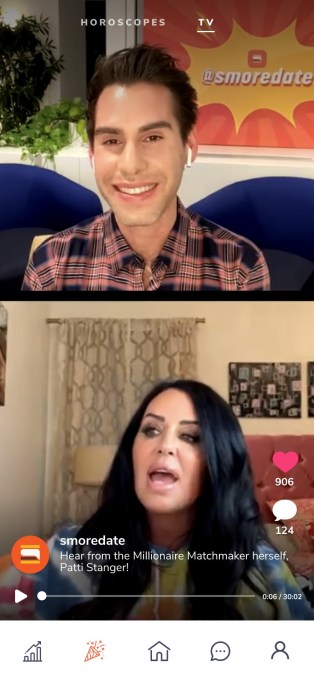
Dating startup S’More has launched a new feature called S’More TV, which CEO Adam Cohen-Aslatei said could give users new ways to talk to each other. It also bringing the startup closer to his goal of becoming not just a dating app, but “a lifestyle brand.”

The videos on S’More TV may be familiar to people who follow the company on Instagram, where Cohen-Aslatei has hosted dating-related interviews with celebrities like WWE stars Chelsea Green and Leah Van Dale, models Nichole Holms and Sarah Miller and Mary Fitzgerald of “Selling Sunset.” Now, however, these videos are getting a home in the S’More app itself.

Cohen-Aslatei said this wasn’t the initial plan when he started filming videos for S’More Live, but eventually he and his team decided to do more with their “nearly 50 hours of exclusive celebrity content,” seeing them as “the first organic way to have content not related to a dating profile” in the app. He suggested that this isn’t just giving users another reason to open the app, but also a crucial conversation starter.

After all, anyone who’s had to start a conversation in a dating app will probably remember moments when you’ve struggled to come up with something better than “Hey” or “How’s it going?” — and S’More presents unique challenges on that front, since the app blurs all user photos until you’ve had some real interaction. So Cohen-Aslatei said these videos can spur a more natural conversation, allowing users to “really talk about topics that they care about.”

S'More TV

Image Credits: S’More

The S’More app now includes prompts directing users to watch S’More TV, where anyone can watch and comment on the videos. If you post a particularly scintillating comment, that may help to attract potential matches, and it will give them an easy starting point for the conversation.

In fact, Cohen-Aslatei claimed that since releasing S’More TV in beta testing, the app has seen Day 1 retention (the number of users who open the app one day after installation) increase by 15% to the “mid 60s,” while time in the app has doubled.

He also said S’More Live is quickly approaching its 100th episode, but you won’t see all of those episodes the app right away. Instead, the company will be adding 15 new videos to the S’More app each month.

In addition, S’More has launched a new feature called cover photos. This is basically the one exception to the blurred photos rule (although it sounds like even this photo is subtly warped), allowing users to showcase a single image of their friends, their life or their personality even before they start a conversation.


from Social – TechCrunch https://ift.tt/32NFSYX
via IFTTT

Facebook introduces a new miniplayer that streams Spotify within the Facebook app

Facebook announced last week an expanded partnership with streaming music service Spotify that would bring a new way to listen to music or podcasts directly within Facebook’s app, which it called Project Boombox. Today, the companies are rolling out this integration via a new “miniplayer” experience that will allow Facebook users to stream from Spotify through the Facebook app on iOS or Android. The feature will be available to both free Spotify users and Premium subscribers.

The miniplayer itself is an extension of the social sharing option already supported within Spotify’s app. Now, when Spotify users are listening to content they want to share to Facebook, they’ll be able to tap the existing “Share” menu (the three dot-menu at the upper right of the screen) and then tap either “Facebook” or “Facebook News Feed.”

When a user posts an individual track or podcast episode to Facebook through this sharing feature, the post will now display in a new miniplayer that allows other people who come across their post to also play the content as they continue to scroll, or reshare it. (Cue MySpace vibes!)

Spotify’s paid subscribers will be able to access full playback, the company says. Free users, meanwhile, will be able to hear the full shared track, not a clip . But afterwards, they’ll continue to listen to ad-supported content on Shuffle mode, just as they would in Spotify’s own app.

One important thing to note here about all this works is that the integration allows the music or podcast content to actually play from within the Spotify app. When a user presses play on the miniplayer, an app switch takes place so the user can log into Spotify. The miniplayer activates and controls the launch and playback in the Spotify app — which is how the playback is able continue even as the user scrolls on Facebook or if they minimize the Facebook app altogether.

This setup means users will need to have the Spotify mobile app installed on their phone and a Spotify account for the miniplayer to work. For first-time Spotify users, they’ll have to sign up for a free account in order to listen to the music shared via the miniplayer.

Spotify notes that it’s not possible to sign up for a paid account through the mini-player experience itself, so there’s no revenue share with Facebook on new subscriptions. (Users have to download the Spotify app and sign up for Paid accounts from there if they want to upgrade.)

The partnership allows Spotify to leverage Facebook’s reach to gain distribution and to drive both sign-ups and repeat usage of its app just as the Covid bump to subscriber growth may be wearing off. However, it’s still responsible for the royalties paid on streams, just as it was before, the company told TechCrunch, because its app is the one actually doing the streaming. It’s also fully in charge of the music catalog and audio ads that play alongside the content.

For Facebook, this deal means it now has a valuable tool to keep users spending time on its site — a metric that has been declining over the years, reports have indicated.

Spotify and Facebook have a long history of working together on music efforts. Facebook back in 2011 had been planning an update that would allow music subscription users to engage with music directly on Facebook, much like this. But those plans were later dialed back, possibly over music rights’ or technical issues. Spotify had also been one of the first media partners on Facebook’s ticker, which would show you in real-time what friends were up to on Facebook and other services. And Spotify had once offered Facebook Login as the default for its mobile app. Today, as it has for years, Spotify users on the desktop can see what their Facebook friends are streaming on its app, thanks to social networking integrations.

The timing for this renewed and extended partnership is interesting. Now, both Facebook and Spotify have a mutual enemy with Apple, whose privacy-focused changes are impacting Facebook’s ad business and whose investments in Apple Music and Podcasts are a threat to Spotify. As Facebook’s own music efforts in more recent years have shifted towards partnership efforts — like music video integrations enabled by music label agreements — it makes sense that it would turn to a partner like Spotify to power a new streaming feature that supports Facebook’s broader efforts around monetizable tools and services aimed at the creator economy.

The miniplayer feature had been tested in non-U.S. markets, Mexico and Thailand, ahead of its broader global launch today.

In addition to the U.S., the integration is fully rolling out to users in Argentina, Australia, Bolivia, Brazil, Canada, Chile, Colombia, Costa Rica, Dominican Republic, Ecuador, El Salvador, Guatemala, Honduras, Indonesia, Israel, Japan, Malaysia, Mexico, New Zealand, Nicaragua, Panama, Paraguay, Peru, South Africa, Thailand, and Uruguay.


from Social – TechCrunch https://ift.tt/3nlxOYJ
via IFTTT

India orders Twitter to take down tweets critical of its coronavirus handling

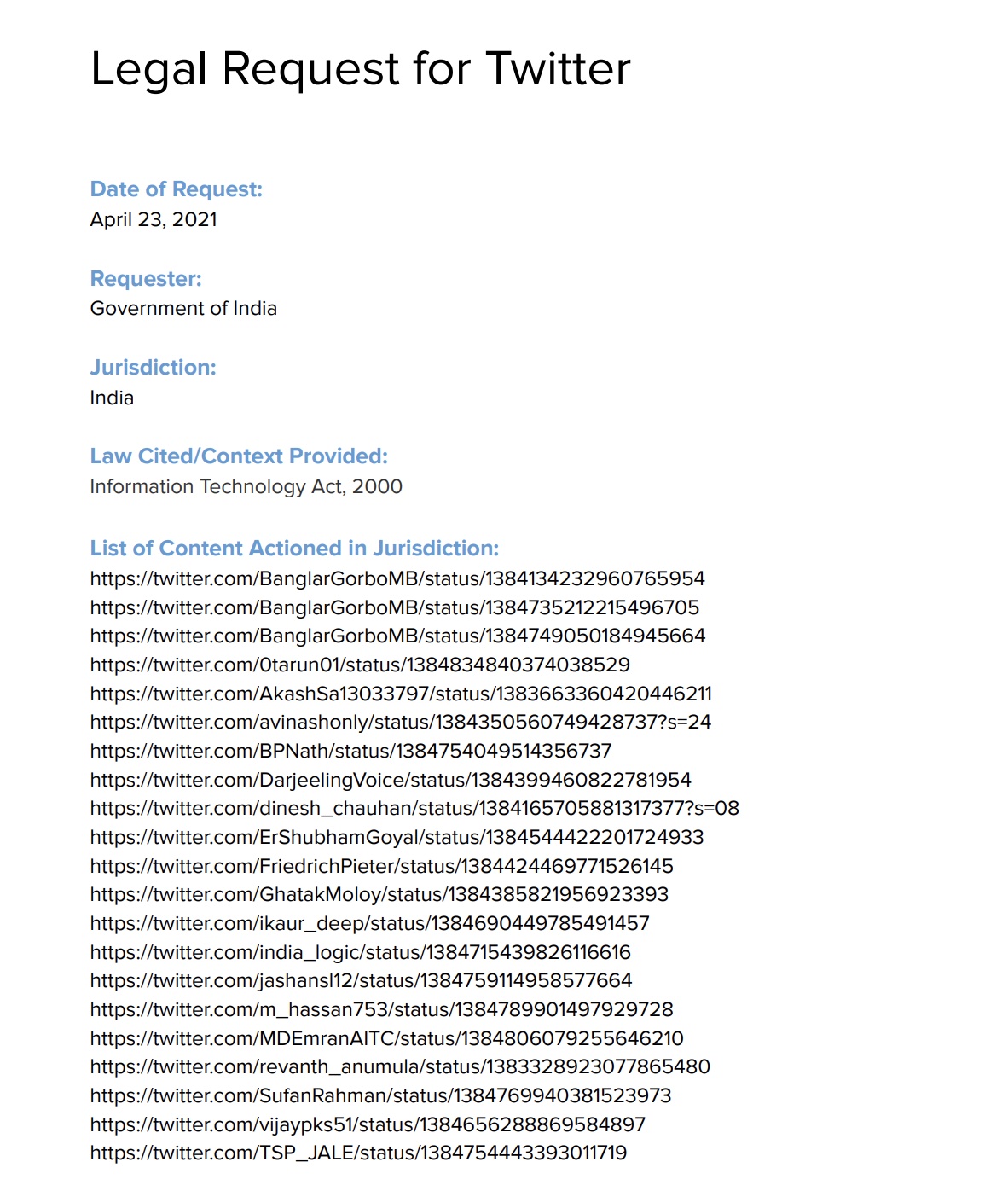
Twitter has taken down dozens of tweets in India, some of which were critical of New Delhi’s handling of the coronavirus, to comply with an emergency order from the Indian government.

New Delhi made an emergency order to Twitter to censor over 50 tweets in the country, Twitter disclosed on Lumen database. The social network has complied with the request, and withheld those tweets from users in India.

TechCrunch has learned that Twitter is not the only platform affected by the new order.

India, which has also previously ordered Twitter to take down some tweets and accounts critical of its policies and threatened jail time to employees in the event of non-compliance, comes as the country reports a record of over 330,000 new covid cases a day, the worst by any country. News reports suggest that even this number is underreported.

Amid a collapse of the nation’s health infrastructure, Twitter has become a rare beam of hope as people crowdsource data and help one another find medicines and oxygen cylinders.

A copy of one of Indian government’s orders disclosed by Twitter. (Lumen Database)

Medianama, which first reported on New Delhi’s new order, said among those whose tweets have been censored in India include Revanth Reddy (a Member of Parliament), Moloy Ghatak (a minister in West Bengal), Vineet Kumar Singh (actor) filmmakers Vinod Kapri and Avinash Das.

In a statement, a Twitter spokesperson said, “When we receive a valid legal request, we review it under both the Twitter Rules and local law. If the content violates Twitter’s Rules, the content will be removed from the service. If it is determined to be illegal in a particular jurisdiction, but not in violation of the Twitter Rules, we may withhold access to the content in India only. In all cases, we notify the account holder directly so they’re aware that we’ve received a legal order pertaining to the account.”

“We notify the user(s) by sending a message to the email address associated with the account(s), if available. Read more about our Legal request FAQs.  The legal requests that we receive are detailed in the bianual Twitter Transparency Report, and requests to withhold content are published on Lumen.”


from Social – TechCrunch https://ift.tt/32Lf5fC
via IFTTT

Filing: Snap paid $124M for Fit Analytics as it gears up for a bigger e-commerce push

Earlier this year we reported on how Snap had acquired Berlin-based Fit Analytics, an AI-based fitting technology startup, as part of a wider push into e-commerce services, specifically to gain technology that can help prospective online shoppers get a better sense of how a particular item or size would fit them. A 10-Q filing from Snap today has now put a price tag on that deal.

Snap paid a total of $124.4 million, covering technology, IP, customer relationships and payouts to the team. The filing also noted that Snap spent a total of $204.5 million on acquisitions in 2020, but did not break them out.

The news comes ahead of Snap — whose flagship app Snapchat now has 280 million daily active users — preparing for its Snap Partner Conference in May. Sources say the company plans to announce, among other news, deeper commerce features for Snapchat — specifically tools to make it easier for Snapchat users to interact with and buy items that appear in the app, either in ads or more organically in content shared by other users.

While the exact details of those commerce tools, and the timing of when they might come online, are not yet known, Snap has hardly kept its interest in commerce a secret.

Snap has been hiring for roles to support its commerce efforts. Currently it’s advertising for a variety of engineering, marketing and product roles in commerce, to, in the words of one of the listings, for a Product Manager, “develop and launch shopping experiences and services that make shopping fun for Snapchatters and drive results for brands.” The listings also include a role specifically to work on Snapchat-based e-commerce efforts for direct-to-consumer (D2C) businesses.

And it has been making other recent acquisitions in addition to Fit Analytics that also line up with that.

They have included Screenshop, an app that describes itself as “the first AI-back style lens,” which can identify shoppable items in photos and then build a custom catalog of similar products that you can buy (akin to “shop the look” features that you will have come across in fashion media). And it’s also acquired Ariel AI, which has built technology to quickly render people in 3D, technology that can be used in a diverse set of applications, from games to virtual try-ons of clothing, makeup or accessories.

Snap confirmed the Ariel acquisition to CNBC in January. And while Screenshop deal was first reported earlier this month by The Information, Snap has declined to comment on it, although we have found people who worked at the startup now working at Snap.

Both acquisitions closed in 2020, according to reports, meaning that they came out of that year’s $204.5 million acquisition run. (Snap also noted a smaller acquisition, for $7.6 million, in the most recent quarter, but it did not disclose any further details.)

Even before all this, Snap had been making smaller efforts and tests in commerce going back years, although none of them have tipped into mainstream efforts.

Among them, in 2018 it launched a Snap Store — but that so far has not progressed beyond selling merchandise based on Bitmoji characters. And work on a Gucci shoe campaign last year, where Snapchat users could try shoes on in AR and then buy them, was seen by some as its big step into commerce — “we’ve moved from pure entertainment and expanded the use-case. And so with brands, it’s a really exciting time, especially in fashion and beauty. The Snapchat camera is connecting brands to their audiences in new ways,” a Snapchat AR executive said at the time — but that also didn’t develop into much beyond a one-off effort.

But with the pandemic leading to a surge of shopping online, and technology continuing to improve, the iron may finally be hot here.

As we said around the Fit Analytics acquisition, the idea of diversifying Snapchat’s revenue streams by building in more commerce experiences makes a lot of sense.

It gives the company another revenue stream at a time when Apple is introducing changes that might well affect how advertising can run and be monetized in the future. (The company most recently posted average revenues per user of $2.74, a figure Wall Street will be hoping will grow, not shrink.) It also plays into the demographics that Snapchat targets, where younger consumers are using social media apps to discover, share and shop for goods.

And specifically in the case of fashion, building experiences to shop for items on Snapchat leans into the augmented reality, image-altering, hyper-visual technology that has become a well-known and much-used hallmark of Snapchat and its owner, self-titled “camera company” Snap.


from Social – TechCrunch https://ift.tt/3vk8uVV
via IFTTT

Engineered earworms on TikTok aren’t that far off from disinfo campaigns

Ever since I read this Bloomberg story about how songs are engineered to go viral on TikTok, I’ve had one thought in my head – if you can call it that – it’s more of a noise, or impression: 

AHHHHHHHHHHHHHHH

Yes, it’s the sound of internally screaming. Just when I thought I understood how deeply social media algorithms have hijacked our desires, tastes and preferences – WHAM! Another jab straight to the nose. I have to admit, I was blindsided by this one. It knocked me out.

Now, I understand that I work for a website called TechCrunch, emphasis on the tech, but if this story doesn’t make you feel at least a teensy bit like a Luddite, well, I don’t know what to tell you. You’re probably like that character in the Matrix, Cypher, who wants to be plugged in.

Is that harsh? I mean, companies are going to company, and partnerships with major record labels is a common sense move for a social media app all about honing the art of short, clever combinations of sound and video. And fair dues to the creators, many of them in college or high school, for jumping at the chance to make some money and get a little bit of fame.

But it’s probably not too harsh when you consider what else is possible when catchiness is weaponized. Here’s what we know: whether it’s internet memes or political slogans or Megan Thee Stallion’s Savage, what drives information dissemination is not the truthfulness of the content or the credibility of the speaker but 1) how easy it is to remember and 2) how quickly it sparks conversations. 

And would you look at that! Those are exactly the variables music producers optimize for today. What the Bloomberg story highlights, inadvertently or not, is how a #1 pop hit and a piece of political disinformation are not all that different, aesthetically. Everyone’s an entertainer.

Now read to the end of the Bloomberg story. Get to the part where it’s revealed that ByteDance (the Chinese company that owns TikTok), in response to threats of a U.S. ban on the app, recruited creators to orchestrate a seemingly grassroots lawsuit against the proposed ban. And I think: damn. Attention really is the most precious commodity in the world. And we’re just…giving it away.

(Cue the internal screams.)


from Social – TechCrunch https://ift.tt/3tRof6g
via IFTTT

Facebook launches a series tests to inform future changes to its News Feed algorithms

Facebook may be reconfiguring its News Feed algorithms. After being grilled by lawmakers about the role that Facebook played in the attack on the U.S. Capitol, the company announced this morning it will be rolling out a series of News Feed ranking tests that will ask users to provide feedback about the posts they’re seeing, which will later be incorporated into Facebook’s News Feed ranking process. Specifically, Facebook will be looking to learn which content people find inspirational, what content they want to see less of (like politics), and what other topics they’re generally interested in, among other things.

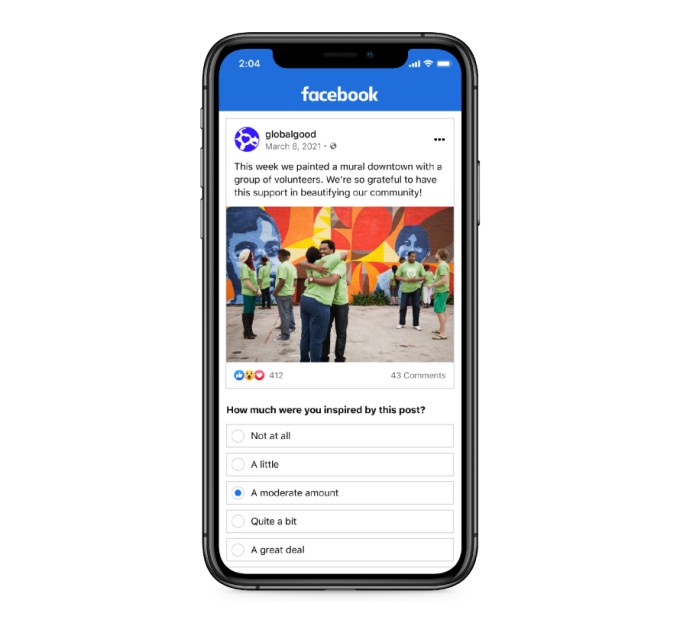
This will be done through a series of global tests, one of which will involve a survey directly beneath the post itself which asks, “how much were you inspired by this post?,” with the goal of helping to show more people posts of an inspirational nature closer at the top of the News Feed.

Image Credits: Facebook

Another test will work to the Facebook News Feed experience to reflect what people want to see. Today, Facebook prioritizes showing you content from friends, Groups and Pages you’ve chosen to follow, but it has algorithmically crafted an experience of whose posts to show you and when based on a variety of signals. This includes both implicit and explicit signals — like how much you engage with that person’s content (or Page or Group) on a regular basis, as well as whether you’ve added them as a “Close Friend” or “Favorite” indicating you want to see more of their content than others, for example.

However, just because you’re close to someone in real life, that doesn’t mean that you like what they post to Facebook. This has driven families and friends apart in recent years, as people discovered by way of social media how people they thought they knew really viewed the world. It’s been a painful reckoning for some. Facebook hasn’t managed to fix the problem, either. Today, users still scroll News Feeds that reinforce their views, no matter how problematic. And with the growing tide of misinformation, the News Feed has gone from just placing users into a filter bubble to presenting a full alternate reality for some, often populated by conspiracies theories.

Facebook’s third test doesn’t necessarily tackle this problem head-on, but instead looks to gain feedback about what users want to see, as a whole. Facebook says that it will begin asking people whether they want to see more or fewer posts on certain topics, like Cooking, Sports, or Politics, and more. Based on users’ collective feedback, Facebook will adjust its algorithms to show more content people say they’re interested in, and fewer posts about topics they don’t want to see.

The area of politics, specifically, has been an issue for Facebook. The social network for years has been charged with helping to fan the flames of political discourse, polarizing and radicalizing users through its algorithms, distributing misinformation at scale, and encouraging an ecosystem of divisive clickbait, as publishers sought engagement instead of fairness and balance when reporting the news. There are now entirely biased and subjective outlets posing as news sources who benefit from algorithms like Facebook’s, in fact.

Shortly after the Capitol attack, Facebook announced it would try clamping down on political content in the News Feed for a small percentage of people in the U.S., Canada, Brazil and Indonesia, for period of time during tests.

Now, the company says it will work to better understand what content is being linked negative News Feed experiences, including political content. In this case, Facebook may ask users on posts with a lot of negative reactions what sort of content they want to see less of.

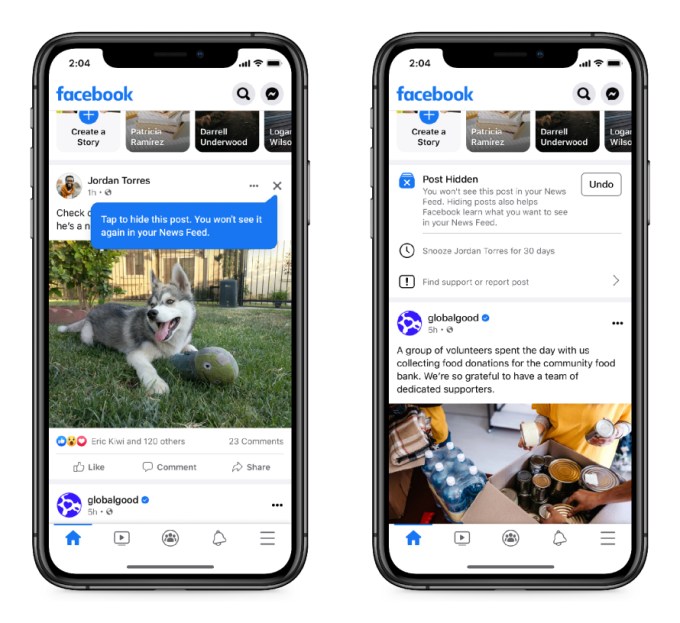
It will also more prominently feature the option to hide posts you find “irrelevant, problematic or irritating.” Although this feature existed before, you’ll now be able to tap an X in the upper-right corner of a post to hide it from the News Feed, if in the test group, and see fewer like in the future, for a more personalized experience.

It’s not clear that allowing users to pick and choose their topics is the best way to solve the larger problems with negative posts, divisive content or misinformation, though this test is less about the latter and more about making the News Feed “feel” more positive.

As the data is collected from the tests, Facebook will incorporate the learnings into its News Feed ranking algorithms. But it’s not clear to what extent it will be adjusting the algorithm on a global basis versus simply customizing the experience for end users on a more individual basis over time.

The company says the tests will run over the next few months.


from Social – TechCrunch https://ift.tt/3dIuZxu
via IFTTT