This is default featured slide 1 title

Go to Blogger edit html and find these sentences.Now replace these sentences with your own descriptions.This theme is Bloggerized by Lasantha Bandara - Premiumbloggertemplates.com.

This is default featured slide 2 title

Go to Blogger edit html and find these sentences.Now replace these sentences with your own descriptions.This theme is Bloggerized by Lasantha Bandara - Premiumbloggertemplates.com.

This is default featured slide 3 title

Go to Blogger edit html and find these sentences.Now replace these sentences with your own descriptions.This theme is Bloggerized by Lasantha Bandara - Premiumbloggertemplates.com.

This is default featured slide 4 title

Go to Blogger edit html and find these sentences.Now replace these sentences with your own descriptions.This theme is Bloggerized by Lasantha Bandara - Premiumbloggertemplates.com.

This is default featured slide 5 title

Go to Blogger edit html and find these sentences.Now replace these sentences with your own descriptions.This theme is Bloggerized by Lasantha Bandara - Premiumbloggertemplates.com.

Facebook’s Oversight Board throws the company a Trump-shaped curveball

Facebook’s controversial policy-setting supergroup issued its verdict on Trump’s fate Wednesday, and it wasn’t quite what most of us were expecting.

We’ll dig into the decision to tease out what it really means, not just for Trump, but also for Facebook’s broader experiment in outsourcing difficult content moderation decisions and for just how independent the board really is.

What did the Facebook Oversight Board decide?

The Oversight Board backed Facebook’s determination that Trump violated its policies on “Dangerous Individuals and Organizations,” which prohibits anything that praises or otherwise supports violence. The the full decision and accompanying policy recommendations are online for anyone to read.

Specifically, the Oversight Board ruled that two Trump posts, one telling Capitol rioters “We love you. You’re very special” and another calling them “great patriots” and telling them to “remember this day forever” broke Facebook’s rules. In fact, the board went as far as saying the pair of posts “severely” violated the rules in question, making it clear that the risk of real-world harm in Trump’s words was was crystal clear:

The Board found that, in maintaining an unfounded narrative of electoral fraud and persistent calls to action, Mr. Trump created an environment where a serious risk of violence was possible. At the time of Mr. Trump’s posts, there was a clear, immediate risk of harm and his words of support for those involved in the riots legitimized their violent actions. As president, Mr. Trump had a high level of influence. The reach of his posts was large, with 35 million followers on Facebook and 24 million on Instagram.”

While the Oversight Board praised Facebook’s decision to suspend Trump, it disagreed with the way the platform implemented the suspension. The group argued that Facebook’s decision to issue an “indefinite” suspension was an arbitrary punishment that wasn’t really supported by the company’s stated policies:

It is not permissible for Facebook to keep a user off the platform for an undefined period, with no criteria for when or whether the account will be restored.

In applying this penalty, Facebook did not follow a clear, published procedure. ‘Indefinite’ suspensions are not described in the company’s content policies. Facebook’s normal penalties include removing the violating content, imposing a time-bound period of suspension, or permanently disabling the page and account.”

The Oversight Board didn’t mince words on this point, going on to say that by putting a “vague, standardless” punishment in place and then kicking the ultimate decision to the Oversight Board, “Facebook seeks to avoid its responsibilities.” Turning things around, the board asserted that it’s actually Facebook’s responsibility to come up with an appropriate penalty for Trump that fits its set of content moderation rules.


Is this a surprise outcome?

If you’d asked me yesterday, I would have said that the Oversight Board was more likely to overturn Facebook’s Trump decision. I also called Wednesday’s big decision a win-win for Facebook, because whatever the outcome, it wouldn’t ultimately be criticized a second time for either letting Trump back onto the platform or kicking him off for good. So much for that!

A lot of us didn’t see the “straight up toss the ball back into Facebook’s court” option as a possible outcome. It’s ironic and surprising that the Oversight Board’s decision to give Facebook the final say actually makes the board look more independent, not less.

Facebook likely saw a more clear-cut decision on the Trump situation in the cards. This is a challenging outcome for a company that’s probably ready to move on from its (many, many) missteps during the Trump era. But there’s definitely an argument that if the board declared that Facebook made the wrong call and reinstated Trump that would have been a much bigger headache.

What does it mean that the Oversight Board sent the decision back to Facebook?

Ultimately the Oversight Board is asking Facebook to either a) give Trump’s suspension and end date or b) delete his account. In a less severe case, the normal course of action would be for Facebook to remove whatever broke the rules, but given the ramifications here and the fact that Trump is a repeat Facebook rule-breaker, this is obviously all well past that option.

What will Facebook do?

We’re in for a wait. The board called for Facebook to evaluate the Trump situation and reach a final decision within six months, calling for a “proportionate” response that is justified by its platform rules. Since Facebook and other social media companies are re-writing their rules all the time and making big calls on the fly, that gives the company a bit of time to build out policies that align with the actions it plans to take. See you again on November 5.

In the months following the violence at the U.S. Capitol, Facebook repeatedly defended its Trump call as “necessary and right.” It’s hard to imagine the company deciding that Trump will get reinstated six months from now, but in theory Facebook could decide that length of time was an appropriate punishment and write that into its rules. The fact that Twitter permanently banned Trump means that Facebook could comfortably follow suit at this point.

If Trump had won reelection, this whole thing probably would have gone down very differently. As much as Facebook likes to say its decisions are aligned with lofty ideals — absolute free speech, connecting people — the company is ultimately very attuned to its regulatory and political environment. Trump’s actions were on January 6 were dangerous and flagrant, but Biden’s looming inauguration two weeks later probably influenced the company’s decision just as much.

In direct response to the decision, Facebook’s Nick Clegg wrote only: “We will now consider the board’s decision and determine an action that is clear and proportionate.” Clegg says Trump will stay suspended until then but didn’t offer further hints at what comes next.

Did the board actually change anything?

Potentially. In its decision, the Oversight Board said that Facebook asked for “observations or recommendations from the Board about suspensions when the user is a political leader.” The board’s policy recommendations aren’t binding like its decisions are, but since Facebook asked, it’s likely to listen.

If it does, the Oversight Board’s recommendations could reshape how Facebook handles high profile accounts in the future:

The Board stated that it is not always useful to draw a firm distinction between political leaders and other influential users, recognizing that other users with large audiences can also contribute to serious risks of harm.

While the same rules should apply to all users, context matters when assessing the probability and imminence of harm. When posts by influential users pose a high probability of imminent harm, Facebook should act quickly to enforce its rules. Although Facebook explained that it did not apply its ‘newsworthiness’ allowance in this case, the Board called on Facebook to address widespread confusion about how decisions relating to influential users are made. The Board stressed that considerations of newsworthiness should not take priority when urgent action is needed to prevent significant harm.

Facebook and other social networks have hidden behind newsworthiness exemptions for years instead of making difficult policy calls that would upset half their users. Here, the board not only says that political leaders don’t really deserve special consideration while enforcing the rules, but that it’s much more important to take down content that could cause harm than it is to keep it online because it’s newsworthy.

So… we’re back to square one?

Yes and no. Trump’s suspension may still be up in the air, but the Oversight Board is modeled after a legal body and its real power is in setting precedents. The board kicked this case back to Facebook because the company picked a punishment for Trump that wasn’t even on the menu, not because it thought anything about his behavior fell in a gray area.

The Oversight Board clearly believed that Trump’s words of praise for rioters at the Capitol created a high stakes, dangerous threat on the platform. It’s easy to imagine the board reaching the same conclusion on Trump’s infamous “when the looting starts, the shooting starts” statement during the George Floyd protests, even though Facebook did nothing at the time. Still, the board stops short of saying that behavior like Trump’s merits a perma-ban — that much is up to Facebook.


from Social – TechCrunch https://ift.tt/2RtBls2
via IFTTT

Facebook launches Neighborhoods, a Nextdoor clone

Facebook is launching a new section of its app designed to connect neighbors and curate neighborhood-level news. The new feature, predictably called Neighborhoods, is available now in Canada and will be rolling out soon for U.S. users to test.

As we reported previously, Neighborhoods has technically been around since at least October of last year, but that limited test only recruited residents of Calgary, Canada.

On Neighborhoods, Facebook users can create a separate sub-profile and can populate it with interests and a custom bio. You can join your own lower-case neighborhood and nearby neighborhoods and complain about porch pirates, kids these days, or whatever you’d otherwise be doing on Nextdoor.

Aware of the intense moderation headaches on Nextdoor, Facebook says that it will have a set of moderators dedicated to Neighborhoods to will review comments and posts to keep matters “relevant and kind.” Within Neighborhoods neighborhoods, deputized users can steer and strike up conversations and do some light moderation, it sounds like. The new corner of Facebook will also come with blocking features.

As far as privacy goes, well, it’s Facebook. Neighborhoods isn’t its own standalone app and will naturally be sharing your neighborly behavior to serve you targeted ads elsewhere.


from Social – TechCrunch https://ift.tt/2R00v1v
via IFTTT

Twitter rolls out improved ‘reply prompts’ to cut down on harmful tweets

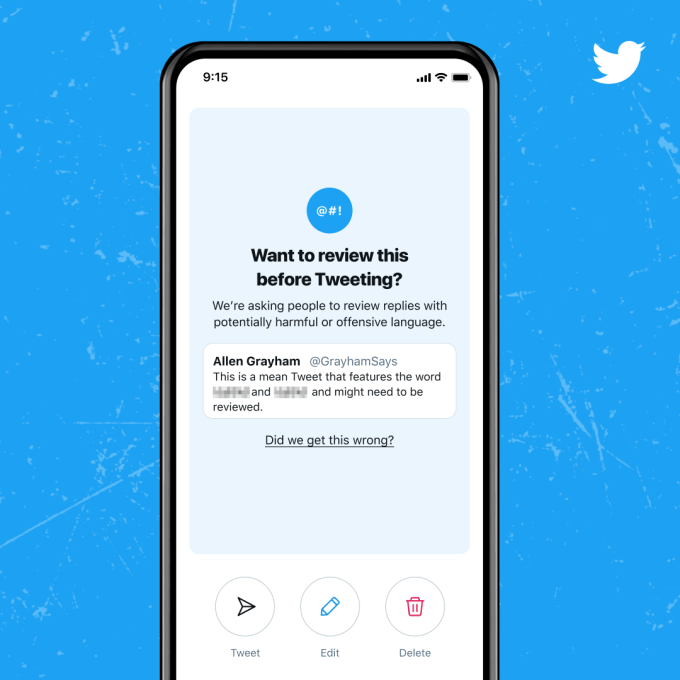
A year ago, Twitter began testing a feature that would prompt users to pause and reconsider before they replied to a tweet using “harmful” language — meaning language that was abusive, trolling, or otherwise offensive in nature. Today, the company says it’s rolling improved versions of these prompts to English-language users on iOS and soon, Android, after adjusting its systems that determine when to send the reminders to better understand when the language being used in the reply is actually harmful.

The idea behind these forced slow downs, or nudges, are about leveraging psychological tricks in order to help people make better decisions about what they post. Studies have indicated that introducing a nudge like this can lead people to edit and cancel posts they would have otherwise regretted.

Twitter’s own tests found that to be true, too. It said that 34% of people revised their initial reply after seeing the prompt, or chose not to send the reply at all. And, after being prompted once, people then composed 11% fewer offensive replies in the future, on average. That indicates that the prompt, for some small group at least, had a lasting impact on user behavior. (Twitter also found that users who were prompted were less likely to receive harmful replies back, but didn’t further quantify this metric.)

Image Credits: Twitter

However, Twitter’s early tests ran into some problems. it found its systems and algorithms sometimes struggled to understand the nuance that occurs in many conversations. For example, it couldn’t always differentiate between offensive replies and sarcasm or, sometimes, even friendly banter. It also struggled to account for those situations in which language is being reclaimed by underrepresented communities, and then used in non-harmful ways.

The improvements rolling out starting today aim to address these problems. Twitter says it’s made adjustments to the technology across these areas, and others. Now, it will take the relationship between the author and replier into consideration. That is, if both follow and reply to each other often, it’s more likely they have a better understanding of the preferred tone of communication than someone else who doesn’t.

Twitter says it has also improved the technology to more accurately detect strong language, including profanity.

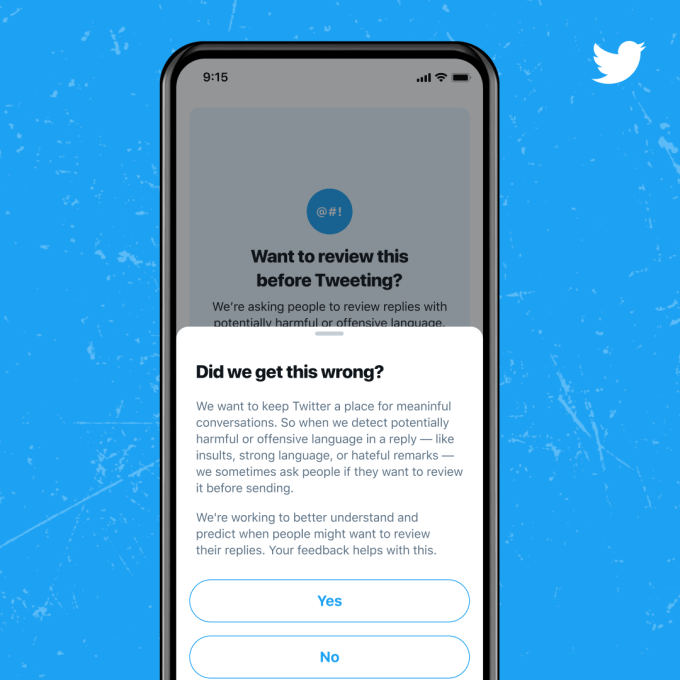
And it’s made it easier for those who see the prompts to let Twitter know if the prompt was helpful or relevant — data that can help to improve the systems further.

How well this all works remains to be seen, of course.

Image Credits: Twitter

While any feature that can help dial down some of the toxicity on Twitter may be useful, this only addresses one aspect of the larger problem — people who get into heated exchanges that they could later regret. There are other issues across Twitter regarding abusive and toxic content that this solution alone can’t address.

These “reply prompts” aren’t the only time Twitter has used the concept of nudges to impact user behavior. It also reminds users to read an article before you retweet and amplify it in an effort to promote more informed discussions on its platform.

Twitter says the improved prompts are rolling out to all English-language users on iOS starting today, and will reach Android over the next few days.


from Social – TechCrunch https://ift.tt/3h7Mh9w
via IFTTT

Facebook’s hand-picked ‘oversight’ panel upholds Trump ban — for now

Facebook’s content decision review body, a quasi-external panel that’s been likened to a ‘Supreme Court of Facebook’ but isn’t staffed by sitting judges, can’t be truly independent of the tech giant which funds it, has no legal legitimacy or democratic accountability, and goes by the much duller official title ‘Oversight Board’ (aka the FOB) — has just made the biggest call of its short life…

Facebook’s hand-picked ‘oversight’ panel has voted against reinstating former U.S. president Donald Trump’s Facebook account.

However it has sought to row the company back from an ‘indefinite’ ban — finding fault with its decision to impose an indefinite restriction, rather than issue a more standard penalty (such as a penalty strike or permanent account closure).

In a press release announcing its decision the board writes:

“Given the seriousness of the violations and the ongoing risk of violence, Facebook was justified in suspending Mr. Trump’s accounts on January 6 and extending that suspension on January 7.

However, it was not appropriate for Facebook to impose an ‘indefinite’ suspension.

It is not permissible for Facebook to keep a user off the platform for an undefined period, with no criteria for when or whether the account will be restored.”

The board wants Facebook to revision its decision on Trump’s account within six months — and “decide the appropriate penalty”. So it appears to have succeeded in… kicking the can down the road.

The FOB is due to hold a press conference to discuss its decision shortly so stay tuned for updates.

This story is developing… refresh for updates…

It’s certainly been a very quiet five months on mainstream social media since Trump had his social media ALL CAPS megaphone unceremoniously shut down in the wake of his supporters’ violent storming of the capital.

For more on the background to Trump’s deplatforming do make time for this excellent explainer by TechCrunch’s Taylor Hatmaker. But the short version is that Trump finally appeared to have torched the last of his social media rule-breaking chances after he succeeded in fomenting an actual insurrection on U.S. soil on January 6. Doing so with the help of the massive, mainstream social media platforms whose community standards don’t, as a rule, give a thumbs up to violent insurrection…


from Social – TechCrunch https://ift.tt/3h3GcLq
via IFTTT

For Trump and Facebook, judgment day is around the corner

Facebook unceremoniously confiscated Trump’s biggest social media megaphone months ago, but the former president might be poised to snatch it back.

Facebook’s Oversight Board, an external Supreme Court-like policy decision making group, will either restore Trump’s Facebook privileges or banish him forever on Wednesday. Whatever happens, it’s a huge moment for Facebook’s nascent experiment in outsourcing hard content moderation calls to an elite group of global thinkers, academics and political figures and allowing them to set precedents that could shape the world’s biggest social networks for years to come.

Facebook CEO Mark Zuckerberg announced Trump’s suspension from Facebook in the immediate aftermath of the Capitol attack. It was initially a temporary suspension, but two weeks later Facebook said that the decision would be sent to the Oversight Board. “We believe the risks of allowing the President to continue to use our service during this period are simply too great,” Facebook CEO Mark Zuckerberg wrote in January.

Facebook’s VP of Global Affairs Nick Clegg, a former British politician, expressed hope that the board would back the company’s own conclusions, calling Trump’s suspension an “unprecedented set of events which called for unprecedented action.”

Trump inflamed tensions and incited violence on January 6, but that incident wasn’t without precedent. In the aftermath of the murder of George Floyd, an unarmed Black man killed by Minneapolis police, President Trump ominously declared on social media “when the looting starts, the shooting starts,” a threat of imminent violence with racist roots that Facebook declined to take action against, prompting internal protests at the company.

The former president skirted or crossed the line with Facebook any number of times over his four years in office, but the platform stood steadfastly behind a maxim that all speech was good speech, even as other social networks grew more squeamish.

In a dramatic address in late 2019, Zuckerberg evoked Martin Luther King Jr. as he defended Facebook’s anything goes approach. “In times of social turmoil, our impulse is often to pull back on free expression,” Zuckerberg said. “We want the progress that comes from free expression, but not the tension.” King’s daughter strenuously objected.

A little over a year later, with all of Facebook’s peers doing the same and Trump leaving office, Zuckerberg would shrink back from his grand free speech declarations.

In 2019 and well into 2020, Facebook was still a roiling hotbed of misinformation, conspiracies and extremism. The social network hosted thousands of armed militias organizing for violence and a sea of content amplifying QAnon, which moved from a fringe belief on the margins to a mainstream political phenomenon through Facebook.

Those same forces would converge at the U.S. Capitol on January 6 for a day of violence that Facebook executives characterized as spontaneous, even though it had been festering openly on the platform for months.


How the Oversight Board works

Facebook’s Oversight Board began reviewing its first cases last October. Facebook can refer cases to the board, like it did with Trump, but users can also appeal to the board to overturn policy decisions that affect them after they exhaust the normal Facebook or Instagram appeals process. A five member subset of its 20 total members evaluate whether content should be allowed to remain on the platform and then reach a decision, which the full board must approve by a majority vote. Initially, the Oversight Board was only empowered to reinstate content removed on Facebook and Instagram, but in mid-April began accepting requests to review controversial content that stayed up.

Last month, the Oversight Board replaced departing member Pamela Karlan, a Stanford professor and voting rights scholar critical of Trump, who left to join the Biden administration. Karlan’s replacement, PEN America CEO Susan Nossel, wrote an op-ed in the LA Times in late January arguing that extending a permanent ban on Trump “may feel good” but that decision would ultimately set a dangerous precedent. Nossel joined the board too late to participate in the Trump decision.

The Oversight Board’s earliest batch of decisions leaned in the direction of restoring content that’s been taken down — not upholding its removal. While the board’s other decisions are likely to touch on the full spectrum of frustration people have with Facebook’s content moderation preferences, they come with far less baggage than the Trump decision. In one instance, the Oversight Board voted to restore an image of a woman’s nipples used in the context of a breast cancer post. In another, the board decided that a quote from a famous Nazi didn’t merit removal because it wasn’t an endorsement of Nazi ideology. In all cases, the Oversight Board can issue policy recommendations, but Facebook isn’t obligated to implement them — just the decisions.

Befitting its DNA of global activists, political figures and academics, the Oversight Board’s might have ambitions well beyond one social network. Earlier this year, Oversight Board co-chair and former Prime Minister of Denmark Helle Thorning-Schmidt declared that other social media companies would be “welcome to join” the project, which is branded in a conspicuously Facebook-less way. (The group calls itself the “Oversight Board” though everyone calls it the “Facebook Oversight Board.”)

“For the first time in history, we actually have content moderation being done outside one of the big social media platforms,” Thorning-Schmidt declared, grandly. “That in itself… I don’t hesitate to call it historic.”

Facebook’s decision to outsource some major policy decisions is indeed an experimental one, but that experiment is just getting started. The Trump case will give Facebook’s miniaturized Supreme Court an opportunity to send a message, though whether the takeaway is that it’s powerful enough to keep a world leader muzzled or independent enough to strike out from its parent and reverse the biggest social media policy decision ever made remains to be seen.

If Trump comes back, the company can shrug its shoulders and shirk another PR firestorm, content that its experiment in external content moderation is legitimized. If the board doubles down on banishing Trump, Facebook will rest easy knowing that someone else can take the blowback this round in its most controversial content call to date. For Facebook, for once, it’s a win-win situation.


from Social – TechCrunch https://ift.tt/3vGoBwZ
via IFTTT

Instagram adds a captions option for Stories and soon, Reels

Instagram is making its video Stories and Reels more accessible with the launch of a new “captions sticker” that will allow users to watch without having the sound on. The addition will not only make it easier for users who are hard of hearing or deaf to engage with video content, it also offers a way for users to watch videos when they’re somewhere they don’t want to have their sound on — and either don’t want to wear or don’t have access headphones or earbuds.

To use the feature, creators will first record a new video using the Stories or Reels Camera in the Instagram app, or select a video to upload from their phone’s gallery. Then, you’ll open the sticker tray and look for the new “Captions” sticker, which will convert your speech to text. You can also edit the style, position of the caption, and the text and color so it matches your content. When you post, the captions will appear alongside your video for everyone to see.

At launch, the feature is only available in English and in English-speaking countries, but Instagram plans to roll it out to other countries and languages soon, it says. It’s also rolling out the captions sticker first to Stories and will then begin testing it in Reels, with a broader launch to follow.

The captions sticker had been spotted last year while in development, alongside other potential new additions, like a Collab sticker, Link sticker, Reshare sticker, and others. Instagram parent Facebook also appears to have a captions sticker of its own in development. The sticker then began testing earlier this spring with some number of Instagram users.

The addition comes only weeks after TikTok announced its own captions feature, which it calls auto captions. The two products are somewhat different, however. Auto captions automatically translate the speech from a TikTok video in either American English and Japanese, to start, but the text itself isn’t customizable and can be turned on or off by the viewer from the app’s share panel. It also hasn’t yet been broadly adopted and many TikTok creators tend to still use captions they create themselves or via third-party apps.

Instagram notes it had previously launched support for captions across Threads and IGTV, but its expansion to Stories and Reels will make more of an impact, given that instagram Stories alone is used by over 500 million people every day.


from Social – TechCrunch https://ift.tt/2ShBTBG
via IFTTT

Twitter acquires distraction-free reading service Scroll to beef up its subscription product

Twitter this morning announced it’s acquiring Scroll, a subscription service that offers readers a better way to read through long-form content on the web, by removing ads and other website clutter that can slow down the experience. The service will become a part of Twitter’s larger plans to invest in subscriptions, the company says, and will later be offered as one of the premium features Twitter will provide to subscribers.

Premium subscribers will be able to use Scroll to easily read their articles from news outlets and from Twitter’s own newsletters product, Revue, another recent acquisition that’s already been integrated into Twitter’s service. When subscribers use Scroll through Twitter, a portion of their subscription revenue would go to support the publishers and the writers creating the content, explains Twitter in an announcement.

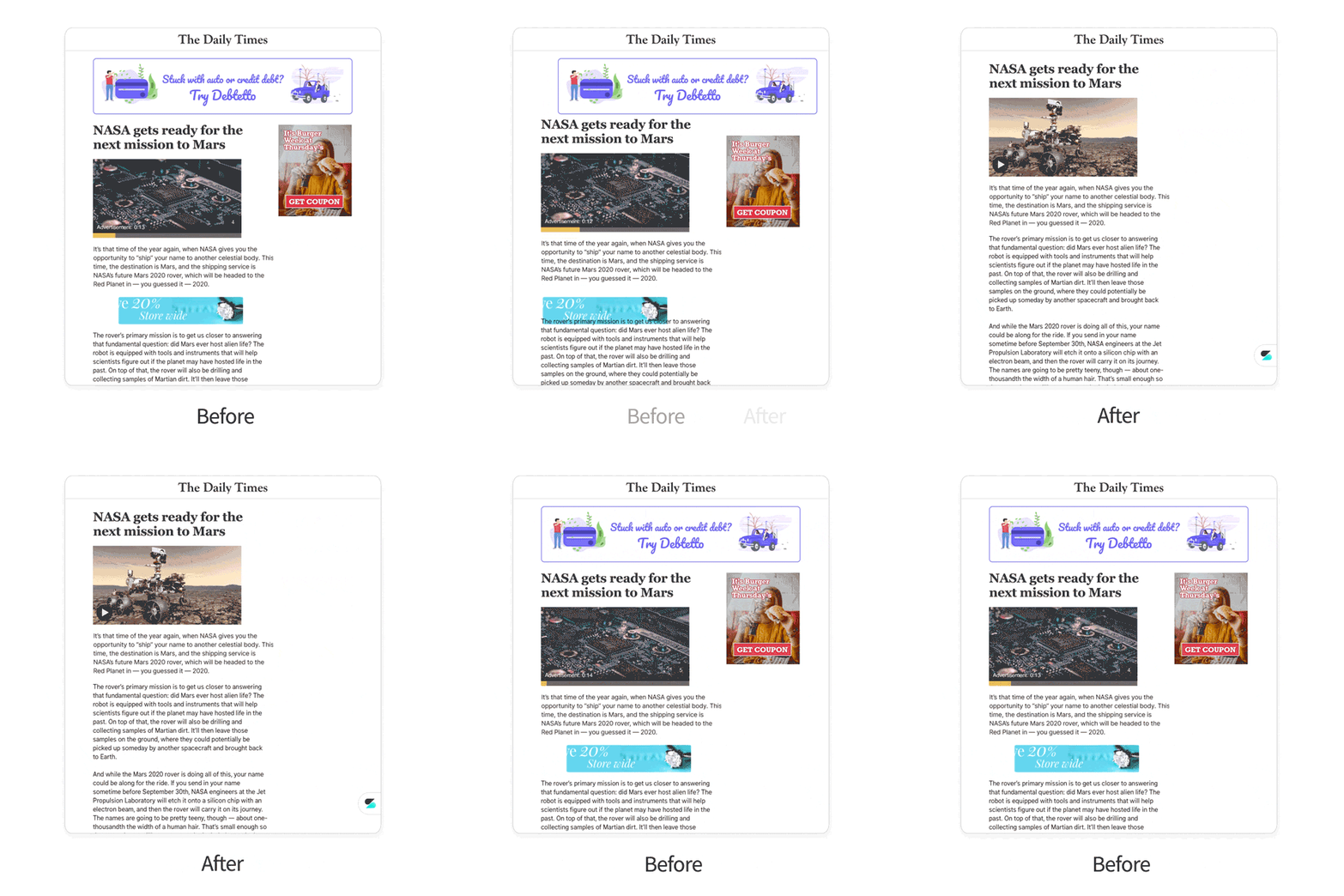
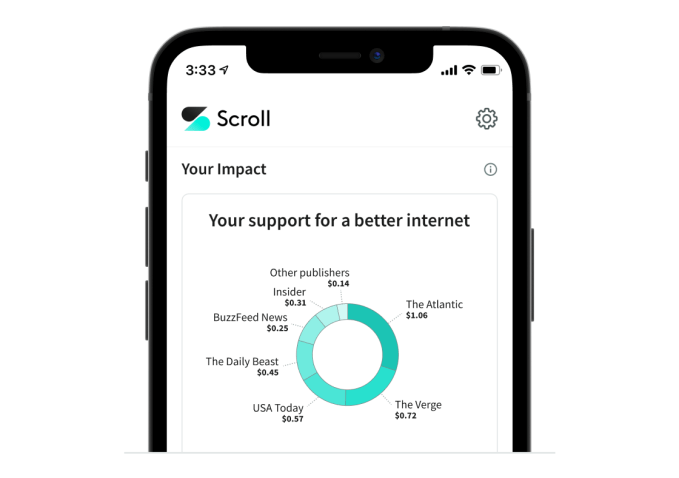
Scroll’s service today works across hundreds of sites, including The Atlantic, The Verge, USA Today, The Sacramento Bee, The Philadelphia Inquirer and The Daily Beast, among others. For readers, the experience of using Scroll is similar to that of a “reader view” — ads, trackers, and other website junk is stripped so readers can focus on the content.

Image Credits: Twitter

Scroll’s pitch to publishers has been that it can end up delivering cleaner content that can make them more money than advertising alone.

Deal terms were not disclosed, but Twitter will be bringing on the entire Scroll team, totalling 13 people.

For the time being, Scroll will pause new customer sign-ups so it can focus on integrating its product into Twitter’s subscriptions work and prepare for the expected growth. It will, however, continue to onboard new publishers who want to participate in Scroll’s network, following the deal’s closure.

And Scroll itself will be headed back into private beta as the team works to integrate the product into Twitter.

Image Credits: Twitter

Twitter says it will also be winding down Scroll’s news aggregator Nuzzel product, but will work to bring some of Nuzzel’s core elements to Twitter over time.

“Twitter exists to serve the public conversation. Journalism is the mitochondria of that conversation. It initiates, energizes and informs. It converts and confounds perspectives. At its best it helps us stand in one another’s shoes and understand each other’s common humanity,” said Tony Haile, Scroll CEO, in the company’s post about Scroll’s acquisition.

“The mission we’ve been given by Jack and the Twitter team is simple: take the model and platform that Scroll has built and scale it so that everyone who uses Twitter has the opportunity to experience an internet without friction and frustration, a great gathering of people who love the news and pay to sustainably support it,” he added.

Twitter earlier this year detailed its plans to head into subscriptions, as a way to diversify beyond ad revenue for its own business. The company unveiled what it’s calling “Super Follow,” a creator-focused subscription that would give paid subscribers access to an expanded array of perks, like exclusive content, subscriber-only newsletters, deals, badges, paywalled media, and more. The company is aiming to use this new product to help it achieve its goal of doubling company revenue from $3.7 billion in 2020 to $7.5 billion or more in 2023, it said.


from Social – TechCrunch https://ift.tt/3h1Imef
via IFTTT