This is default featured slide 1 title

Go to Blogger edit html and find these sentences.Now replace these sentences with your own descriptions.This theme is Bloggerized by Lasantha Bandara - Premiumbloggertemplates.com.

This is default featured slide 2 title

Go to Blogger edit html and find these sentences.Now replace these sentences with your own descriptions.This theme is Bloggerized by Lasantha Bandara - Premiumbloggertemplates.com.

This is default featured slide 3 title

Go to Blogger edit html and find these sentences.Now replace these sentences with your own descriptions.This theme is Bloggerized by Lasantha Bandara - Premiumbloggertemplates.com.

This is default featured slide 4 title

Go to Blogger edit html and find these sentences.Now replace these sentences with your own descriptions.This theme is Bloggerized by Lasantha Bandara - Premiumbloggertemplates.com.

This is default featured slide 5 title

Go to Blogger edit html and find these sentences.Now replace these sentences with your own descriptions.This theme is Bloggerized by Lasantha Bandara - Premiumbloggertemplates.com.

Nextdoor’s SPAC investor deck paints a picture of sizable scale and sticky users

The SPAC parade continues in this shortened week with news that community social network Nextdoor will go public via a blank-check company. The unicorn will merge with Khosla Ventures Acquisition Co. II, taking itself public and raising capital at the same time.

Per the former startup, the transaction with the Khosla-affiliated SPAC will generate gross proceeds of around $686 million, inclusive of a $270 million private investment in public equity, or PIPE, which is being funded by a collection of capital pools, some prior Nextdoor investors (including Tiger), Nextdoor CEO Sarah Friar and Khosla Ventures itself.

Notably, Khosla is not a listed investor in the company per Crunchbase or PitchBook, indicating that even SPACs formed by venture capital firms can hunt for deals outside their parent’s portfolio.

Per a Nextdoor release, the transaction will value the company at a “pro forma equity [valuation] of approximately $4.3 billion.” That’s a great price for the firm that was most recently valued at $2.17 billion in a late 2019-era Series H worth $170 million, per PitchBook data. Those funds were invested at a flat $2.0 billion pre-money valuation.

So, what will public investors get the chance to buy into at the new, higher price? To answer that we’ll have to turn to the company’s SPAC investor deck.

Our general observations are that while Nextdoor’s SPAC deck does have some regular annoyances, it offers are clear-eyed look at the company’s financial performance both in historical terms and in terms of what it might accomplish in the future. Our usual mockery of SPAC charts mostly doesn’t apply. Let’s begin.

Nextdoor’s SPAC pitch

We’ll proceed through the deck in its original slide order to better understand the company’s argument for its value today, as well as its future worth.

The company kicks off with a note that it has 27 million weekly active users (neighbors, in its own parlance), and claims users in around one in three U.S. households. The argument, then, is that Nextdoor has scale.

A few slides later, Nextdoor details its mission: “To cultivate a kinder world where everyone has a neighborhood they can rely on.” While accounts like @BestOfNextdoor might make this mission statement as coherent as ExxonMobil saying that its core purpose was, say, atmospheric carbon reduction, we have to take it seriously. The company wants to bring people together. It can’t control what they do from there, as we’ve all seen. But the fact that rude people on Nextdoor is a meme stems from the same scale that the company was just crowing about.

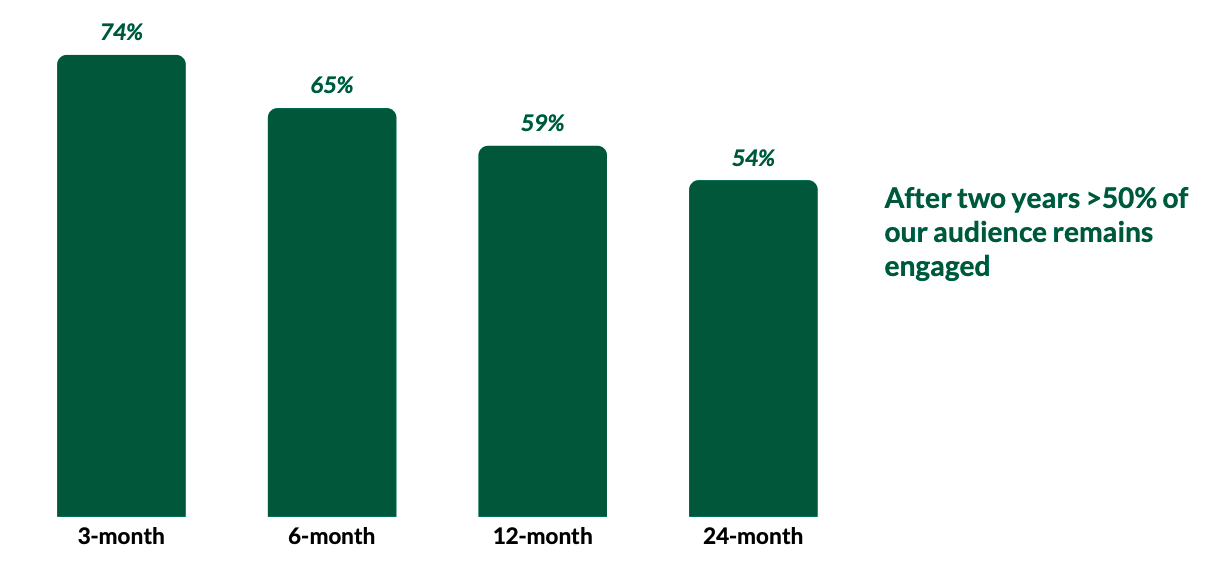
Underscoring its active user counts are Nextdoor’s retention figures. Here’s how it describes that metric:

Image Credits: Nextdoor SPAC investor deck

These are monthly active users, mind, not weekly active, the figure that the company cited up top. So, the metrics are looser here. And the company is counting users as active if they have “started a session or opened a content email over the trailing 30 days.” How conservative is that metric? We’ll leave that for you to decide.

The company’s argument for its value continues in the following slide, with Nextdoor noting that users become more active as more people use the service in a neighborhood. This feels obvious, though it is nice, we suppose, to see the company codify our expectations in data.

Nextdoor then argues that its user base is distinct from that of other social networks and that its users are about as active as those on Twitter, albeit less active than on the major U.S. social networks (Facebook, Snap, Instagram).

Why go through the exercise of sorting Nextdoor into a cabal of social networks? Well, here’s why:


from Social – TechCrunch https://ift.tt/3yrAAjs
via IFTTT

Twitter has lost liability protection in India, government says

Twitter no longer enjoys the liability protection against user-generated content in India, the government said in a court filing this week as tension escalates between the two over the South Asian nation’s new IT rules.

In a court filing on Monday, New Delhi said Twitter has lost its immunity in India after the American social network failed to comply with the new local IT rules, which was unveiled in February and went into effect in late May.

Experts have said in recent weeks that the Indian court — and not the Indian government — holds the power to decide whether Twitter gets to keep its safe harbor protections in the world’s second largest internet market.

“I state the immunity conferred on intermediaries under section 79(1) is a conditional immunity subject to the intermediary satisfying the conditions under sections 79(2) and 79(3). As provided in Rule 7, failure to observe the IT Rules 2021 results in provisions of Section 79(1) of the IT Act, 2000 not being applicable to such an intermediary,” N Samaya Balan of Ministry of Electronics and Information Technology wrote in the filing.

The move comes as tension escalates between the Indian government and Twitter. Google, Facebook, and several other firms have partially or fully complied with the IT rules, which among other things, requires any significant social media firm (any firm with over 5 million users in India) to appoint a chief compliant officer, a resident grievance officer, and a so-called nodal contact person to address on-ground concerns.

Twitter has not complied with any of these requirements, the court filing said. Twitter had no comment on Monday’s filing, but has said in the past that it intends to comply with the IT rules.

“All social media platforms are welcome to do business in India. They can criticize Ravi Shankar Prasad, my Prime Minister or anyone. The issue is of misuse of social media. Some of them say we are bound by American laws. You operate in India, make good money, but you will take the position that you’ll be governed by American laws. This is plainly not acceptable,” India’s IT Minister Ravi Shankar Prasad said in a conference last week.

With the liability protection stripped off, Twitter executives in India could face several criminal charges over content deemed objectionable on the platform. Indian police have already filed at least five cases against the company or its officials in the country over a range of issues.

A special squad of Delhi police made a surprise visit to two of Twitter’s offices in late May in what many perceived as an intimidation tactic. Twitter said at the time that it was “concerned by recent events regarding our employees in India and the potential threat to freedom of expression for the people we serve” and requested the Indian government to grant it three additional months to comply with the new IT rules.

WhatsApp, too, hasn’t fully complied with the new IT rules. The IT rules also mandate operators of encrypted messaging apps to introduce a way for the law enforcement to be able to “trace” the originator of objectionable messages. WhatsApp, which has amassed over 530 million users in India, sued the Indian government in May over this requirement, saying making “traceability” possible would violate citizens’ constitutional right to privacy.

Signal has also reportedly not complied with the traceability requirement. The messaging service didn’t respond to a request for comment. It’s unclear whether Apple, which has tens of millions of Messages / iMessage users in India, has complied with the traceability requirement. It declined to comment.


from Social – TechCrunch https://ift.tt/3ywvVgh
via IFTTT

This week in growth marketing on TechCrunch

TechCrunch is trying to help you find the best growth marketer to work with through founder recommendations that we get in this survey. We’re sharing a few of our favorites so far, below.

We’re using your recommendations to find top experts to interview and have them write their own columns here. This week we talked to Kathleen Estreich and Emily Kramer of new growth advising firm MKT1 and veteran designer Scott Tong, and published a pair of articles by growth marketing agency Demand Curve.

Demand Curve: Email marketing tactics that convert subscribers into customers Growth marketing firm Demand Curve shares their approaches to subject line length, the three outcomes of an email and how to optimize your format for each outcome.

(Extra Crunch) Demand Curve: 7 ad types that increase click-through rates The growth marketing agency tells us how to use customer reactions and testimonials, and other ads types to a startup’s advantage.

MKT1: Developer marketing is what startup marketing should look like MKT1, co-founded by Kathleen Estreich, previously at Facebook, Box, Intercom and Scalyr, and Emily Kramer, previously at Ticketfly, Asana, Astro and Carta, tell us about the importance of finding the right marketer at the right time, and the biggest mistakes founders are still making in 2021.

The pandemic showed why product and brand design need to sit together Scott Tong shares the importance of understanding users and his thoughts on how companies manage to work together collaboratively in a remote world.

(Extra Crunch) 79% more leads without more traffic: Here’s how we did it — Conversion rate optimization expert Jasper Kuria shared a detailed case study deconstructing the CRO techniques he used to boost conversion rates by nearly 80% for China Expat Health, a lead generation company.

This week’s recommended growth marketers

As always, if you have a top-tier marketer that you think we should know about, tell us!

Marketer: Dipti Parmar
Recommended by: Brody Dorland, co-founder, DivvyHQ
Testimonial: “She gave me an easy-to-implement plan to start with clear outcomes and timeline. She delivered it within one month and I was able to see the results in a couple of months. This encouraged me to hand over bigger parts of our content strategy and publishing to her.”

Marketer: Amy Konefal (Closed Loop)
Recommended by: Dan Reardon, Vudu
Testimonial: “Amy drove scale for us as we grew to a half-billion-dollar company. She identified and exploited efficiencies and built out a rich portfolio of channels.”

Marketer: Karl Hughes (draft.dev)
Recommended by: Joshua Shulman, Bitmovin.com
Testimonial: “Karl is incredibly knowledgeable in the field of content and growth marketing to a large (and equally niche) target audience of developers. He and his team at Draft.dev are some of the best at “developer marketing,” which is a greatly underrated target audience.”

Marketer: Ladder
Recommended by: Anonymous
Testimonial: “They really get what I need. By testing different messaging on different personas, we discover what works and what doesn’t to better understand our users and prospects. This is gold for a company at our stage. Showing those results to our investors blew their minds.”


from Social – TechCrunch https://ift.tt/3wdyZMO
via IFTTT

Extra Crunch roundup: CEO Twitter etiquette, lifting click-through rates, edtech avalanche

Yesterday, China ordered ride-hailing company Didi to stop signing up new customers after regulators announced a cybersecurity review of the company’s operations.

As of this writing, Didi’s stock price is down 5.3%. In today’s edition of The Exchange, Alex Wilhelm suggested that the move wasn’t a complete surprise, but it still “puts a bad taste in our mouths,” since the company went public days ago.


Full Extra Crunch articles are only available to members.
Use discount code ECFriday to save 20% off a one- or two-year subscription.


When Didi filed to go public, it listed several potential pitfalls facing Chinese companies that go public in the U.S., including “numerous legal and regulatory risks” and “extensive government regulation and oversight in its F-1.”

What does this news signify for other Chinese companies that are hoping for stateside IPOs?

We’ll be off on Monday, July 5 in observance of Independence Day. Thanks very much for reading, and I hope you have an excellent weekend.

Walter Thompson
Senior Editor, TechCrunch
@yourprotagonist

3 guiding principles for CEOs who post on Twitter

Did you hear about the CEO who made misleading claims about a funding round and got sued? How about that pharmaceutical executive whose taunts to a former Secretary of State led to a 4.4% decline in the Nasdaq Biotechnology Index?

In case it isn’t clear: Startup executives are held to a higher standard when it comes to what they post on social media.

“Reputation and goodwill take a long time to build and are difficult to maintain, but it only takes one tweet to destroy it all,” says Lisa W. Liu, a senior partner at The Mitzel Group, a San Francisco-based law practice that serves many startups.

To help her clients (and Extra Crunch readers) Liu has six basic questions for tech execs with itchy Twitter fingers.

And if the answer to any of them is “I don’t know,” don’t post.

The 2021 edtech avalanche has just begun

A report from Brighteye Ventures on Europe’s edtech scene shows that this year’s deal flow is on pace to meet or surpass 2020, when remote instruction exploded.

According to Brighteye’s head of Research, Rhys Spence, the average deal size is now $9.4 million, a threefold increase from last year. Still, “It’s interesting that we are not seeing enormous increases in deal count,” he noted.

How Robinhood’s explosive growth rate came to be

jagged line written by robinhood quill logo on graph background

Image Credits: TechCrunch

Trading platform Robinhood has attracted enough users and activity to change the conversation around retail investing — economists will likely be discussing the 2021 GameStop saga for years to come.

After the company filed to go public yesterday, Alex Wilhelm sorted through Robinhood’s main income statement to better understand how it scaled year-ago revenue from $127.6 million to $522.2 million in Q1.

“Those are numbers that we frankly do not see often amongst companies going public,” says Alex. “300% growth is a pre-Series A metric, usually.”

So: where is all that revenue coming from?

As EU venture capital soars, will the region retain future IPOs?

Given the valuation gap between U.S. tech markets and those overseas, it’s easy to see why some foreign startups would head to our shores when it’s time to go public.

But Anna Heim and Alex Wilhelm found that a record increase in European venture capital activity is picking up the pace of IPOs this year, and many of these companies are content to go public in their native markets.

To gain some insight into where European investors believe they have an advantage, Anna and Alex interviewed:

  • Franck Sebag, partner, EY
  • David Miranda, partner, Osborne Clarke Spain
  • Yoram Wijngaarde, founder and CEO, Dealroom

How VCs can get the most out of co-investing alongside LPs

A red and a green shoe tied together

Image Credits: Diana Ilieva (opens in a new window) / Getty Images

In a recent private equity survey, 80% of respondents said their co-investments with people outside traditional VC firms outperformed their PE fund investments.

Alternative investors are highly motivated, and because they’re seeking higher returns than are generally available in public markets, they are less daunted by risk. In return, they benefit from less expensive fee structures and develop close ties with VCs, enlarging the talent pool as they build investment skills.

These relationships have direct benefits for VCs as well, such as more flexibility with diversification and consolidated decision-making power.

“With the right deal structure, deal selection and deal investigation, co-investors can significantly increase their returns,” says C5 Capital Managing Partner William Kilmer, who wrote an Extra Crunch post for VCs considering an alternative path.

Dear Sophie: How can I bring my parents and sister to the U.S.?

lone figure at entrance to maze hedge that has an American flag at the center

Image Credits: Bryce Durbin/TechCrunch

Dear Sophie,

My husband and I are both U.S. permanent residents.

Given what we’ve gone through this past year being isolated from loved ones during the pandemic, we’d like to bring my parents and my sister to the U.S. to be close to our family and help out with our children.

Is that possible?

— Symbiotic in Sunnyvale

How to cut through the promotional haze and select a digital building platform

Modern city buildings on a printed circuits board. Digital illustration.

Image Credits: Andreus (opens in a new window) / Getty Images

Smart-building products include everything from connecting landlords with tenants to managing construction sites.

Given their widespread impact on the enterprise — and the novel nature of much of this new technology, selecting the right digital building platform (DBP) is a challenge for most organizations.

Brian Turner, LEED-AP BD&C, has created a matrix intended to help decision-makers identify the fundamental functions and desired outcomes for stakeholders.

“When it comes to the built environment, creating those comfortable, healthy and enjoyable places requires new tools,” says Turner. “Selecting a solid DBP is one of the most important decisions to be made.”

Demand Curve: 7 ad types that increase click-through rates

Use these seven ad types to improve CTR

Image Credits: Octavian Iolu / EyeEm (opens in a new window)/ Getty Images

One perennial problem inside startups: Because no one on the founding team has significant marketing experience, growth-related efforts are pro forma and generally unlikely to move the needle.

Everyone wants higher click-through rates, but creating ads that “stand out” is a risky strategy, especially when you don’t know what you’re doing. This guest post by Demand Curve offers seven strategies for boosting CTR that you can clone and deploy today inside your own startup.

Here’s one: If customers are talking about you online, reach out to ask if you can add a screenshot of their reviews to your advertising. Testimonials are a form of social proof that boost conversions, and they’re particularly effective when used in retargeting ads.

Earlier this week, we ran another post about optimizing email marketing for early-stage startups.

We’ll have more expert growth advice coming soon, so stay tuned.

To guard against data loss and misuse, the cybersecurity conversation must evolve

Locking down data centers and networks against intruders is just one aspect of an organization’s security responsibilities; cloud services, collaboration tools and APIs extend security perimeters even farther. What’s more, the systems created to prevent the misuse and mishandling of sensitive data often depend heavily on someone’s better angels.

According to Sid Trivedi, a partner at Foundation Capital, and seven-time CIO Mark Settle, IT managers need to replace existing DLP frameworks with a new one that centers on DMP — data misuse protection.

These solutions “will provide data assets with more sophisticated self-defense mechanisms instead of relying on the surveillance of traditional security perimeters,” and many startups are already competing in this space.


from Social – TechCrunch https://ift.tt/3yhkVTJ
via IFTTT

3 guiding principles for CEOs who post on Twitter

A CEO’s fiduciary duties to their company and its shareholders do not end when they are off the clock — they must always act in good faith. However, navigating the boundaries between a company’s official communications and a personal voice can be difficult in today’s social-media-connected environment.

What a CEO posts on Twitter can raise not only serious reputational issues for themselves and their companies but posting the wrong things at the wrong time can also cause breach of fiduciary duties and may even run afoul of securities laws.

Reputation and goodwill take a long time to build and are difficult to maintain, but it only takes one tweet to destroy it all.

Fiduciary duties can be divided into three buckets: (1) duty of care — CEOs must act in good faith with the care of a reasonable person in a like position with a reasonable belief that their decisions are in furtherance of their company’s best interest; (2) duty of loyalty — CEOs must put the interest of shareholders and the company above their own self-interest; and (3) duty of good faith — CEOs must act with honesty and fairness to shareholders and the company.

There is no denying that Twitter can be leveraged as a powerful tool. Used appropriately, it can fortify the reputation of a company and its CEO, forge stronger consumer relationships and drive business profits. For example, Tim Cook’s habit of tweeting about his interactions with Apple customers demonstrates his customer-service values and effort to connect with consumers, which can potentially lead to a bigger and more loyal following.

Lately, more and more CEOs are communicating their stance on issues that are important to their consumer base to exhibit authenticity, relatability and demonstrate their personal and corporate values through social media. Following last year’s murder of George Floyd and rise of the Black Lives Matter movement, nearly 60% of all S&P 100 tech CEOs, unicorn CEOs, and Fortune 500 CEOs tweeted, “Black Lives Matter.” This was the first time CEOs active on Twitter overwhelmingly voiced their position on racial and social justice issues.

Twitter can also be an opportunity to show transparency in policy. CEOs can use social media to announce new management initiatives, capability expansions and new investments in employees (diversity initiatives, new roles for women, organizational changes) that are positive in tone and speak about the future direction of the company. These can have a positive correlation with stock prices.

It wasn’t that long ago that the world was fixated on Donald Trump’s Twitter posts and their correlation with the stock market. Words have permanence and their impact can be catastrophic. Given their elevated role as a leader and representative of the company and the fiduciary duties they owe, CEOs must watch what they say and when they say it. What it all boils down to is awareness, common sense and the law.

Don’t break the law and stick to the facts

For U.S. publicly traded companies, SEC Regulation Fair Disclosure (Reg FD) says that “an issuer may not disclose material nonpublic information to certain groups, either intentionally or unintentionally, without disclosing the same information to the entire marketplace.” If companies use social media to announce key information, to comply, they must alert investors that social media will be used to disseminate such information.

Regardless of whether it is a public or private company, CEOs are corporate officers and owe fiduciary duties to their companies and their shareholders. Fiduciary duty requires CEOs to act in good faith, apply their best business judgment and to act in the best interest of the company. This is true whether they are in the boardroom or on Twitter.


from Social – TechCrunch https://ift.tt/2TmWQMJ
via IFTTT

Twitter tests more attention-grabbing misinformation labels

Twitter is considering changes to the way it contextualizes misleading tweets that the company doesn’t believe are dangerous enough to be removed from the platform outright.

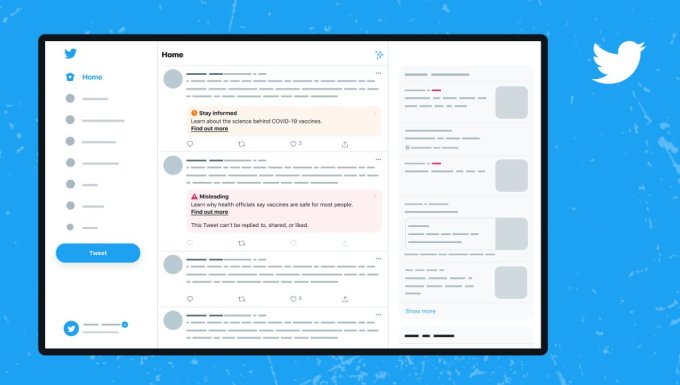
The company announced the test in a tweet Thursday with an image of the new misinformation labels. Within the limited test, those labels will appear with color-coded backgrounds now, making them much more visible in the feed while also giving users a way to quickly parse the information from visual cues. Some users will begin to see the change this week.

Tweets that Twitter deems “misleading” will get a red background with a short explanation and a notice that users can’t reply to, like or share the content. Yellow labels will appear on content that isn’t as actively misleading. In both cases, Twitter has made it more clear that you can click the labels to find verified information about the topic at hand (in this case, the pandemic).

“People who come across the new labels as a part of this limited test should expect a more communicative impact from the labels themselves both through copy, symbols and colors used to distill clear context about not only the label, but the information or content they are engaging with,” a Twitter spokesperson told TechCrunch.

Image Credits: Twitter

Twitter found that even tiny shifts in design could impact how people interacted with labeled tweets. In a test the company ran with a pink variation of the label, users clicked through to the authoritative information that Twitter provided more but they also quote-tweeted the content itself more, furthering its spread. Twitter says that it tested many variations on the written copy, colors and symbols that made their way into the new misinformation labels.

The changes come after a long public feedback period that convinced the company that misinformation labels needed to stand out better in a sea of tweets. Facebook’s own misinformation labels have also faced criticism for blending in too easily and failing to create much friction for potentially dangerous information on the platform.

Twitter first created content labels as a way to flag “manipulated media” — photos and videos altered to deliberately mislead people, like the doctored deepfake of Nancy Pelosi that went viral back in 2019. Last May, Twitter expanded its use of labels to address the wave of Covid-19 misinformation that swept over social media early in the pandemic.

A month ago, the company rolled out new labels specific to vaccine misinformation and introduced a strike-based system into its rules. The idea is for Twitter to build a toolkit it can use to respond in a proportional way to misinformation depending on the potential for real-world harm.

“… We know that even within the space of our policies, not all misleading claims are equally harmful,” a Twitter spokesperson said. “For example, telling someone to drink bleach in order to cure COVID is a more immediate and severe harm than sharing a viral image of a shark swimming on a flooded highway and claiming that’s footage from a hurricane. (That’s a real thing that happens every hurricane season.)”

Labels are just one of the content moderation options that Twitter developed over the course of the last couple of years, along with warnings that require a click-through and pop-up messages designed to subtly steer people away from impulsively sharing inflammatory tweets.

When Twitter decides not to remove content outright, it turns to an a la carte menu of potential content enforcement options:

  • Apply a label and/or warning message to the Tweet
  • Show a warning to people before they share or like the Tweet;
  • Reduce the visibility of the Tweet on Twitter and/or prevent it from being recommended;
  • Turn off likes, replies, and Retweets; and/or
  • Provide a link to additional explanations or clarifications, such as in a curated landing page or relevant Twitter policies.

In most scenarios, the company will opt for all of the above.

“While there is no single answer to addressing the unique challenges presented by the range of types of misinformation, we believe investing in a multi-prong approach will allow us to be nimble and shift with the constantly changing dynamic of the public conversation,” the spokesperson said.


from Social – TechCrunch https://ift.tt/3dyNwfx
via IFTTT

Twitter considers new features for tweeting only to friends, under different personas, and more

Twitter has a history of sharing feature and design ideas it’s considering at very early stages of development. Earlier this month, for example, it showed off concepts around a potential “unmention” feature that would let users untag themselves from others’ tweets. Today, the company is sharing a few more of its design explorations that would allow users to better control who can see their tweets and who ends up in their replies. The new concepts include a way to tweet only to a group of trusted friends, new prompts that would ask people to reconsider the language they’re using when posting a reply, and a “personas” feature that would allow you to tweet based on your different contexts — like tweets about your work life, your hobbies and interests, and so on.

The company says it’s thinking through these concepts and is looking to now gather feedback to inform what it may later develop.

The first of the new ideas builds on work that began last year with the release of a feature that allows an original poster to choose who’s allowed to reply to their tweet. Today, users can choose to limit replies to only people mentioned in the tweet, ony people they follow, or they can leave it defaulted to “everyone.” But even though this allows users to limit who can respond, everyone can see the tweet itself. And they can like, retweet or quote tweet the post.

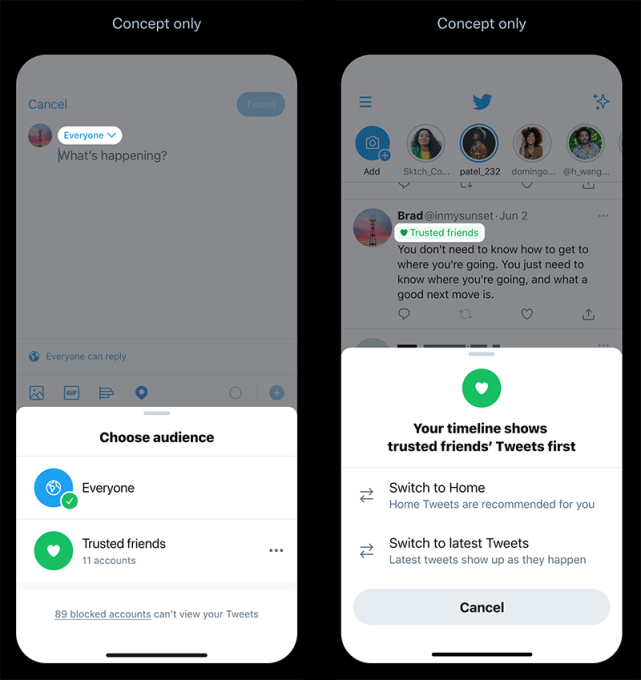
With the proposed Trusted Friends feature, users could tweet to a group of their own choosing. This could be a way to use Twitter with real-life friends, or some other small network of people you know more personally. Perhaps you could post a tweet that only your New York friends could see when you wanted to let them know you were in town. Or maybe you could post only to those who share your love of a particular TV show, sporting event, or hobby.

Image Credits: Twitter

This ability to have private conversations alongside public ones could boost people’s Twitter usage and even encourage some people to try tweeting for the first time. But it also could be disruptive to Twitter, as it would chip away at the company’s original idea of a platform that’s a sort of public message board where everyone is invited into the conversation. Users may begin to think about whether or not their post is worthy of being shared in public, and decide to hold more of their content back from the wider Twitter audience, which could impact Twitter engagement metrics. It also pushes Twitter closer to Facebook territory where only some posts are meant for the world, while more are shared with just friends.

Twitter says the benefit of this private, “friends only” format is that it could save people from the workarounds they’re currently using — like juggling multiple alt accounts or toggling between public to protected tweets.

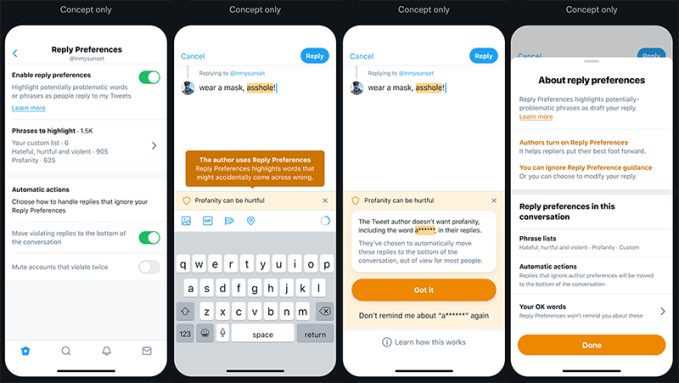
Another new feature under consideration is Reply Language Prompts. This feature would allow Twitter users to choose phrases they don’t want to see in their replies. When someone is writing back to the original poster, these words and phrases would be highlighted and a prompt would explain why the original poster doesn’t want to see that sort of language. For instance, users could configure prompts to appear if someone is using profanity in their reply.

The feature wouldn’t stop the poster from tweeting their reply — it’s more a gentle nudge that asks them to be more considerate.

These “nudges” can have impact. For example, when Twitter launches a nudge that suggested users read an article before they amplify it with a retweet, it found that users opened articles before sharing them 40% more often. But in the case of someone determined to troll, it may not do that much good.

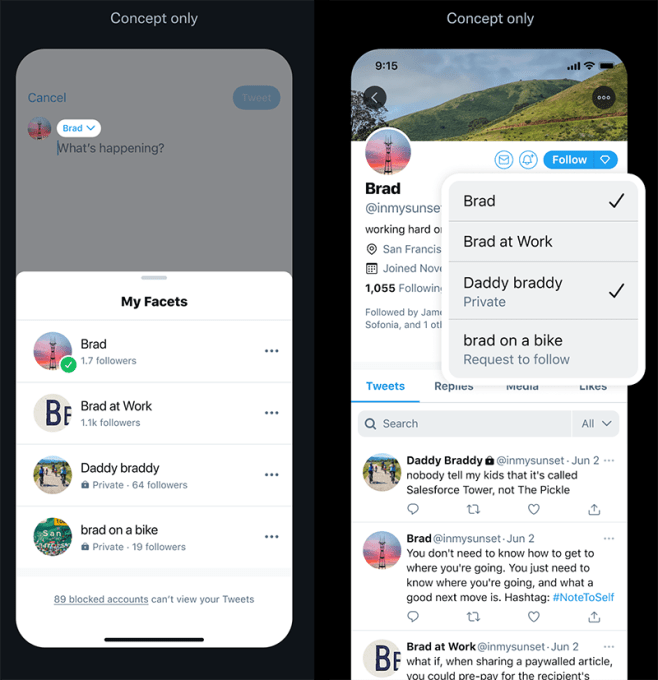
The third, and perhaps most complicated, feature is something Twitter is calling “Facets.”

This is an early idea about tweeting from different personas from one account. The feature would make sense for those who often tweet about different aspects of their lives, including their work life, their side hustles, their personal life or family, their passions, and more.

Image Credits: Twitter

Unlike Trusted Friends, which would let you restrict some tweets to a more personal network, Facets would give other users the ability to choose whether or not they wanted to follow all your tweets, or only those about the “facet” they’re interested in. This way, you could follow someone’s tweets about tech, but ignore their stream of reactions they post when watching their favorite team play. Or you could follow your friend’s personal tweets, but ignore their work-related content. And so on.

This is an interesting idea, as Twitter users have always worried about alienating some of their followers by posting “off-topic” so to speak. But this also puts the problem of determining what tweets to show which users on the end user themselves. Users may be better served by the algorithmic timeline that understands which content they engage with, and which they tend to ignore. (Also: “facets?!”)

Twitter says none of the three features are in the process of being built just yet. These are only design mockups that showcase ideas the company has been considering. It also hasn’t yet made the decision whether or not any of the three will go under development — that’s what the user feedback it’s hoping to receive will help to determine.


from Social – TechCrunch https://ift.tt/3qJjACO
via IFTTT