This is default featured slide 1 title

Go to Blogger edit html and find these sentences.Now replace these sentences with your own descriptions.This theme is Bloggerized by Lasantha Bandara - Premiumbloggertemplates.com.

This is default featured slide 2 title

Go to Blogger edit html and find these sentences.Now replace these sentences with your own descriptions.This theme is Bloggerized by Lasantha Bandara - Premiumbloggertemplates.com.

This is default featured slide 3 title

Go to Blogger edit html and find these sentences.Now replace these sentences with your own descriptions.This theme is Bloggerized by Lasantha Bandara - Premiumbloggertemplates.com.

This is default featured slide 4 title

Go to Blogger edit html and find these sentences.Now replace these sentences with your own descriptions.This theme is Bloggerized by Lasantha Bandara - Premiumbloggertemplates.com.

This is default featured slide 5 title

Go to Blogger edit html and find these sentences.Now replace these sentences with your own descriptions.This theme is Bloggerized by Lasantha Bandara - Premiumbloggertemplates.com.

Match beta test targets dating app complaints like frustration with swiping, ghosting

Match today is introducing new features that aim to address some of users’ complaints with modern-day dating apps — like how much time it takes to find a relevant match and how frustrating it is when users ghost one another after the initial conversation fades. As part of a new strategy to better position Match for more “emotionally mature” singles (read: adults), the company says it will begin beta testing a recommendation system called “Matched by Us,” which may pave the way for a broader matchmaking service in the future. It’s also testing an anti-ghosting feature which pushes users to either continue a conversation or unmatch the recipient, instead of leaving them hanging.

The features are designed to address the challenges that face Match’s older demographic. Match users tend to be in their 30’s and up, and have full lives. They’re generally ready to find relationships and settle down with a partner. That’s a different life phase than those using other Match dating apps, like Tinder, where younger users are still in a more exploratory phase and enjoy on going on many dates, including casual dates.

“When we talk to our members, we hear a lot of frustration around [there being] a lot of swiping, a lot of messaging back and forth — that’s happening in the dating world more broadly,” explains Dushyant Saraph, Match’s Chief Product Officer. “When we think about folks on our product, who don’t have a ton of time, that’s where ‘Matched by Us’ came from. Our singles don’t want to swipe through hundreds of profiles,” he says.
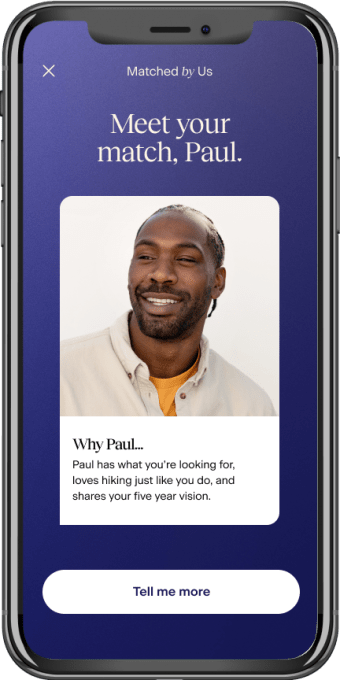
Image Credits: Match

The new feature, which is made available to free and paid users alike, will present one, free customized match every week, where both users can see each other and no longer have to wait for a “like” back in order to engage in a conversation.

The system works to find compatible matches by algorithmically examining a new set of preferences around users’ personalities, based on responses to questions posed in users’ Match bios.

For example, questions may ask about users’ five-year plans, their favorite weekend activities, or whether they’re open to moving somewhere new if they find the right person. The latter has become especially relevant in the new age of remote work, driven by the pandemic, which no longer requires people to live in the bigger cities where their company may be headquartered, Saraph notes.
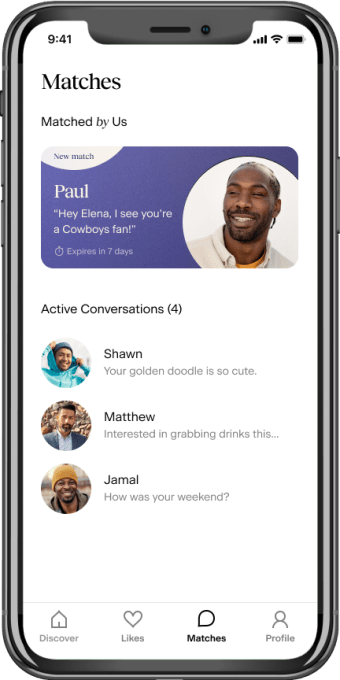
Image Credits: Match

Currently, the system will recommend a match based on a holistic view of users’ preferences, as determined by an algorithm, but the company has been internally testing adding a layer of human curation to its suggestions, as well.

In other words, Match is testing an actual match-making service.

For the time being, however, the human curation team inside Match is working in more of an R&D capacity, Saraph says.

“We’ve been flexing how many experts we need as we’re testing kind of different concepts — everything from coaching to expert picks, where we’re doing human curation,” he says. The team also works on other features, like suggesting conversation starters to keep conversations going.

“Long-term we expect to be flexible, depending on which of these [products] is most interesting to our members, and scaling up our expert team accordingly. Right now, human curation is one area that we’re really excited about and want to crack, and I think you’ll hear more about that in the coming months,” Saraph adds.

Another new feature aimed at helping adults to stop waste their time on dating apps involves how Match will handle matches’ conversations. Typically, conversations either take off leading to real-world dates, or slowly fade away, until communication stops altogether. Sometimes, the other party simply “ghosts,” and never responds at all.
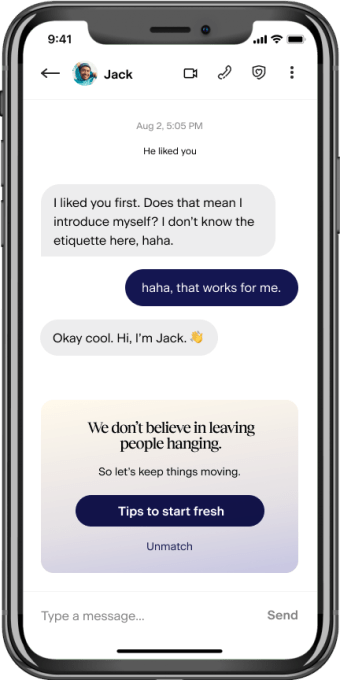
Image Credits: Match

Users told Match that their main issue with ghosting is the uncertainty around what it means.

Did the user just get busy, or did they decide they weren’t interested?, users wonder.

A new feature aims to keep conversations’ momentum going by nudging users when a conversation is about to “expire” — that is, when it will be archived into a new section of the inbox for inactive conversations.

And if you are in the app, you can visit the conversation to get suggestions of conversation starters to help you pick things back up, or you can tap a button to unmatch the other user. The latter would send a more explicit signal to the recipient that there was a lack of interest, though it won’t actually push a notification that tells the user they’ve been unmatched. (That can sometimes lead to safety issues, particularly for women who have received threats from men they’ve rejected.)
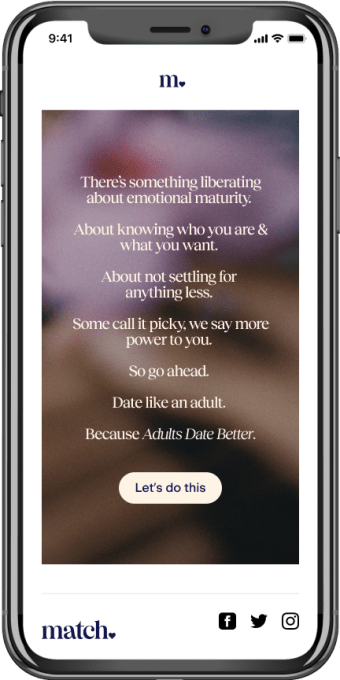
Image Credits: Match

Match says it’s currently testing the right number of days to elapse before it nudges users to either re-engage or end their conversations with an unmatch. But the right amount of time seems to be in the three to five-day range, Saraph says.

The new features are rolling out to some portion of Match’s U.S. user base in beta, as the company kicks off a new brand campaign targeting adult daters. The campaign’s message is that Match understands what modern adult singles are looking for in order to date better, and these features are an example of that understanding being put into practice.

The beta tests are rolling out across all Match platforms, including iOS, Android, mobile web and desktop over the next few months, starting in the U.S.

The news follows a mixed earnings report from the dating app giant, Match Group, which owns top brands including Match, Tinder, OKCupid, Plenty of Fish, Hinge, and others. The company saw the impact of a pandemic recovery in the second quarter, with 15 million paying customers across its brands, up from 13 million in the year-ago quarter. Revenue was $707.8 million, topping analyst projections of $694 million. But Match Group missed on earnings, with net income of $140.9 million, or 46 cents a share, when analysts expected 49 cents per share.

The company also spoke in detail about its plans for social networking app maker Hyperconnect, a company Match bought for $1.73 billion earlier this year. Match Group said it plans to add audio and video chat, including live video, to its dating brand portfolio.

Match’s dating app is among those that will benefit from Hyperconnect integrations, Saraph told TechCrunch, as Match plans to explore “building out live experiences.” The company expects these to be added around year end towards the beginning of 2022, we’re told.


from Social – TechCrunch https://ift.tt/2VFqzkX
via IFTTT
Early-stage brands should also unlock the power of influencers

They’ve made waves on every screen and have been sponsored by nearly every major brand, from Charli D’Amelio x Hollister to MrBeast x Honey. And they’re only multiplying.

If influencers aren’t part of your early-stage growth marketing plan, it’s time to get on board. When companies think of how to rapidly increase their reach and revenue, paid acquisition is always at the top of the list. But there are other important pillars in a growth marketing engine, such as leveraging lifecycle marketing, cultivating organic reach via SEO and doing later-stage brand marketing.

Influencer marketing isn’t solely for big brands; it’s for every brand. If influencers aren’t part of your growth marketing plan, it’s time to get on board.

However, an often overlooked tactic for new brands is influencer marketing. If the value and power of influencer marketing were widespread knowledge, we would see more of an uptick. And it doesn’t help that we have a supply-constrained pool of marketers who understand how to unlock this lever.

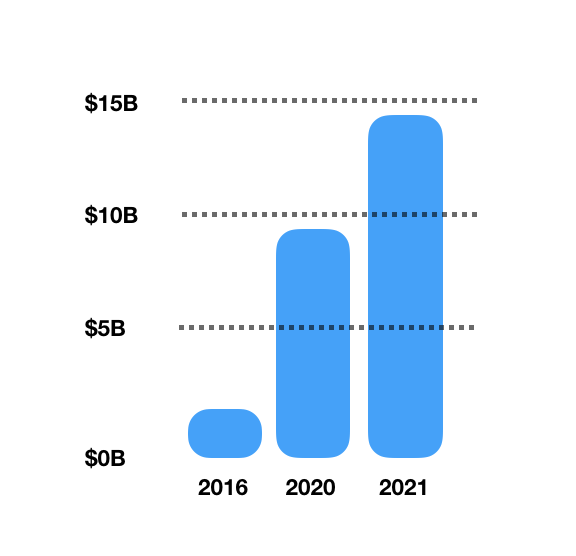
Influencer marketing spending from 2016 to 2021 (predicted). Image Credits: Jonathan Martinez

This marketing tactic is only growing. So let’s demystify influencer marketing, learn how to couple it with a little-known paid marketing hack and uncover the numerous mediums to leverage influencer assets. After three years at Postmates (which nailed influencer marketing), being a YouTuber myself in 2008 and advising startups, I’ve unlocked the power of influencer marketing and want everyone to do the same.

Starting out

If there’s one key piece of advice to take from this column, it’s that influencer marketing isn’t solely for big brands. It’s for every brand. As you start to formulate your growth strategy, make sure to include an influencer pillar as part of the plan.

When reaching out to influencers, it’s a sheer numbers game in capturing their attention and pitching your brand, but there are myriad ways to increase response conversion. Below are the cold message components you must nail down before reaching out to influencers:

  • Your brand pitch.
  • An enticing offer.
  • Clear next steps.

The one constant with influencers is the high number of messages they receive from fans and brands alike. If you’re at the marketing stage, nailing your pitch should hopefully be natural at this point, so utilize what you’ve crafted and condense it down to a sentence or two.

What are your brand’s key value propositions, and why should influencers care? To show them, relate your brand to their category, to their style and to the content that they post.

After the pitch, an irresistible offer needs to follow — something that’s the opposite of this: “I’ll send you a few samples of our protein bars.” The conversion rate will be a freakishly low tenth of a percent with that offer. Instead, make your offer enticing and utilize one of these structures: fixed fee, fixed fee + performance or performance.

Depending on budget and risk tolerance, there are a few ways to structure an influencer offer: paying a one-time fixed fee, paying for each conversion (CPA performance basis) or a hybrid of the two.


from Social – TechCrunch https://ift.tt/3CpVeDk
via IFTTT

Instagram tests ads in its Shop tab

Instagram is further investing in its e-commerce business, Instagram Shops, with the launch of a new advertising product, Ads in Instagram Shop. The company says it’s currently testing the new format, which includes both single images and the option for an image carousel, with select U.S.-based advertisers ahead of an expansion to other markets in the months to come.

The company first introduced Instagram Shops last year as part of a larger effort at Facebook to make its social platforms not just a place to connect with friends and follow favorite brands, but also an online shopping destination with an integrated checkout experience. Naturally, this type of initiative also lends itself to Facebook’s advertising model, as brands looking to connect with consumers could pay for expanded reach.

Like Instagram’s other advertising products, Ads in Instagram Shop will launch with an auction-based model, the company says. The ads will only appear on mobile, as the Instagram Shop tab is a mobile-only feature. However, how many ads an individual consumer sees will be based on how they use Instagram and how many people are shopping in the Instagram tab. The company plans to monitor consumer sentiment on this point, in order to balance ads and content.

Initially, Instagram is working with a handful of U.S. advertisers who will test the product and provide feedback, including Away, Donny Davy, Boo Oh, Clare paint, JNJ Gifts, DEUX and Fenty Beauty. These brands encompass some of the more popular categories of goods Instagram users like to shop for, including beauty, home décor, pet products, travel and more.

The company hasn’t yet disclosed an exact time frame for rolling out the ads more publicly, but says the plan is to expand the new format to advertisers in other, non-U.S. markets over the next several months.

The Instagram Shop tab has been one of the app’s more controversial additions in recent years, as it replaced the popular “Activity” tab (heart button) in the bottom navigation row — a change that made the app feel more commercially driven than in the past and alienated some users. Today, the creative community is weighing its options as Instagram distances itself further from its photo-sharing roots with other new additions, like its TikTok clone Reels, as well.


from Social – TechCrunch https://ift.tt/3jHajaW
via IFTTT

Senators press Facebook for answers about why it cut off misinformation researchers

Facebook’s decision to close accounts connected to a misinformation research project last week prompted a broad outcry from the company’s critics — and now Congress is getting involved.

A handful of lawmakers criticized the decision at the time, slamming Facebook for being hostile toward efforts to make the platform’s opaque algorithms and ad targeting methods more transparent. Researchers believe that studying those hidden systems is crucial work for gaining insight on the flow of political misinformation.

The company specifically punished two researchers with NYU’s Cybersecurity for Democracy project who work on Ad Observer, an opt-in browser tool that allows researchers to study how Facebook targets ads to different people based on their interests and demographics.

In a new letter, embedded below, a trio of Democratic senators are pressing Facebook for more answers. Senators Amy Klobuchar (D-MN), Chris Coons (D-DE) and Mark Warner (D-VA) wrote to Facebook CEO Mark Zuckerberg asking for a full explanation on why the company terminated the researcher accounts and how they violated the platform’s terms of service and compromised user privacy. The lawmakers sent the letter on Friday.

“While we agree that Facebook must safeguard user privacy, it is similarly imperative that Facebook allow credible academic researchers and journalists like those involved in the Ad Observatory project to conduct independent research that will help illuminate how the company can better tackle misinformation, disinformation, and other harmful activity that is proliferating on its platforms,” the senators wrote.

Lawmakers have long urged the company to be more transparent about political advertising and misinformation, particularly after Facebook was found to have distributed election disinformation in 2016. Those concerns were only heightened by the platform’s substantial role in spreading election misinformation leading up to the insurrection at the U.S. Capitol, where Trump supporters attempted to overturn the vote.

In a blog post defending its decision, Facebook cited compliance with FTC as one of the reason the company severed the accounts. But the FTC called Facebook’s bluff last week in a letter to Zuckerberg, noting that nothing about the agency’s guidance for the company would preclude it from encouraging research in the public interest.

“Indeed, the FTC supports efforts to shed light on opaque business practices, especially around surveillance-based advertising,” Samuel Levine, the FTC’s acting director for the Bureau of Consumer Protection, wrote.


from Social – TechCrunch https://ift.tt/3s453lx
via IFTTT

Twitter Spaces now let you invite co-hosts

Fleets weren’t long for this world, but Twitter’s product teams aren’t slowing down on bringing new stuff to Spaces, the company’s own take on audio rooms. Twitter introduced Spaces in a limited test last year, expanding the Clubhouse copycat feature more broadly to anyone with at least 600 followers in May.

Now, Twitter is giving Space hosts the ability to add two co-hosts, who they can rope in through an invite system. Spaces will allow one main host, two additional co-hosts and up to 10 speakers. Additional co-hosts will make the task of moderation much more manageable, as they’ll be able to vet speaker requests, tap speakers and give anyone in the Space the boot.

With Fleets out of the picture, Twitter’s Spaces are the only feature for now that lives above the main feed in the Twitter app. That virtual real estate, which has echoes of Instagram’s Stories, draws the eye to anything that a social network wants its users to check out first. Twitter also began rolling out a dedicated tab to make it easier to discover Spaces, surfacing live audio rooms in real time in a central location.

A number of major apps spliced live audio chat rooms into their platforms in light of Clubhouse’s breakout run. In June, Spotify launched Greenroom, a standalone app that allows people to create 1,000-person voice events. Naturally, Facebook also launched its own spin on live audio rooms (called Live Audio Rooms) in June. Discord, already a leader in voice-based chat, added its own Clubhouse-like event channels in March. Twitter followed the same trend with Spaces, but unlike with Fleets, it looks like the company plans to continue supporting the relatively new feature.


from Social – TechCrunch https://ift.tt/3rZMTBI
via IFTTT

Oh, Facebook changed its privacy settings again

Ever considerate of its users, Facebook has determined that its privacy settings needed a bit of a shuffle to keep things clear and easy to find. To that end they’ve taken the “privacy settings” settings and scattered them mischievously among the other categories.

“We’ve redesigned our entire settings menu on mobile devices from top to bottom to make things easier to find. Instead of having settings spread across nearly 20 different screens, they’re now accessible from a single place,” writes Facebook in a blog post announcing the changes.

Oh, sorry — that’s from 2018, when they centralized privacy settings to make them easier to find. This is the one from today about decentralizing them into a bunch of different places.

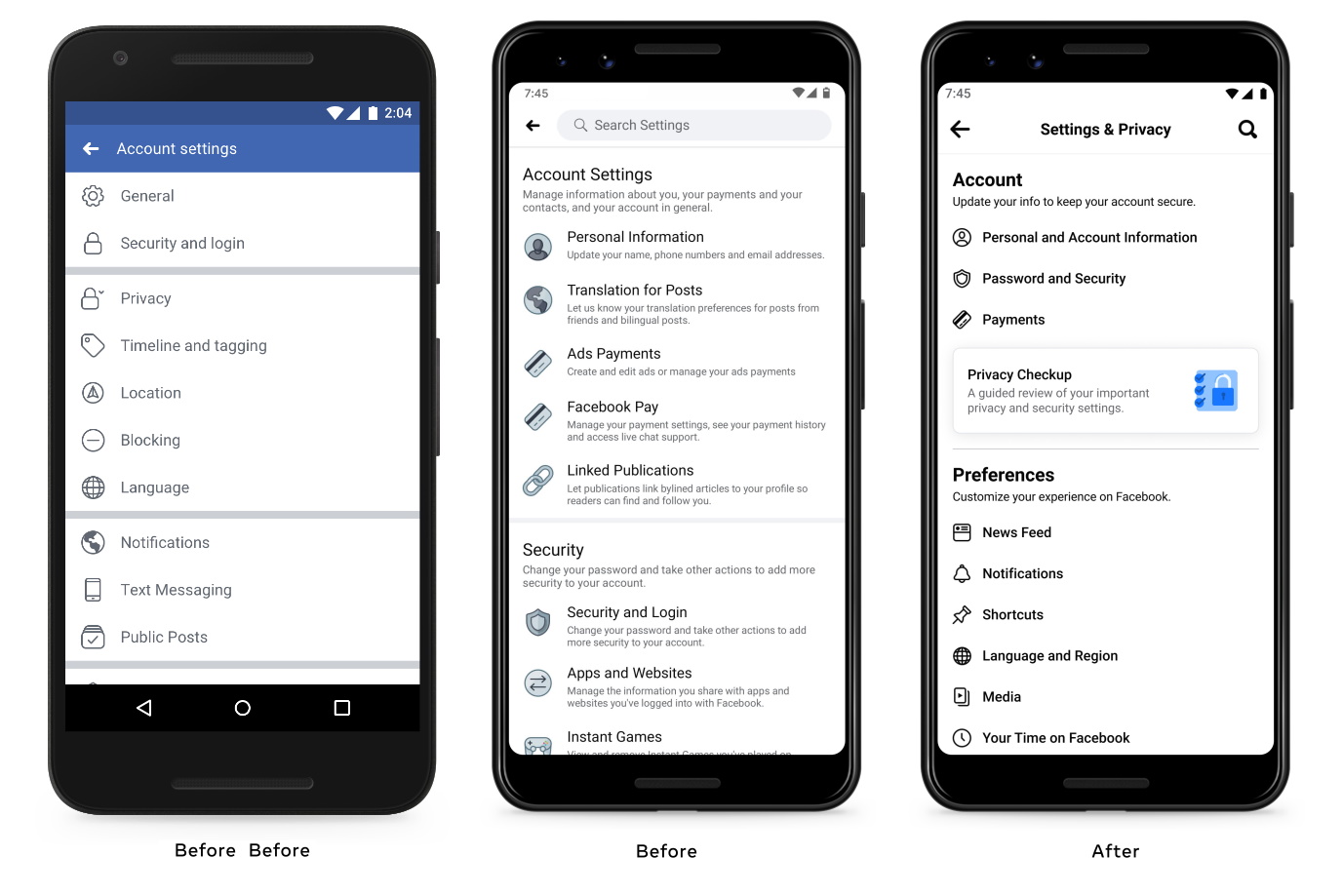
“Settings are now grouped into six broad categories, each containing several related settings: Account, Preferences, Audience and Visibility, Permissions, Your Information, and Community Standards and Legal Policies … We’ve unbundled the Privacy Settings category and moved the settings previously contained within it into other categories.”

Facebook unbundling its privacy settings (but the image is actually a guy sprinkling salt in the wind)

Pictured: Facebook unbundling its privacy settings into new categories.

Under which of those categories do you think privacy settings belong? Facebook “renamed them to more closely match people’s mental models,” so it should be obvious. Just use your mental model.

If your answer is “all of them, conceivably,” congratulations, you got it! Now if you want to update your privacy settings, all you need to do is visit all of these new categories and subcategories individually. Any one of them might have a crucial toggle inside — it’s like a treasure hunt!

Facebook’s settings page, from oldest to newest. Which do you prefer? Image Credits: TechCrunch

We joke, but Facebook did also make the “Privacy Checkup” item much more prominent in this update. This “guided review” may give the company opportunities to employ dark patterns that lure users away from less desirable (for the company) privacy choices, but does certainly go through many of the more important settings and let people change them.

“We’re confident this new settings page will make it easier for people to visit their settings, find what they came for, and make the changes they want,” Facebook writes. We’ll all find out one way or another later today when the redesign rolls out for iOS, Android, mobile web and FB Lite.


from Social – TechCrunch https://ift.tt/37jPywe
via IFTTT

TikTok confirms pilot test of TikTok Stories is now underway

Twitter may have shut down its Stories features known as Fleets, but the Stories format will continue to invade other social platforms. TikTok today confirmed it’s piloting a new feature, TikTok Stories, which will allow it to explore additional ways for its community to bring their creative ideas to life.

The company notes the new feature will be another option, in addition to its existing storytelling tools like videos, Duets, Stitch, and LIVE — it’s not meant to replace them.

TikTok didn’t say how long the pilot test would run or whether it would result in a public launch. However, we understand the test has been running for several days, not weeks or months, and is available in a small handful of non-U.S. markets for the time being.

The current set of features may or may not make it to the public product, either, we should warn.

The feature was discovered by social media consultant Matt Navarra, who is often among the first to find new features in social apps. In this case, he tells us that several tipsters brought screenshots of TikTok Stories to him, but it was initially unclear whether or not it was a hoax.

The timing, of course, was somewhat suspect —  Twitter had just shut down Fleets in what was a fairly high-profile example of a failure to make Stories work on a social platform, despite their popularity on other popular apps, like Snapchat, Instagram, Facebook, and even, as of late, Pinterest.

From the screenshots and videos of TikTok Stories in action, we see a product that appears to be, for the most part, something that looks familiar to users of Stories on other platforms.

Users can tap a camera button from the new navigation bar on the left side of the screen to create their first Story, then use common tools like those to add text or stickers, insert sounds, and even use effects on their content. Like other platforms, users can either record videos or upload photos — the latter which opens up TikTok to take advantage of users’ larger camera rolls, rather than relying only on video.

Where TikTok’s version of Stories differentiates itself is that it allows users to comment publicly on the creator’s content. These comments are public, the app explains, as mutual friends can see each other’s comments. There is also another tab where you can see how many people viewed a given Story, and whether or not you’re following those users. A button will allow you to click to follow people back, if you choose.

TikTok’s Stories are also ephemeral and disappear in 24 hours, the app’s tutorial explains.

To view Stories from other creators, you can scroll through the new sidebar and tap on the creator’s avatar to watch their content. (This almost looks like a vertical version of Twitter’s Fleets bar, even down to the blue rings around creator’s profile photos.)

The addition of Stories may give TikTok users who don’t post with regularity (or at all), an easier way to start engaging with TikTok’s tools by getting started with a more comfortable and familiar format. But it can also give creators a way to interact more casually with fans in between their more polished and edited TikTok video posts.

The feature is also a direct shot across Instagram’s bow, following the Facebook-owned app’s direct attempt to copy TikTok with Reels.

TikTok declined to say which markets, specifically, can try out TikTok Stories. Screenshots show the feature described in English and on Android phones, however.

Though Stories may have failed on Twitter, the platform isn’t known for being a home for rich, creative tools, like TikTok. Meanwhile, TikTok believes in exploring any creative tool that could allow its users to express themselves — whether that’s through video, live streaming, interacting with others, or now, through ephemeral, short-form content.


from Social – TechCrunch https://ift.tt/3fsGlq0
via IFTTT