This is default featured slide 1 title

Go to Blogger edit html and find these sentences.Now replace these sentences with your own descriptions.This theme is Bloggerized by Lasantha Bandara - Premiumbloggertemplates.com.

This is default featured slide 2 title

Go to Blogger edit html and find these sentences.Now replace these sentences with your own descriptions.This theme is Bloggerized by Lasantha Bandara - Premiumbloggertemplates.com.

This is default featured slide 3 title

Go to Blogger edit html and find these sentences.Now replace these sentences with your own descriptions.This theme is Bloggerized by Lasantha Bandara - Premiumbloggertemplates.com.

This is default featured slide 4 title

Go to Blogger edit html and find these sentences.Now replace these sentences with your own descriptions.This theme is Bloggerized by Lasantha Bandara - Premiumbloggertemplates.com.

This is default featured slide 5 title

Go to Blogger edit html and find these sentences.Now replace these sentences with your own descriptions.This theme is Bloggerized by Lasantha Bandara - Premiumbloggertemplates.com.

WhatsApp gains the ability to transfer chat history between mobile operating systems

WhatsApp users will finally be able to move their entire chat history between mobile operating systems — something that’s been one of users’ biggest requests to date. The company today introduced a feature that will soon become available to users of both iOS and Android devices, allowing them to move their WhatsApp voice notes, photos, and conversations securely between devices when they switch between mobile operating systems.

The company had been rumored to be working on such functionality for some time, but the details of which devices would be initially supported or when it would be released weren’t yet known.

In product leaks, WhatsApp had appeared to be working on an integration into Android’s built-in transfer app, the Google Data Transfer Tool, which lets users move their files from one Android device to another, or switch from iOS to Android.

The feature WhatsApp introduced today, however, works with Samsung devices and Samsung’s own transfer tool, known as Smart Switch. Today, Smart Switch helps users transfer contacts, photos, music, messages, notes, calendars, and more to Samsung Galaxy devices. Now, it will transfer WhatsApp chat history, too.

WhatsApp showed off the new tool at Samsung’s Galaxy Unpacked event, and announced Samsung’s newest Galaxy foldable devices would get the feature first in the weeks to come. The feature will later roll out to Android more broadly. WhatsApp didn’t say when iOS users would gain access, but a spokesperson for WhatsApp told TechCrunch the team is working to bring the feature to users worldwide.

To use the feature, WhatsApp users will connect their old and new device together via a USB-C to Lightning cable, and launch Smart Switch. The new phone will then prompt you to scan a QR code using your old phone and export your WhatsApp history. To complete the transfer, you’ll sign into WhatsApp on the new device and import the messages.

Building such a feature was non-trivial, the company also explained, as messages across its service are end-to-end encrypted by default and stored on users’ devices. That meant the creation of a tool to move chat history between operating systems required additional work from both WhatsApp as well as operating system and device manufacturers in order to build it in a secure way, the company said.

“Your WhatsApp messages belong to you. That’s why they are stored on your phone by default, and not accessible in the cloud like many other messaging services,” noted Sandeep Paruchuri, product manager at WhatsApp, in a statement about the launch. “We’re excited for the first time to make it easy for people to securely transfer their WhatsApp history from one operating system to another. This has been one of our most requested features from users for years and we worked together with operating systems and device manufacturers to solve it,” he added.


from Social – TechCrunch https://ift.tt/2Xiw6yq
via IFTTT
In the wake of recent racist attacks, Instagram rolls out more anti-abuse features

Instagram today is rolling out a set of new features aimed at helping people protect their accounts from abuse, including offensive and unwanted comments and messages. The company will introduce tools for filtering abusive direct message (DM) requests as well as a way for users to limit other people from posting comments or sending DMs during spikes of increased attention — like when going viral. In addition, those who attempt to harass others on the service will also see stronger warnings against doing so, which detail the potential consequences.

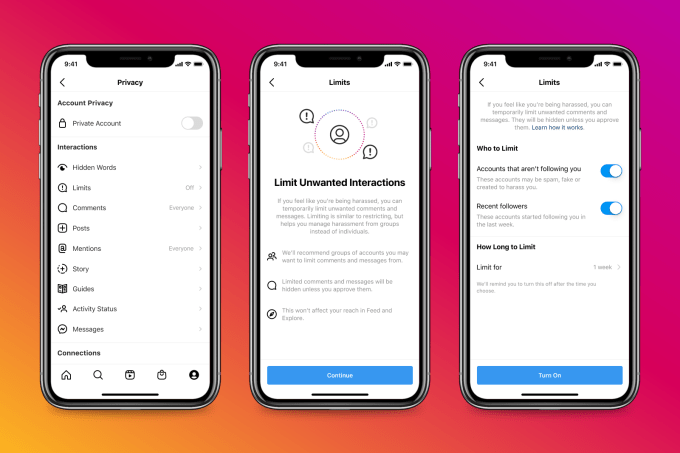
The company recently confirmed it was testing the new anti-harassment tool, Limits, which Instagram head Adam Mosseri referenced in a video update shared with the Instagram community last month. The feature aims to give Instagram users an easy way to temporarily lock down their accounts when they’re targeted with a flood of harassment.

Such an addition could have been useful to combat the recent racist attacks that took place on Instagram following the Euro 2020 final, which saw several England footballers viciously harassed by angry fans after the team’s defeat. The incidents, which had included racist comments and emoji, raised awareness of how little Instagram users could do to protect themselves when they’ve gone viral in a negative way.

Image Credits: Instagram

During these sudden spikes of attention, Instagram users see an influx of unwanted comments and DM requests from people they don’t know. The Limits feature allows users to choose who can interact with you during these busy times.

From Instagram’s privacy settings, you’ll be able to toggle on limits that restrict accounts that are not following you as well as those belonging to recent followers. When limits are enabled, these accounts can’t post comments or send DM requests for a period of time of your choosing, like a certain number of days or even weeks.

Twitter had been eyeing a similar set of tools for users who go viral, but has yet to put them into action.

Instagram’s Limits feature had already been in testing, but is now becoming globally available.

The company says it’s currently experimenting with using machine learning to detect a spike in comments and DMs in order to prompt people to turn on Limits with a notification in the Instagram app.

Another feature, Hidden Words, is also being expanded.

Designed to protect users from abusive DM requests, Hidden Words automatically filters requests that contain offensive words, phrases and emojis and places them into a Hidden Folder, which you can choose to never view. It also filters out requests that are likely spam or are otherwise low-quality. Instagram doesn’t provide a list of which words it blocks to prevent people from gaming the system, but it has now updated that database with new types of offensive language, including strings of emoji — like those that were used to abuse the footballers — and included them in the filter.

Hidden Words had already been rolled out to a handful of countries earlier this year, but will reach all Instagram users globally by the end of the month. Instagram will push accounts with a larger following to use it, with messages both in their DM inbox and in their Stories tray.

The feature was also expanded with a new option to “Hide More Comments,” which would allow users to easily hide comments that are potentially harmful, but don’t go against Instagram’s rules.

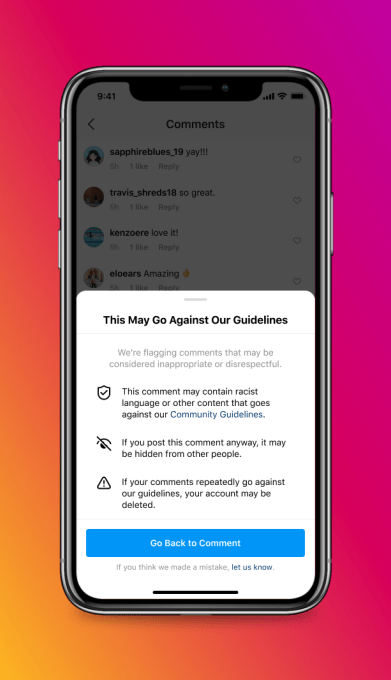
Another change will involve the warnings that are displayed when someone posts a potentially abusive comment. Already, Instagram would warn users when they first try to post a comment, and it would later display an even stronger warning when they tried to post potentially offensive comments multiple times. Now, the company says users will see the stronger message the first time around.

Image Credits: Instagram

The message clearly states the comment may “contain racist language” or other content that goes against its guidelines, and reminds users that the comment may be hidden when it’s posted as a result. It also warns the user if they continue to break the community guidelines, their account “may be deleted.”

While systems to counteract online abuse are necessary and underdeveloped, there’s also the potential for such tools to be misused to silence dissent. For example, if a creator was spreading misinformation or conspiracies, or had people calling them out in the comments, they could turn to anti-abuse tools to hide the negative interactions. This would allow the creator to paint an inaccurate picture of their account as one that was popular and well-liked. And that, in turn, can be leveraged into marketing power and brand deals.

As Instagram puts more power into creators’ hands to handle online abuse, it has to weigh the potential impacts those tools have on the overall creator economy, too.

“We hope these new features will better protect people from seeing abusive content, whether it’s racist, sexist, homophobic or any other type of abuse,” noted Mosseri, in an announcement about the changes. “We know there’s more to do, including improving our systems to find and remove abusive content more quickly, and holding those who post it accountable.”


from Social – TechCrunch https://ift.tt/3lOx9Al
via IFTTT

Signal now lets you choose disappearing messages by default for new chats

The encrypted chat app Signal is adding a few new options for users looking to lock down their messages. The app will now allow anyone to turn on a default timer for disappearing messages, automatically applying the settings to any newly initiated conversations.

Signal’s disappearing messages option deletes chats for both the sender and receiver after a set amount of time passes. Previously, you had to toggle the option on and select an interval for each individual conversation, which made it easy to overlook the extra privacy feature if you had a lot of chats going at once.

Signal is also adding more options for how long disappearing messages stick around before evaporating. The app’s users can now select an interval up to four weeks and as low as 30 seconds. You can even lower than to a single second in the app’s custom time options.

On any chat app, it’s important to remember that disappearing messages vanish from the user interface but that doesn’t mean they’re gone for good. Anything you share online can live on indefinitely via screenshots or through someone taking a photo of an app’s screen with another device.

Signal wants its users to keep this in mind, noting that the disappearing message options are best for saving storage space and keeping conversation history to a minimum, just in case. “This is not for situations where your contact is your adversary,” the company wrote in a blog post.

The app remains one of the most popular end-to-end encrypted messaging options to date and earlier this year even managed to absorb some WhatsApp users who grew skittish over data sharing policy changes at Facebook.

The privacy-minded messaging app is very well regarded for its strong feature set and the company’s independence, though Signal remains relatively small compared to Facebook’s own end-to-end encrypted WhatsApp, which the company acquired in 2014. As of December 2020, Signal boasted around 20 million monthly active users, while WhatsApp hit 2 billion users early last year.


from Social – TechCrunch https://ift.tt/3iHkfCp
via IFTTT

What’s driving the global surge in retail media spending?

Most businesses by now are well versed with the consequences of the COVID-19 pandemic: Faltering offline sales, flexible work-from-anywhere options, fluctuating foot traffic with lockdown mandates and e-commerce becoming a channel many brands wished they had built infrastructure for earlier.

As a record number of consumers in Southeast Asia move from shopping malls to online platforms like Shopee, Lazada, Tiki and Tokopedia, the advertising dollars are naturally flowing in. Emerging markets are witnessing the advent of retail media right now.

Amazon paved the way in North America in 2018 by launching Amazon Advertising to become the first bid-and-buy marketplace. BCG now estimates retailers have a $100 billion business opportunity to capture, if they can keep up.

The money is where the consumer is

To understand why retailers will capture more ad spend, it’s important to evaluate what modern day marketing has become.

Is it bus stop advertisements? Bidding on Google keywords or a Clubhouse session? Or is it a viral TikTok video? As the world becomes more connected and the lines between offline and online blur even more, modern day marketing is a mix of all the channels tied to key performance metrics.

The main goal of marketing, no matter the medium, is to highlight a business or product to the right consumers to score a potential sale. And like most things, there is a bad, a good and a much better way of doing things.

E-commerce as an advertising channel is unique, because it encapsulates the entire consumer journey from start to finish, especially as marketplaces continue to steal the share of search from search engines.

Traditional marketing channels were primarily linear TV, radio and print, because the mediums were highly popular at the time. However, with the birth of the internet newer platforms emerged such as email, websites and streaming. Then came the rise of social media and apps that shook up the advertising landscape. But regardless of these shifts, there has always been one constant: The business went where the consumer was.

So when sources of traffic and revenue once again change, let’s say due to a pandemic, the marketing mix follows. In the next 12 months alone, many marketers are planning to decrease spending in cinema, print and out of home (OOH), while the majority will increase budgets in social and search, according to Nielsen.

The search for superior advertising channels

So which channels will benefit as money flows out of outdated buckets? A good indicator is ad revenue trends in mature markets like the U.S. While Google and Facebook remain the dominant advertising players, Amazon has eaten into the duopoly’s ad revenue pie in the U.S., growing its share from 7.8% to 10.3% in 2020 alone, according to eMarketer.

How? Because the most valuable advertising channel is the one that has the most measurable touch points with the consumer.


from Social – TechCrunch https://ift.tt/3jYIdIL
via IFTTT

Twitter suspends Marjorie Taylor Greene temporarily for spreading vaccine misinformation

Twitter temporarily suspended Rep. Marjorie Taylor Greene on Tuesday after the Georgia Republican posted a tweet that claimed vaccines don’t reduce the spread of Covid-19.

“These vaccines are failing & do not reduce the spread of the virus & neither do masks,” Greene tweeted, contradicting the scientific community and calling for the FDA to refuse to approve vaccines. Greene’s tweet remains up on her Twitter feed, but it’s paired with a misinformation warning from the company that points users to information from the CDC.

Twitter told TechCrunch the tweet was “labeled in line with [Twitter’s] COVID-19 misleading information policy” and will result in Greene’s account being frozen in read-only mode for seven days in light of “repeated violations” of Twitter’s platform rules. Last month, Greene was suspended for 12 hours for falsely claiming that the virus posed little threat to healthy people under the age of 65.

The new suspension is Greene’s fourth slap on the wrist from Twitter under its current strike-based system for Covid-19-related misinformation. Greene is a repeat rule-breaker on the platform, which puts her account in jeopardy of a permanent ban if she offends a fifth time after her account is reinstated.

In spite of a widely available trio of vaccines proven to dramatically and effectively reduce the severity of Covid-19 infections or prevent them outright, Covid cases are on the rise in the U.S. in a major way. Florida continues to break its own record for daily infections, topping the numbers the state saw during the pre-vaccine months of 2020.

Online misinformation continues to play a major role in discouraging Americans from seeking the vaccine, even with the highly contagious delta variant on the rise. In states like Alabama, where vaccination rates are some of the lowest in the nation, those numbers have begun trending up as residents realize how vulnerable they are to the new variant, which is ravaging pockets of the population that haven’t yet sought the shot.


from Social – TechCrunch https://ift.tt/3g9oyVp
via IFTTT

Twitter now in compliance with India’s new IT rules, government says

Twitter is now complying with India’s new IT rules, New Delhi told a court Tuesday, in a move that is expected to ease months-long tension between the American social media network and the government of the key overseas market.

A lawyer representing the Indian government told the Delhi High Court that Twitter’s recent steps — appointment of chief compliance officer, nodal contact person and resident grievance officer in the country — have made the social network “prima facie” compliant with the new law.

A Twitter spokesperson in India didn’t immediately return a text.

India’s new IT rules, which were unveiled in February this year, mandates significant social media firms, among other things, to appoint officials to address on-ground concerns in the country.

Facebook and Google complied with this requirement in May, when the proposed rules went into effect in the South Asian market.

Twitter, which was facing heat from the Indian government for not blocking some tweets that the Indian government had deemed objectionable, had requested additional few months to comply with the new rules and in the meantime vacated the required roles with temporary staff.

Tension has been brewing between the two for several months. Twitter labeled a tweet from Sambit Patra, the spokesperson of India’s ruling party BJP, in May as “manipulated media.” Days later, a special squad of Delhi police that investigates terrorism and other crimes made a surprise visit to two of Twitter’s offices in the country to seek information about Twitter’s rationale to term Patra’s tweets as manipulated.

Twitter at the time said it was “concerned by recent events regarding our employees in India and the potential threat to freedom of expression for the people we serve.”

The firm’s slow-efforts to comply with the new IT rules had cost the firm liability protection in the country last month, the Indian government said earlier. Internet services enjoy what is broadly referred to as “safe harbor” protection that say that tech platforms won’t be held liable for the things their users post or share online.

The new rules also require significant social media firms operating encrypted messaging services to devise a way to trace originator of messages for special cases. Several firms including Facebook’s WhatsApp and Signal have not complied with this requirement. WhatsApp has sued the Indian government over this requirement.

This is a developing story. More to follow…


from Social – TechCrunch https://ift.tt/3fO4iZd
via IFTTT

Fortnite’s Ariana Grande concert offers a taste of music in the metaverse

Ariana Grande strutted and soared around a candy-colored series of Fortnite sets in Epic’s latest major in-game live music event. The multi-day “tour” offered gamers and Grande fans alike plenty to enjoy while showcasing Epic’s impressively smooth and visually inventive vision for live events that millions of people can enjoy simultaneously.

Fortnite players have known an Ariana Grande event was in the works for a while, and the concert followed previous in-game events featuring rapper Travis Scott and Marshmello. Scott’s in-game performance saw 12.3 million live viewers, a number that the Ariana Grande event is likely to top given that it ran over multiple days.

Epic put up a video of the concert that’s well worth checking out, if only to marvel at the kind of stuff that’s possible in gaming worlds these days. Experiencing the event live in the game is obviously ideal, but the video captures the experience pretty well, minus the sense of presence from having an avatar zooming around the space with grande Grande.

This time around, the show featured a handful of mini-games that gave players more to do than just flying around while a gigantic virtual pop star does her thing. The sequence kicked off with players surfing a rainbow racetrack, hitting power ups in a cross between Mario Kart and Splatoon to “Come & Go” by Juice WRLD and Marshmello. The racetrack sequence was followed by bouncing players through a Dr. Seuss style landscape with candy-pink trees and giant floating eyeballs before dropping them into a mini-game shooting down the game’s Storm King boss to Wolfmother’s “Victorious.”

Grande made her Fortnite debut a few songs in to the 2019 hit “7 Rings,” streaking across the sky and materializing on top of a planet suspended in a sea of stars. Later she soared through the clouds with angelic wings as players followed, suspended in rainbow bubbles. In the coolest portion, a skyscraper-high Grande ascended a series of Escher-esque staircases with a giant diamond mallet before slinging it to shatter the sky, shotput-style.

Fortnite’s latest event didn’t have any huge surprises, but that’s only because Epic sets the bar so high. Getting dressed up in your favorite skin to sail around a skyscraper-tall pop star along with millions of people around the world might not be everyone’s vision for the metaverse, but Fortnite’s wildly imaginative live events are a taste of the future that here’s right now.


from Social – TechCrunch https://ift.tt/3s6eBwI
via IFTTT