This is default featured slide 1 title

Go to Blogger edit html and find these sentences.Now replace these sentences with your own descriptions.This theme is Bloggerized by Lasantha Bandara - Premiumbloggertemplates.com.

This is default featured slide 2 title

Go to Blogger edit html and find these sentences.Now replace these sentences with your own descriptions.This theme is Bloggerized by Lasantha Bandara - Premiumbloggertemplates.com.

This is default featured slide 3 title

Go to Blogger edit html and find these sentences.Now replace these sentences with your own descriptions.This theme is Bloggerized by Lasantha Bandara - Premiumbloggertemplates.com.

This is default featured slide 4 title

Go to Blogger edit html and find these sentences.Now replace these sentences with your own descriptions.This theme is Bloggerized by Lasantha Bandara - Premiumbloggertemplates.com.

This is default featured slide 5 title

Go to Blogger edit html and find these sentences.Now replace these sentences with your own descriptions.This theme is Bloggerized by Lasantha Bandara - Premiumbloggertemplates.com.

Twitter India head moves to a different role

Manish Maheshwari, the head of Twitter India, has taken a new role at the company and is relocating to the U.S., the latest in a series of developments for the American social giant after a tense stand off with New Delhi this year.

Maheshwari is moving on from the high-profile position, a role he assumed in April 2019, at a time when he was personally named in police cases in at least two Indian states — Uttar Pradesh and Madhya Pradesh — over complaints that Twitter was allegedly hurting sentiments of people in the South Asian market.

The update was shared with Twitter employees on Friday. Maheshwari will be taking on a new role in San Francisco as Senior Director, Revenue Strategy and Operations with focus on New Market Entry and report to Senior Director Deitra Mara, according to an internal email. A Twitter spokesperson confirmed the move to TechCrunch.

Twitter has faced heat in India from New Delhi for not blocking some Twitter accounts or deleting tweets that the Indian government deemed objectionable and labeling its officials’ tweets as misleading. The company also briefly lost the safe harbor protection in the country, New Delhi said, after it failed to comply with the nation’s new IT rules, which went into effect in May.

The social network has since complied with the new law that requires, among other things, appointing several executives in the country to address on-ground concerns, a lawyer for the Indian government said in a court earlier this week.

Also this week, the company has been facing criticism from some politicians for locking the account of India’s largest opposition party.

This is a developing story. More to follow…


from Social – TechCrunch https://ift.tt/2VMW24o
via IFTTT

WhatsApp and other social media platforms restricted in Zambia amidst ongoing elections

Several users from Zambia have taken to Twitter informing the general public that WhatsApp has been restricted in the country amidst ongoing general elections today.

The president and parliamentary elections culminate in a face-off between current President Edgar Lungu and opposition Hakainde Hichilema.

Internet monitoring organization Netblocks further corroborated these reports, adding that multiple internet providers in Zambia had restricted access to the American social messaging platform. Some of these networks include Zambian government-owned Zamtel, Airtel Zambia, Liquid Telecom and MTN.

Just this week, reports circulated that the Zambian government had threatened to shut down the internet if Zambians “failed to use the cyberspace during this year’s election correctly.” The reports say the government intended to go through with its plans from Thursday, the polling day, till Sunday, when vote counts are expected to have ended.

However, the Zambian government, via its Information and Broadcasting Services Permanent Secretary, Amos Malupenga, came out to deny the reports, calling them “malicious.” Nevertheless, he mentioned that the government would not tolerate abuse of the internet and if any mischief occurred, there would be no hesitation to take appropriate measures.

“The government, therefore, expects citizens to use the internet responsibly. But if some people choose to abuse the internet to mislead and misinform, the government will not hesitate to invoke relevant legal provisions to forestall any breakdown of law and order as the country passes through the election period,” Malupenga said.

Zambia isn’t the first African country to witness this during an election as social media restrictions and internet shutdowns are now a recurring theme for most African states.

Countries like Cameroon, Congo, Uganda, Tanzania, Guinea, Togo, Benin, Mali and Mauritania have faced social media restrictions and internet shutdowns during elections. A handful of others like Chad, Nigeria and Ethiopia, on the other hand, have experienced similar restrictions for unrelated events.

Most governments argue that they carry out social media restrictions and internet shutdowns to maintain security during elections; however, it’s glaring to see the process as a means to curb the spread of vital information among voters and the media within and outside the country.

Today’s event shows that despite denying reports about an imminent internet shutdown, the Zambian government is heading in that direction by first cutting off WhatsApp. While writing on the WhatsApp restriction, Netblocks also reported that the Zambian government has proceeded to restrict other social media platforms, including Facebook, Instagram, Messenger and Twitter.

Still, internet users in Zambia are now using VPN services to bypass the restrictions on WhatsApp and these other social media platforms. Yet, it remains to be seen if the government will enforce a full internet shutdown.


from Social – TechCrunch https://ift.tt/3yGzbpD
via IFTTT

Reddit is raising up to $700M in Series F funding

Earlier this year, Reddit raised $250 million, bringing the 16-year-old site up to around $800 million in total funding. Today, it announced plans for an even more massive windfall, with a Series F led by Fidelity. The company confirmed with TechCrunch that it has raised $410 million thus far, with plans to raise up to $700 million, putting Reddit at a $10 billion valuation.

The company says funding will go toward building out community and advertising efforts and increasing headcount.

“These efforts require us to grow our teams and make smart bets on how to make Reddit better, faster, easier to use, and more empowering for communities,” Reddit writes. “We are also evolving as a business, maturing, and building the operational structures that will help propel us into the future with transparency, values and integrity.”

As we noted back in February, an extraordinarily strange couple of years found the content aggregation service playing a key role in rollercoaster stock figures for companies like GameStop and AMC, by way of the r/WallStreetBets subreddit. It also kicked off 2021 with a short Super Bowl spot. All of that helped lead to a doubling of the company’s valuation to $6 billion.

For now, it seems, the hype train is continuing. In Q2, Reddit broke $100 million in advertising revenue for the first time, marking a 192% year-over-year increase for the quarter. The site now attracts 50 million daily visitors and hosts 100,000 active subreddits. In March, it announced Drew Vollero would be joining as the site’s first-ever CFO, after assisting with Snap’s IPO efforts four years prior.

In an interview with The New York Times, co-founder Steve Huffman notes that it hadn’t planned to raise another round so quickly, but ultimately couldn’t turn down what Fidelity was offering. He adds that the funding will also factor into Reddit’s eventual IPO plans.

“We are still planning on going public, but we don’t have a firm timeline there yet,” he told the paper. “All good companies should go public when they can.”


from Social – TechCrunch https://ift.tt/3yJGn4p
via IFTTT

TikTok to add more privacy protections for teenaged users, limit push notifications

TikTok today becomes the latest tech company to roll out increased protections for minors on its platform in the wake of increased regulatory scrutiny. The company says it will introduce a series of product changes for teen users aged 13 to 17, aimed at making their TikTok experience more private, safer and less addictive. TikTok’s news follows similar moves recently announced by other tech companies catering to teens, including Google and YouTube, as well as Instagram.

The changes TikTok plans to roll out over the coming months will address in-app messaging, the public nature of users’ videos, the default download settings for videos and TikTok’s use of push notifications.

This expands on the changes to privacy settings and defaults for users under the age of 18 that TikTok introduced in January. At the time, TikTok debuted stricter rules for teens aged 13 to 15 and slightly more permissive settings for users 16 to 17 focused on default account types, commenting and the use of TikTok’s interactive features, like Stitch and Duet.

Now, TikTok says new users aged 16 to 17 will have their Direct Message setting be set to “No One” by default and existing users would be prompted to review and confirm their settings the next time they use the messaging feature.

The company won’t prevent teens from using Direct Messages, however, but they will have to make a more explicit choice to do so.

The app will also now display a pop-up message when a teen under the age of 16 publishes their first video that asks them to choose who can watch their content — either followers, friends only or only themselves. (The “Everyone” option is disabled.) Before, TikTok had limited who would come across the accounts belonging to teens under the age of 16, which would reduce the visibility of their content to only followers they approved, when using the default settings. Now, it’s more directly pushing teens to make a choice about how public they want their content to be — and they have to decide in order for the video to be published, TikTok notes.
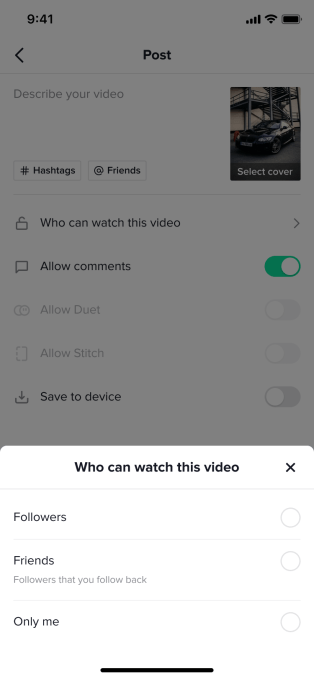
Image Credits: TikTok

TikTok also said it will disable Duet and Stitch for users under 16, but this is not new — it was a part of the privacy changes that rolled out in January.

Separately, teens 16 to 17 will now be asked to make a decision about whether or not their videos can be downloaded by others. While TikTok won’t prevent the teens from making their content downloadable, it will pop up a box that asks them to reconfirm their choice, while reminding them that this means the videos could be shared to other platforms. (Downloads remain disabled for users 13 to 15, meanwhile.)
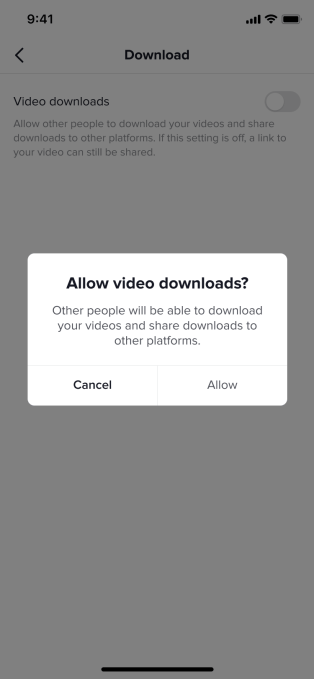
Image Credits: TikTok

The final change is perhaps the most interesting because it’s something neither YouTube nor Instagram introduced: TikTok will limit push notifications.

Younger teens ages 13 to 15 won’t receive any push notifications after 9 PM, while those aged 16 to 17 won’t receive any notifications after 10 PM. (The notifications resume the following morning at 8 AM).

This part of the update is reflective of TikTok’s global mindset and its parent company’s Chinese roots. Today, China is in the midst of a tech crackdown, encompassing antitrust regulations, data security practices, tech business models and even social mores — like the addictive nature of video games, which state media equated to a drug like “opium.”

TikTok, too, has been called out as one of the most addictive social apps on the market, thanks to its advanced personalization technology, interactive design and simple interface, and psychological tricks that activate the pleasure center of users brains. The company already inserts “take a break” videos inside its main feed, because users have been losing hours to scrolling the app. Its decision to limit notifications is yet another acknowledgment of the app’s ability to lead users — and particularly younger users — to create negative digital media habits. By preventing notifications during certain hours, TikTok can point potential regulators to a feature that demonstrates it’s doing something to address that problem.

The changes come at a time when there’s a broader shift in the industry in terms of how tech companies cater to their younger users, as concerns about screen time, addictiveness, online abuse, data collection, privacy and more have been brought to light.

In the U.S., Congress has been pressuring companies to do more to protect younger users from the more harmful and negative impacts of technology.

One key piece of legislation in the works is an update to the decades-old children’s privacy law, COPPA (Children’s Online Privacy Protection Act). A new bill, the Protecting the Information of our Vulnerable Children and Youth Act, would expand COPPA to include teens under the age of 18 and prevent tech companies from using targeted advertising, among other things.

As a result, tech companies have been revamping their products to make teens’ experience more private and they’ve increased protections, including over how teens’ data is collected and used by advertisers.

TikTok was early to take action on protections to teens, as a result of the multimillion-dollar fine by the U.S. Federal Trade Commission for earlier violations of children’s privacy laws in a crackdown by the government agency that later extended to YouTube. Beyond the privacy changes from earlier in the year and take a break reminders, TikTok also led the market by bundling parent controls inside its app with the Family Pairing feature. The company also offers other resources for parents, including educational safety videos and parental guides. And it brought in outside experts to advise on policy creation, with the introduction of the TikTok Content Advisory Council.

“Our priority is to ensure teens on TikTok have a safe and age-appropriate experience as they create and share on our platform,” said Tracy Elizabeth, TikTok’s Global Minor Safety Policy Lead, in a statement about today’s changes. “This announcement builds on our industry-leading efforts to make all accounts under 16 private by default, age-restrict features like direct messaging, and empower parents with Family Pairing,” she said.

TikTok told us the features will roll out globally, over time, but couldn’t share a specific timeframe.


from Social – TechCrunch https://ift.tt/3ABHDap
via IFTTT

Twitter locks account of India’s largest opposition party

Twitter has locked the account of Indian National Congress, the South Asian nation’s largest opposition party, for violating its rules.

The Indian National Congress wrote about the Twitter episode on Facebook Thursday.

“When our leaders were put in jails, we were not scared then why would we be afraid of closing our Twitter accounts now. We are Congress, this is the message of the people, we will fight, we will keep fighting. If it is a crime to raise our voice to get justice for the rape victim girl, then we will do this crime a hundred times. Jai Hind… Satyamev Jayate,” it said.

Rohan Gupta, the head of social media for Congress, alleged that Twitter had taken the step at the direction of the ruling Bharatiya Janata Party, adding that the firm had also suspended profiles of several of the party’s senior leaders.

“The Twitter Rules are enforced judiciously and impartially for everyone on our service. We have taken proactive action on several hundred Tweets that posted an image that violated our Rules, and may continue to do so in line with our range of enforcement options. Certain types of private information carry higher risks than others, and our aim is always to protect individuals’ privacy and safety. We strongly encourage everyone on the service to familiarise themselves with the Twitter Rules and report anything they believe is in violation,” a Twitter spokesperson told TechCrunch.

Last week, Twitter suspended the account of Rahul Gandhi, the former president of the Indian National Congress, after he tweeted pictures with the family of a nine-year-old who was allegedly raped and murdered. The company was shortly reached by the National Commission for Protection of Child Rights, an Indian statutory body, which said the Congress leader’s tweets violated the privacy of a minor victim.

The new episode is Twitter’s latest headache in India. After months-long public discourse with the Indian government, Twitter finally complied with the South Asian nation’s new IT law, which went into effect in May, a lawyer for New Delhi said in a court Tuesday.

This is a developing story. More to follow…


from Social – TechCrunch https://ift.tt/37ApfSH
via IFTTT

India’s VerSe Innovation raises over $450 million to expand Dailyhunt and Josh apps globally

VerSe Innovation, the parent firm of popular news aggregator Dailyhunt and short video app Josh, said on Thursday it has raised over $450 million in a new financing round, just five months after securing $200 million, as the Indian startup looks to expand its offerings to international markets.

Siguler Guff, Baillie Gifford, affiliates of Carlyle Asia Partners Growth II and others financed VerSe Innovation’s Series I round, while existing investors Sofina Group, Qatar Investment Authority and BCap participated.

VerSe Innovation said in a statement that its valuation has more than doubled in the past five months without disclosing a precise figure. The startup was valued at over $1 billion in its Series H financing round.

The Google and Microsoft-backed startup claimed that Josh, which has amassed over 115 million monthly active users, 56 million of whom use the app each day. Dailyhunt, the startup said, has amassed over 300 million monthly active users.

Josh competes with scores of short video apps including Moj and MX TakaTak. All these apps mushroomed after India banned TikTok over cybersecurity concerns in mid-2020 to cash in on the opportunity. ByteDance’s app identified India as its biggest international market, where it had courted over 200 monthly active users.

Moj, which claims to have over 100 million users, is operated by Tiger Global-backed ShareChat that was valued at $2.88 billion in a financing round it unveiled last month. MX TakaTak’s parent firm MX Player is also currently engaging with investors to raise a round that would value the startup at over $1 billion, according to three people aware of the development.

VerSe Innovation is betting on building a family of apps that serves users in scores of local languages. Dailyhunt, for instance, offers its content in 14 languages from over 100,000 content partners and creators. And it plans to replicate the same strategy as it looks to expand in international markets, VerSe Innovation said.

The startup said it also plans to invest in broadening its AI / ML stack to offer users more personalized experience.

The new fundraise comes at a time when Indian startups are raising record capital from high-profile investors. India, which is the world’s second largest internet market, has produced over 20 unicorns this year, up from 11 last year and 6 in 2019. Some investors have also doubled down on the South Asian market after China, one of the other rare big growth markets, enforced a series of regulatory changes that has wiped hundreds of billions of dollars in recent weeks.

This is a developing story. More to follow…


from Social – TechCrunch https://ift.tt/3AGaZod
via IFTTT

Twitter redesigns website with new font, less clutter and high-contrast features

Twitter today is introducing a revamped version of its website, which the company says will make the site more accessible, less cluttered and easier to use. Among the changes, the site is implementing Twitter’s new font, “Chirp,” and it’s changing various elements to become more high-contrast, among other things. Soon, it will roll out new color palettes as well, to allow users to personalize their Twitter experience further.

Chirp was first introduced in January as Twitter’s first proprietary typeface. In the past, the company had relied on fonts like SF Pro, Roboto and Helvetica Neue for its brand. The goal with Chirp — beyond giving Twitter its own form of visual expression — was to offer a typeface that’s sharp and legible for everyday use, but also one that would allow for more personality, including when put into motion or used for brand advertising.

At the time of its debut, however, Twitter had not yet committed to making Chirp the typeface for its wider product, though the creative director for Twitter’s global brand, Derrit DeRouen, said it was his “personal desire” to do so.

Today, Twitter is making Chirp a core part of the new Twitter website.

It’s also making all Western-language text align left, which the company says will make it easier to read as you scroll. (Non-Western text is unchanged.)

The colors on Twitter.com have been updated to be more high-contrast, too, as have the buttons. One notable change is that there’s a lot less of Twitter’s blue on the site. For example, the tweets and the navigation have now shifted to black when using the default Twitter theme with the white background. And the changes to buttons — like Twitter’s “Follow” buttons, for instance — are aimed at making the most important actions stand out, notes Twitter.

These tweaks may seem minor for now, but they could become more important as Twitter rolls out its expanded feature set — like the Super Follow and other features — as they give the company a way to emphasize particular actions it wanted the user to take.

The redesign has removed some of the visual clutter on the screen, too, like what Twitter refers to as “unnecessary divider lines.” There are fewer gray backgrounds, as well as increased space to make text easier to read.

The changes prepare Twitter to make room for a different type of online experience that goes beyond just sharing text-based posts with the occasional photo or other media attached.

With Super Follow, Twitter is aiming to bring more creators onto the platform, and the company is also rolling out e-commerce shopping features, a subscription service for power users, live audio with Spaces, redesigned bookmark collections and more.

But adding features could lead to a more confusing experience, particularly for newcomers, as the new options could begin to crowd the screen. That’s why it makes sense that Twitter is redesigning its website now. However, whether Twitter users will appreciate the update remains to be seen.

The company says today’s changes are just the start of more visual updates to come, though it didn’t hint at what those future tweaks may include. It only noted that it would roll out more color palettes “soon.”


from Social – TechCrunch https://ift.tt/3CDZYVY
via IFTTT