This is default featured slide 1 title

Go to Blogger edit html and find these sentences.Now replace these sentences with your own descriptions.This theme is Bloggerized by Lasantha Bandara - Premiumbloggertemplates.com.

This is default featured slide 2 title

Go to Blogger edit html and find these sentences.Now replace these sentences with your own descriptions.This theme is Bloggerized by Lasantha Bandara - Premiumbloggertemplates.com.

This is default featured slide 3 title

Go to Blogger edit html and find these sentences.Now replace these sentences with your own descriptions.This theme is Bloggerized by Lasantha Bandara - Premiumbloggertemplates.com.

This is default featured slide 4 title

Go to Blogger edit html and find these sentences.Now replace these sentences with your own descriptions.This theme is Bloggerized by Lasantha Bandara - Premiumbloggertemplates.com.

This is default featured slide 5 title

Go to Blogger edit html and find these sentences.Now replace these sentences with your own descriptions.This theme is Bloggerized by Lasantha Bandara - Premiumbloggertemplates.com.

Coronavirus could push consumers away from influencers and toward streaming TV

As the nation struggles with a pandemic and economic uncertainty, fundamental shifts in consumer habits are leading marketers to rethink existing strategies and budgets allocated to influencers and streaming TV.

These significant shifts are nothing new; just as the dot-com bubble reduced landline penetration and boosted mobile phone adoption, the last recession pushed traditional ad spend to digital. It was an option before, but the recession accelerated the trend to targeting select audiences on social media platforms, giving rise to influencers.

Today, social media influencers are so ubiquitous, they risk becoming meaningless.

Prior to the onset of coronavirus, we saw the influencer trend diminishing while the streaming TV trend became more prominent. Today, streaming is still trending up and influencers have actually seen increased levels of engagement, but they face credibility issues, which could lead to a reduction in perceived value to brands.

Streaming has similar, if not more, targeting capabilities as social media, but now it has the eyeballs — the captive audience of quarantined Americans — up 20% this March, according to Nielsen. Marketers on a tight budget will be forced to reevaluate their relationships with influencers as they seek to increase ad spend on streaming TV services.

The evolving realms of influencers


from Social – TechCrunch https://ift.tt/2KA4wCU
via IFTTT

Telegram hits 400 million monthly active users

Instant messaging service Telegram has amassed 400 million monthly active users, it said today, up from 300 million active users the seven-year-old service disclosed to the SEC last October.

The service — founded by Pavel Durov, who also created Russian social networking site VK — said it adds about 1.5 million users each day and is the most downloaded social media app in over 20 nations.

Telegram is working on bringing a secure video call feature to its users this year in response to the growing popularity of Zoom and Houseparty, it said. The company, headquartered in London and Dubai, however, did not talk about the future of its Gram cryptocurrency wallet and TON Blockchain that it had revealed in 2018, but put on hold early this year.

“As the gap in popularity between Telegram and its older competitors narrows, we find more and more validity in that original assumption,” the firm said in a blog post.

Telegram competes with dozens of popular instant messaging services including WhatsApp that has amassed over 2 billion users globally. Telegram often sees a surge in its user base when Facebook-owned service is facing an outage. Durov is also one of the most vocal critics of WhatsApp.

Telegram’s desktop app, which does not require the phone to be connected to the internet to function, and a range of features including folders and cloud storage have won it a loyal set of users.

But these features have also given rise to misuse of its platform with at least a few million of its users relying on the service to distribute and download illegal copies of movies, songs, and applications. Its piracy issue remains prevalent today.

Telegram has always operated with a degree of disregard for the opinions of government authorities and various corporates — that has resulted in some interesting use cases. Telegram, which is banned in China, counts the world’s most populous nation as one of its biggest markets.

People in the nation use virtual private networks (VPN) to download and run Telegram. Amid heavy censorship in China, Telegram became a refuge for WeChat users looking for authoritative information about the coronavirus early this year.

Telegram today revealed a sticker directory that lists over 20,000 stickers, and detailed a handful of improvements such as a new attachment menu on Android. The firm also said it was creating a database of educational tests for students, and plans to distribute 400,000 Euro to creators for creating those tests.

TechCrunch learned last week that the service had reached the 400 million users milestone, but at the time Telegram did not respond to a request for comment.


from Social – TechCrunch https://ift.tt/3cKe1vv
via IFTTT

Facebook pulls ‘pseudoscience’ from its list of targeted ad categories

Even as Mark Zuckerberg touted the “hundreds of thousands of pieces of misinformation related to COVID-19” that the site had pulled in recent months, Facebook continued to offer targeted ads classified as “pseudoscience.” It was an odd choice from a social network so publicly declaring its own campaigns to remove junk science amid a global pandemic.

Using Ad Manager, advertisers were able to serve ads to some 78 million people “who have expressed an interest in pseudoscience.” Following an investigation by The Markup that found the site buying ads to target that category, Facebook says it’s done with the pseudoscience tag.

In a statement to TechCrunch, the company reconfirmed the move. “This interest category of advertising should have been removed in a previous review and we’ve removed it,” Director of Product Management Rob Leathern said. There was never a great time to run junk science ads, of course, but the issue has come to a head in recent weeks and months, as COVID-19 has become a massive hotbed for conspiracy and dangerous cures.

As Zuckerberg noted in his piece last week, popular theories flagged by the company include the notions that “drinking bleach cures the virus or that physical distancing is ineffective at preventing the disease from spreading.” It’s unclear (beyond the obvious answer of ad revenue) why Facebook continued to offer the category until it was essentially called out on the matter.

Other ad networks and social media sites have been taking pains to slow the spread of misinformation. Twitter recently added 5G-related conspiracies to its list of COVID-19 related guidance, while Google just announced that it would be extending its ID verification for its ad systems.


from Social – TechCrunch https://ift.tt/2yFTLfD
via IFTTT

Twitter will remove dubious 5G tweets ‘that could potentially cause harm’

Ever since it first started rolling out, 5G skeptics have attempted to link the next-gen cellular technology to all manner of health issues. Most recently, it’s become an easy scapegoat for the global COVID-19 pandemic, given the rapid rise of both.

Conspiracy theories have gained such a foothold that vigilantes have taken matters into their own hands by destroying cell towers in various European countries. In its latest bid to tamp down on the spread of false information pertaining to the novel coronavirus, Twitter today expanded its COVID-19 guidance to include the topic.

“We’re prioritizing the removal of COVID-19 content when it has a call to action that could potentially cause harm,” a spokesperson for the company told TechCrunch. “As we’ve said previously, we will not take enforcement action on every Tweet that contains incomplete or disputed information about COVID-19. Since introducing these new policies on March 18, we’ve removed more than 2,200 Tweets. As we’ve doubled down on tech, our automated systems have challenged more than 3.4 million accounts which were targeting discussions around COVID-19 with spammy or manipulative behaviors.”

The note seems to leave open the possibility of leaving up some share of 5G claims that don’t “potentially cause harm.” Still, the gray area is fairly wide, when considering activities like property destruction seemingly caused in the name of 5G-related conspiracy.

“We have broadened our guidance on unverified claims that incite people to engage in harmful activity,” the company wrote on social media, “could lead to the destruction or damage of critical 5G infrastructure, or could lead to widespread panic, social unrest or large-scale disorder.”


from Social – TechCrunch https://ift.tt/2Kqz3TR
via IFTTT

Facebook’s $5.7 billion bet on Indian giant Jio spells trouble for Amazon and Flipkart

Facebook’s major bet on Jio Platforms could create a headache for mobile payments services that have amassed tens of millions of users while struggling to find a business model in the world’s second-largest internet market.

The $5.7 billion investment, Facebook’s second-largest to date, could also further its dominance in India — its biggest market by user count — by expanding the reach of consumer-facing services like WhatsApp and expanding its lead over ByteDance’s TikTok, which has amassed more than 250 million Indian users in two years.

But based on what Facebook and Reliance Jio executives have shared — along with feedback from several industry analysts — the companies that need to worry most about this multi-billion-dollar bet are Walmart’s Flipkart, Paytm and Amazon.

Facebook and Jio executives said their companies will work together to build solutions; their biggest synergy would revolve around JioMart and WhatsApp, given that Reliance Jio is India’s top telecom network with more than 380 million subscribers.

One of those collaborations may allow users to find local stores around them on WhatsApp, talk to store operators and place orders from within the Facebook-owned instant messaging service, said Ajit Mohan, a Facebook VP who spearheads the company’s business in India, in an interview with TechCrunch.

“You can browse shops and talk to the shop owner. And ultimately, where we do want to take this flow is for you to be able to place your orders,” he said in an interview with TechCrunch. Mohan refuted reports that Facebook saw the deal as an opportunity to turn WhatsApp into a so-called “super app,” however.


from Social – TechCrunch https://ift.tt/3cKWXFT
via IFTTT

Facebook and Instagram will now show location of posts from high-reach accounts targeting US audiences

Facebook today is introducing another feature aimed at making it easier to see who’s behind the posts published across Facebook and Instagram. The company says it will now display the location of the Facebook Page or Instagram account with a large audience on every post it shares, so end users have a better understanding of how reliable or authentic the accounts may be. While the feature is described as one designed for overall increased transparency, it will initially launch only in the U.S.

That means Facebook will display the location information for Facebook Pages and Instagram accounts that are based outside the U.S., but that reach large audiences located primarily in the U.S.

The move is the latest attempt to crack down on outside influence on U.S. politics and elections, following the revelation that Russia-backed content reached as many as 126 million Americans on Facebook’s platform during and after the 2016 presidential election.

That led Facebook to implement several new processes around Pages and political ad transparency in the years since.
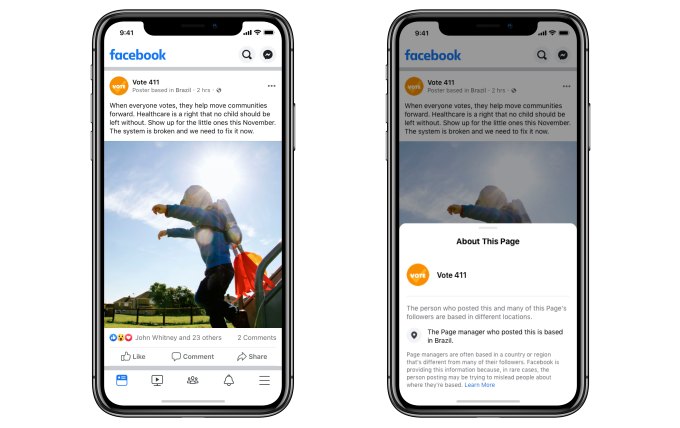
In August 2018, for example, it implemented a new measure for securing Facebook Pages with large U.S. followings in order to make it more difficult for people to administer a Page using a fake or compromised account. This process involved having Facebook Page managers secure their accounts and verify their location. By December 2018, this “People Who Manage This Page” section had rolled out to all Facebook Pages with a large audience.

Facebook last year made this section easier to find by adding it to the Home tab on every Page, and expanded the feature to those who managed Pages with large audiences in India, Indonesia and the EU, as well.

Similar authentication and verification tools were also rolled out to Instagram in 2018.
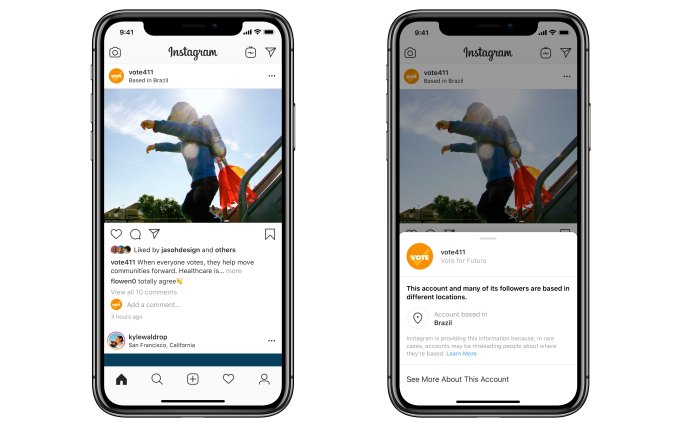
The new feature arriving today is an expansion on those earlier efforts, as it will display the location of the Page or Instagram Account directly beneath their Page or Account name on the posts they share. This will read “Poster based in…” followed by their country on posts published on Facebook and “Based in…” on those published to Instagram.

Users will also be able to access an informational pop-up about the Page or Account which further explains that the person or account who posted this content and many of its followers are based in different locations. The message will also state that Facebook or Instagram is providing this information because some accounts attempt to mislead people about where they’re based.

This is a significant change compared with providing this location information somewhere more buried on the Facebook Page or profile, where it can be easily overlooked. And because it follows the account as the post is shared, it could cut down on the viral re-sharing of misleading information.

However useful, this feature will only be the latest volley in an ongoing war with often state-sponsored propaganda bot networks aimed at misleading Americans. As Facebook’s systems evolve, so will the bot networks’ tactics. They’ll find new ways to fake their location as being U.S.-based…or simply being based outside of Russia. In fact, Russian trolls had already outsourced some of their propaganda efforts to Africa, a recent investigation found. And the battle will continue.

Facebook says it’s piloting the new location transparency feature in the U.S. now and is exploring ways to bring this transparency to more places on Facebook Pages and Instagram Profiles.


from Social – TechCrunch https://ift.tt/2XVLDCz
via IFTTT

Facebook agrees to restrict anti-government content in Vietnam after months of throttling

Facebook has agreed to block access to certain anti-government content to users in Vietnam, following months of having its services throttled there, reportedly by state-owned telecoms.

Reuters, citing sources within the company, reported that Vietnam requested earlier in the year that Facebook restrict a variety of content it deemed illegal, such as posts critical of the government. When the social network balked, the country used its control over local internet providers to slow Facebook traffic to unusable levels.

An explanation at the time that the slowdown was owing to maintenance of undersea cables likely did not convince many, since it was specific to Facebook (and related properties Messenger and Instagram).

All things being equal, Facebook has shown in the past that it would prefer to keep discourse open. But all things are not equal and in this case millions of users were unable to access its services — and consequently, it must be said, unable to be advertised to.

The slowdown lasted some 7 weeks, from mid-February to early April, when Facebook conceded to the government’s demands.

One Reuters source said that “once we committed to restricting more content… the servers were turned back online by the telecommunications operators.”

Facebook offered the following statement confirming general, though not specific, aspects of the story reported by Reuters:

The Vietnamese government has instructed us to restrict access to content which it has deemed to be illegal in Vietnam. We believe freedom of expression is a fundamental human right, and work hard to protect and defend this important civil liberty around the world. However, we have taken this action to ensure our services remain available and usable for millions of people in Vietnam, who rely on them every day.

Facebook is no stranger to government requests both to restrict and to hand over data. Although the company inspects these requests and sometimes challenges them, it’s Facebook’s stated policy to comply with local law — even if that means (as it often does) complicity with government censorship practices.

The justification usually offered (as here) is that people in a country with such restrictions are better served with an incomplete set of Facebook’s communications tools rather than none at all.


from Social – TechCrunch https://ift.tt/2Vtye2V
via IFTTT