This is default featured slide 1 title

Go to Blogger edit html and find these sentences.Now replace these sentences with your own descriptions.This theme is Bloggerized by Lasantha Bandara - Premiumbloggertemplates.com.

This is default featured slide 2 title

Go to Blogger edit html and find these sentences.Now replace these sentences with your own descriptions.This theme is Bloggerized by Lasantha Bandara - Premiumbloggertemplates.com.

This is default featured slide 3 title

Go to Blogger edit html and find these sentences.Now replace these sentences with your own descriptions.This theme is Bloggerized by Lasantha Bandara - Premiumbloggertemplates.com.

This is default featured slide 4 title

Go to Blogger edit html and find these sentences.Now replace these sentences with your own descriptions.This theme is Bloggerized by Lasantha Bandara - Premiumbloggertemplates.com.

This is default featured slide 5 title

Go to Blogger edit html and find these sentences.Now replace these sentences with your own descriptions.This theme is Bloggerized by Lasantha Bandara - Premiumbloggertemplates.com.

After restricting a group critical of Thailand’s monarchy, Facebook says it will take legal action against the government

After restricting access to a popular group with posts critical of Thailand’s monarchy, Facebook is planning legal action against the Thai government, which the social media giant says forced it to restrict content deemed to be illegal.

On Monday, Reuters reported access to Royalist Marketplace had been blocked within Thailand. Users there who try to visit the group, which has more than a million members, now see a message that says access to it has “been restricted within Thailand pursuant to a legal request from the Ministry of Digital Economy and Society.”

In a media statement emailed to TechCrunch, a Facebook spokesperson said, “After careful review, Facebook has determined that we are compelled to restrict access to content which the Thai government has deemed to be illegal. Requests like this are severe, contravene international human rights law, and have a chilling effect on people’s ability to express themselves. We work to protect and defend the rights of all internet users and are preparing to legally challenge this request.”

The spokesperson added, “excessive government actions like this also undermine our ability to reliably invest in Thailand, including maintaining an office, safeguarding our employees, and directly supporting businesses that rely on Facebook.”

The group was started in April by Pavin Chachavalpongpun, a dissident living in self-exile in Japan, where he is an associate professor of political science at Kyoto University’s Center for Southeast Asian Studies.

Pavin told Reuters that Royalist Marketplace “is part of the democratization process, it is a space for freedom of expression. By doing this, Facebook is cooperating with the authoritarian regime to obstruct democracy and cultivating authoritarianism in Thailand.”

The geo-restriction of Royalist Marketplace comes as thousands of pro-democracy protestors in Bangkok demand reform of the monarchy, including abolition of a strict lese-majeste law that mandates prison sentences of up to 15 years for people who defame members of the monarchy.

Pavin has been openly critical of Thailand’s monarchy. In a piece published on the Council of Foreign Relation’s website earlier this month, Pavin wrote that “for several decades now, the supposedly constitutional monarchy of Thailand has often proven to extend its powers beyond constitutional norms and rules,” intervening in politics as the current king, Maha Vajiralongkorn, established closer ties with the military.

In a 2014 New York Times opinion piece, Pavin described having a warrant issued for his arrest by the military junta that overthrew the democratically elected government of Yingluck Shinawatra in 2014. He was also attacked by a intruder in his Kyoto apparent, which Pavin believes “was a warning for my continuing to hold, and express, my positions.”

The restriction of Thai users’ access to Royalist Marketplace took place three weeks after Thailand’s Minister of Digital Economy and Society, Puttipong Punnakanta, threatened to take action against Facebook because he said it did not comply quickly enough with the government’s requests to restrict content.

In 2016, Thailand enacted the Computer-Related Crime Act, which the Human Rights Watch warned “gives overly broad powers to the government to restrict free speech, enforce surveillance and censorship, and retaliate against activists.”

Facebook is also under scrutiny in India, its biggest market by number of users, after The Wall Street Journal reported that Ankhi Das, the company’s top public policy executive in India, had opposed applying the platform’s hate-speech rules to a member of Prime Minister Narendra Modi’s party.


from Social – TechCrunch https://ift.tt/2Ywou9e
via IFTTT

Facebook is bringing a Shop section to its app, while Instagram expands Live Shopping

Facebook is announcing a number of new e-commerce features both within the main Facebook app and on Instagram.

The pandemic has forced many businesses to shift online, and Facebook made a big announcement in May around the ability of merchants to create Facebook Shops that are viewable on both Facebook and Instagram. More recently, Instagram launched a redesigned Shop section, where users can browse products from their favorite brands and creators.

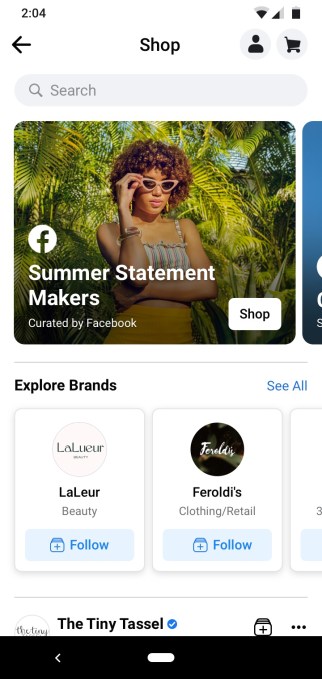
Now the company is bringing a similar experience to the main Facebook app. The company said that in the United States, it’s started testing a new section called Facebook Shop — like Instagram Shop, it’s basically a shopping destination where you can find products from a variety of different businesses. (This is distinct from Facebook Marketplace, which is designed for peer-to-peer sales.)

Director of Product Management George Lee told me the goal is to create something that’s “unique to the Facebook app and the Facebook community.”

Facebook Shop

Image Credits: Facebook

“That’s not to say that there aren’t learnings across the board,” he said. “[Instagram Shop and Facebook Shop] probably look like slightly different on day one, and the goal is not to have them be cookie cutters of the same experience.”

In addition, the company is announcing new tools for businesses running Facebook Shops, including new design layouts, the ability to see a real-time preview of collections, the ability to automatically create Shops if you’re a new seller and new data in Commerce Manager. Shops will also feature a new messaging option for customers to send sellers a message through Messenger, WhatsApp or Instagram Direct.

On the Instagram side, the company said all sellers in the United States will be able to use the Instagram checkout feature “in the coming weeks,” managed either through Facebook’s Commerce Manager or through partners platforms BigCommerce and Shopify (with more integrations planned). Instagram will waive its selling fee for checkout through the rest of the year.

The company has also been testing a live shopping experience, where businesses can show off products in a live video, while consumers can browse the highlighted products and make purchases. Instagram Live Shopping should now be available to all sellers using Instagram Live Shopping in the United States.

Instagram Live Shopping

Image Credits: Facebook

“We’ve seen live shopping take off in other parts of the world,” said Instagram’s vice president of product Vishal Shah. “The pandemic has really changed behavior from a consumer perspective, so we’re moving as fast as we can to bring out these tools to help [businesses respond].”


from Social – TechCrunch https://ift.tt/34rIRbs
via IFTTT

Daily Crunch: TikTok sues the US government

TikTok fights its U.S. ban, Twitter takes action against another Trump tweet and Unity files to go public. This is your Daily Crunch for August 24, 2020.

The big story: TikTok sues the U.S. government

TikTok is fighting back against the Trump administration’s decision to ban the popular video app in the U.S. market (unless it’s sold to an American buyer). The company filed a lawsuit today claiming that the president’s executive order was signed without evidence or due process.

In its suit, the company argued:

The executive order seeks to ban TikTok purportedly because of the speculative possibility that the application could be manipulated by the Chinese government. But, as the U.S. government is well aware, Plaintiffs have taken extraordinary measures to protect the privacy and security of TikTok’s U.S. user data including by having TikTok store such data outside of China (in the United States and Singapore) and by erecting software barriers that help ensure that TikTok stores its U.S. user data separately from the user data of other ByteDance products.

The tech giants

Twitter hides Trump tweet behind notice for potentially dissuading people from voting — In the tweet, posted on Monday, Trump claimed mail drop boxes are a “voter security disaster” and also said they are “not COVID sanitized.”

Zoom meetings hit by outage — Don’t worry, the outage has been resolved.

Facebook to pay $125 million in back taxes in France — French tax authorities raided Facebook’s offices in Paris in 2012 and later opened an investigation on unpaid taxes covering activities between 2009 and 2018.

Startups, funding and venture capital

Sequoia strikes gold with Unity’s IPO filing — After much anticipation, video game engine Unity filed its Form S-1 with the SEC as it prepares a roadshow to go public in the coming weeks.

SugarCRM acquires Node to gain predictive customer intelligence — The acquisition will add a customer prediction element to Sugar’s platform.

With $11 million in fresh capital, Bolt Bikes rebrands to Zoomo — The new name is meant to reflect a customer base that has expanded beyond gig economy workers to include corporate clients and everyday consumers.

Advice and analysis from Extra Crunch

Five VCs discuss how no-code is going horizontal across the world’s industries — Few topics garner cheers and groans quite as quickly as the no-code software explosion.

Red Antler’s Emily Heyward explains how to get people obsessed with your brand — Heyward’s branding company has worked with some of the most iconic startups of the past decade, such as Casper, Allbirds, Brandless and Prose.

Unpacking the Sumo Logic S-1 filing — The company’s showing strong growth for a business now comfortably into the nine-figure annual revenue range.

(Reminder: Extra Crunch is our subscription membership program, which aims to democratize information about startups. You can sign up here.)

Everything else

Conan is coming to Disrupt 2020 — Conan O’Brien will be discussing his shift to podcasting, and more.

Original Content podcast: On Netflix’s ‘Selling Sunset’, everyone’s a villain — Speaking of podcasts, we’ve got a review of the evil-but-addictive Netflix reality show “Selling Sunset.”

The Daily Crunch is TechCrunch’s roundup of our biggest and most important stories. If you’d like to get this delivered to your inbox every day at around 3pm Pacific, you can subscribe here.


from Social – TechCrunch https://ift.tt/2YvIM2E
via IFTTT

TikTok-rival Triller inks deal with Reliance’s JioSaavn in India push

Triller, an app that functions similarly to TikTok, has inked a strategic partnership with a platform owned by India’s richest man to cash in on the Chinese app’s ban in its biggest international market.

The Los Angeles-headquartered firm said on Monday it has partnered with Reliance’s JioSaavn music app to embed Triller videos into the streamer “front and center.”

As part of what Triller said was the “first of many announcements to come from these two digital powerhouses,” JioSaavn app will also provide a “prominent” button on its main screen that will enable its users to create a Triller video, the American firm said.

The announcement comes as scores of local startups have rushed to fill the void from New Delhi’s ban on TikTok and 58 other Chinese apps over cybersecurity concerns created at the end of June this year.

Some of the local firms that are attempting to cash in on TikTok’s absence include on-demand video streaming service Zee5, news aggregator app DailyHunt and Times Internet’s music streaming service Gaana and video streamer MX Player.

So Indian billionaire Mukesh Ambani’s JioSaavn, one of the largest music streaming services in India, showing user-generated videos doesn’t sound like an absurd idea anymore.

Triller claims JioSaavn has amassed over 300 million users in India. I don’t think so: Its Android app had fewer than 30 million weekly active users earlier this month, according to one of the top mobile insight firms. And a press release from two months ago on JioSaavn’s website says it had over 104 million monthly active users.

But what is more interesting about this partnership is that it exists at all. As of early this month, Reliance Industries, the firm that runs telecom giant Jio Platforms, was in early discussions with ByteDance to invest in TikTok’s operations in India. (Jio Platforms, which has raised over $20 billion from Facebook and a dozen other investors this year, operates a bouquet of digital services, including JioTV, JioCinema, and Haptik.)

At any rate, Rishi Malhotra, co-founder and chief executive of JioSaavn, said the partnership with Triller will enable “artists to create and express our culture in the most innovative ways. We are confident that this partnership will exponentially grow both companies.”

Bobby Sarnevesht, executive chairman of Triller, said he was pleased, too, in a statement.


from Social – TechCrunch https://ift.tt/2Efctyd
via IFTTT

Facebook to pay $125 million in back taxes in France

Facebook France is going to pay $125 million (€106 million) in back taxes. Business magazine Capital first reported the agreement. French tax authorities raided Facebook’s offices in Paris in 2012 and later opened an investigation on unpaid taxes covering activities between 2009 and 2018.

“This year, we also reached an agreement with the tax authorities covering the years 2009 – 2018, under which we will pay a settlement of 106 million euros. We take our tax obligations seriously and work closely with tax authorities around the world to ensure compliance with all applicable tax laws and to resolve any disputes, as we have done with the French tax authorities,” a Facebook spokesperson told TechCrunch.

According to the investigation, Facebook allegedly optimized its effective tax rate in France by funneling sales to other subsidiaries in different European countries.

It’s a grey area, as funneling sales to a different country is legal. But you have to prove that there wasn’t any sales person based in France selling to a French customer. Those contracts can be reclassified as French contracts.

Many tech companies have had to pay back taxes in France for the same issue. For instance, Google agreed to pay a $549 million fine and $510 million in back taxes in 2019. Similarly, Apple settled a dispute covering $572 million in back taxes.

This is a new strategy for French authorities. Companies can avoid a public fight if they settle with tax authorities directly. This way, companies avoid some public backlash and it speeds up the process. Amazon was the first company to settle in 2018.

“We pay the taxes we owe in every market we operate. Since 2018, we have changed our selling structure so that revenue from advertisers supported by the team in France is now recorded in this country. This year, we are paying EUR8.46m in tax revenue in France, a nearly 50% increase on last year,” a Facebook spokesperson told TechCrunch.

Even more significant, the company’s revenue in France has jumped from €56 million to €389 million between 2017 and 2018, representing a nearly 600% revenue increase in 12 months.


from Social – TechCrunch https://ift.tt/3gqDsDC
via IFTTT

This subscription social network is happy to be an Albatross in a pandemic

In discussions of ethically dubious social networks Facebook is the usual reference choice. But spare a thought for subscribers of InterNations, a Munich-based social networking community for expats, who have found themselves unable to obtain refunds for full-year payments charged in the middle of the coronavirus crisis.

InterNations has operated an expat networking experience since 2007, offering a free ‘Basic’ tier of membership that gives users some access to site content and community-organized events (if they pay an entry fee); or a premium tier which requires shelling out for a year’s subscription up front to get free/reduced price entry to networking events, plus access to some additional site features.

The German company appears to be a fan of nominative determinism — having named the subscription tier of membership ‘Albatross‘, given how difficult it is for users to exit once they upgrade from Basic to paying, perpetually renewing contract.

Several former members told us their memberships were auto-renewed for a full year without any warning in the middle of the pandemic. When they contacted InterNations to request a refund they were point-blank refused — with the company saying they were bound by the terms of the contract they’d entered into when they paid to upgrade the year before.

In emails we’ve reviewed between users and InterNations’ staff the company repeatedly ignores requests for refunds.

One UK-based user, who told us she had signed up to use the service to attend networking events in London and Paris, where she travelled regularly for work, found herself put on furlough in March when the UK went into lockdown. She only noticed the InterNations subscription had autorenewed when she saw a charge as she was checking her bank statement.

She contacted InterNations to request a refund — pointing out there were now no physical events near her, nor would she be able to attend in-person networking events for the foreseeable future due to shielding as a result of personal vulnerability to the health risk posed by COVID-19. But InterNations still refused to refund her subscription.

Instead it offered to put the year’s ‘Albatross’ membership on hold until 2022 — suggesting she might be able to make use of the services she’d just been billed for in two years’ time.

“Many of the people complaining feel aggrieved by InterNation because the entire event offering is very much voluntary and community based. It relies on people stepping forward to organise groups of people to attend events, walks, screening etc. Most of them do not make financial gain out of it,” she told us.

“So for this organisation not to be looking after its very own community feels like a slap on our faces.”

“My local gym froze my membership from April 2020 without any of its members having to request it. They informed us by email, they would do this. I was able to cancel in July without any question asked,” she added. “If my small gym is able to do this, how come InterNations is not stopping the auto-renewal of the membership at such a time?

“When everyone almost worldwide is worrying about their health, their livelihood, their relatives, we are not remembering to cancel or to stop memberships.”

Another user, who signed up to the service after moving from the US to Singapore, told us he was sent repeated payment demands in the middle of the coronavirus crisis after his on-file credit card had expired — which meant InterNations couldn’t auto collect his payment.

He told it he wanted to cancel the subscription but it told him he would only able to delete his account if he paid up for a full second year. Eventually he said he felt he had no choice but to pay the demand for around $100 in order that he could downgrade from ‘Albatross’ to ‘Basic’ and have his account deleted.

“I was (and still am) a paid subscriber and during the height of the pandemic I never received an offer of ‘free months’ of membership,” he said. “Instead, all I got was a deluge of threatening emails about how they couldn’t process my credit card information. Nothing even remotely about whether I was sick or even still alive. They just wanted my credit card details.”

A third user, who signed up for the service after moving to Hanoi, summed up her experience as “not the best”. She pointed us to a blog post in which she recounts a similar story — finding herself charged for a renewal in the middle of the coronavirus without any advance warning and having forgotten to cancel the subscription herself.

“I didn’t realise I’d been charged until a notification from PayPal arrived in my inbox,” she writes. “Say, what? Where was the email reminder? Where was the ‘now due’ invoice that is the hallmark of good business? Turns out InterNations don’t send them.”

This user was finally able to obtain a refund — but only via disputing the charge through PayPal. She got no joy asking for her money back from InterNations itself.

A deluge of similar complaints about the company can be seen on Trustpilot — where InterNations has an 81% ‘bad’ rating at the time of writing.

“An annual membership was taken from my account, and refund was refused. A year on and I am being threatened with non payment of a new invoice,” writes one reviewer.

“I cancelled my membership the past two years and every year it shows that I didn’t and their records conveniently show no record of my cancellation. Then they will refuse refunds,” recounts another.

“InterNations contacted me via automated email about my membership payment being due. When I responded, asking to cancel membership since I haven’t logged in in months and can’t afford membership during these times, they refused to help,” says another irate reviewer. “They make it impossible to do this simple task. They’re greedily unable to help with anything other than take your money. No empathy. All they have to do is cancel the membership.”

“They don’t even send a reminder for end of membership. Some people have seen their credit card debited, without any reminder. And if your credit card you registered has expired, they keep harassing you and threaten you,” runs another despairing former user.

In emails to users who are requesting a refund which we’ve seen InterNations simply points them to German law — which does appear to be the legal sticking point here. As a number of expat blogs warn, service contracts in Germany can be a lot harder to get out of than into.

Though, of course, it’s unlikely to have been immediately clear to people signing up to a global social network in cities like Hanoi and Singapore that they needed to understand German contract law before hitting ‘subscribe’.

BEUC, the European consumer rights group, told us there’s no pan-EU requirement for a notification to be actively sent to users ahead of an auto-renewal of a services contract — and the lack of such a notification ahead of the InterNations subscription renewal is one of the key recurring complaints.

“EU law only requires the consumer to be informed of the final price and the contractual conditions,” a spokesperson said, noting that consumer rights can vary substantially from member state to member state as the area isn’t harmonised at EU level.

So, while BEUC noted that, for example, Belgium law does have a specific provision which allows the consumer to terminate a contract at no cost after its tacit renewal — Germany, self evidently, does not. Although domestic pressure appears to be growing for reform of its one-sided contract rules.

When we put the various complaints we’d heard about refunds and cancelations (and indeed dark patterns) to InterNations, its founder and co-CEO, Malte Zeeck, said the company does not breach consumer law — and further claimed it “clearly communicates” subscription renewals to users.

“InterNations is operating on a standard subscription model like many other businesses, which is at no point in breach of consumer protection laws,” he said. “Subscriptions are renewed automatically, which is clearly communicated at the beginning of each subscription period, in each invoice, and in every user’s membership and account settings. This is also where a subscription can be cancelled at any time, without a notice period that has to be observed.

“Our members have a continual visual reminder of their membership status through the Albatross symbol found on their profile picture. They can also always see their current membership status by visiting their membership page.”

And while he conceded that InterNations had had to cancel in-person events “during the height of the pandemic” he said it substituted this reduction in service by offering “additional free months of membership” and “working very hard to respond to the situation and find ways for our members to still meet and spend time together online”.

“After only a few weeks, we already offered over 500 online activities worldwide to help expats and global minds connect and share experiences — more online events were being added every day,” he added. “In addition, our users continued to benefit from other online networking and information features our premium membership offers. Since restrictions on in-person events are being lifted around the world, we have started to offer many opportunities for our members again to meet in person.”

EU consumer protection rules do bake in requirements that contract terms be fair — with provisions intended to protect against things like one-sided changes to a service without a valid reason. But it’s pretty clear that InterNations could argue a pandemic is a valid reason for canceling in person events and replacing them with online networking. So angry users are unlikely to find much solace there.

Still, maintaining such an inflexible and user hostile attitude during a pandemic does look risky for InterNations and its reputation, given new users are likely to be far less easy for it to net now the coronavirus has settled like a dead calm on so much foreign travel.

So while it might be legally entitled to sit and claw in revenue from people who — living through a pandemic and worried about things like their jobs, health and loved ones — forgot to cancel a subscription that only comes round once a year, it’s hardly a recipe for long-term customer loyalty.

Indeed, we’ve seen these kind of auto-renewing subscription gigs crop up in the ecommerce space in years past. And none of those dubious tactics went the distance.

Tricking consumers into recurring payments is never a good long term business strategy and it certainly isn’t now that reputational damage can scale all over social media in seconds. (To wit: Irate InterNations users have been organizing via Twitter and have set up a website to amplify negative reviews where they urge people to boycott the service.)

None of the people who’ve been stung by InterNations’ auto-renewing subscription are likely to forget to cancel a second time so won’t be a source of recurring revenue in future. And treating users like so much chum when the company also relies upon their community spirit to power its service looks like a rotten business model long past its sell-by-date. (However many members InterNations claims have contacted it “to say how much our online events have helped them to stay in touch with people and also stay positive during a period of self-isolation”, a minority of satisfied customers are being drowned out by all the angry online views.)

In the meanwhile, it’s certainly curious to encounter a niche social network that’s happy operating with as little regard for users’ wishes as some of the far more maligned giants of the category. To the point where its website displays information regarding the European Commission’s “online dispute resolution” platform in small print right on the contacts page. Er, perhaps Facebook should take note.

On unhappy users, Zeeck only had this to say: “We are sorry that some of our former members perceive this differently and were not happy with the benefits our membership offered them. We are always taking our users’ feedback seriously and are working hard to provide a great experience for them. At the same time, we are aware that it is hard to have the perfect solution for everybody, and there will always be detractors.”

But perhaps he’s been taking cues from Mark Zuckerberg’s neverending apology tours.


from Social – TechCrunch https://ift.tt/2FG782Z
via IFTTT

Facebook trails expanding portability tools ahead of FTC hearing

Facebook is considering expanding the types of data its users are able to port directly to alternative platforms.

In comments on portability sent to US regulators ahead of an FTC hearing on the topic next month, Facebook says it intends to expand the scope of its data portability offerings “in the coming months”.

It also offers some “possible examples” of how it could build on the photo portability tool it began rolling out last year — suggesting it could in future allow users to transfer media they’ve produced or shared on Facebook to a rival platform or take a copy of their “most meaningful posts” elsewhere.

Allowing Facebook-based events to be shared to third party cloud-based calendar services is another example cited in Facebook’s paper.

It suggests expanding portability in such ways could help content creators build their brands on other platforms or help event organizers by enabling them to track Facebook events using calendar based tools.

However there are no firm commitments from Facebook to any specific portability product launches or expansions of what it offers currently.

For now the tech giant only lets Facebook users directly send copies of their photos to Google’s eponymous photo storage service — a transfer tool it switched on for all users this June.

“We remain committed to ensuring the current product remains stable and performant for people and we are also exploring how we might extend this tool, mindful of the need to preserve the privacy of our users and the integrity of our services,” Facebook writes of its photo transfer tool.

On whether it will expand support for porting photos to other rival services (i.e. not just Google Photos) Facebook has this non-committal line to offer regulators: “Supporting these additional use cases will mean finding more destinations to which people can transfer their data. In the short term, we’ll pursue these destination partnerships through bilateral agreements informed by user interest and expressions of interest from potential partners.”

Beyond allowing photo porting to Google Photos, Facebook users have long been able to download a copy of some of the information it holds on them.

But the kind of portability regulators are increasingly interested in is about going much further than that — meaning offering mechanisms that enable easy and secure data transfers to other services in a way that could encourage and support fast-moving competition to attention-monopolizing tech giants.

The Federal Trade Commission is due to host a public workshop on September 22, 2020, which it says will  “examine the potential benefits and challenges to consumers and competition raised by data portability”.

The regulator notes that the topic has gained interest following the implementation of major privacy laws that include data portability requirements — such as the European Union’s General Data Protection Regulation (GDPR) and the California Consumer Privacy Act (CCPA).

It asked for comment submissions by August 21, which is what Facebook’s paper is responding to.

In comments to the Reuters news agency, Facebook’s privacy and public policy manager, Bijan Madhani, said the company wants to see “dedicated portability legislation” coming out of any post-workshop recommendations.

It reports that Facebook supports a portability bill that’s doing the rounds in Congress — called the Access Act, which is sponsored by Democratic Senators Richard Blumenthal and Mark Warner, and Republican senator Josh Hawley — which would require large tech platforms to let their users easily move their data to other services.

Albeit Madhani dubs it a good first step, adding that the company will continue to engage with the lawmakers on shaping its contents.

“Although some laws already guarantee the right to portability, our experience suggests that companies and people would benefit from additional guidance about what it means to put those rules into practice,” Facebook also writes in its comments to the FTC.

Ahead of dipping its toe into portability via the photo transfer tool, Facebook released a white paper on portability last year, seeking to shape the debate and influence regulatory thinking around any tighter or more narrowly defined portability requirements.

In recent months Mark Zuckerberg has also put in facetime to lobby EU lawmakers on the topic, as they work on updating regulations around digital services.

The Facebook founder pushed the European Commission to narrow the types of data that should fall under portability rules. In the public discussion with commissioner Thierry Breton, in May, he raised the example of the Cambridge Analytica Facebook data misuse scandal, claiming the episode illustrated the risks of too much platform “openness” — and arguing that there are “direct trade-offs about openness and privacy”.

Zuckerberg went on to press for regulation that helps industry “balance these two important values around openness and privacy”. So it’s clear the company is hoping to shape the conversation about what portability should mean in practice.

Or, to put it another way, Facebook wants to be able to define which data can flow to rivals and which can’t.

“Our position is that portability obligations should not mandate the inclusion of observed and inferred data types,” Facebook writes in further comments to the FTC — lobbying to put broad limits on how much insight rivals would be able to gain into Facebook users who wish to take their data elsewhere.

Both its white paper and comments to the FTC plough this preferred furrow of making portability into a ‘hard problem’ for regulators, by digging up downsides and fleshing out conundrums — such as how to tackle social graph data.

On portability requests that wrap up data on what Facebook refers to as “non-requesting users”, its comments to the FTC work to sew doubt about the use of consent mechanisms to allow people to grant each other permission to have their data exported from a particular service — with the company questioning whether services “could offer meaningful choice and control to non-requesting users”.

“Would requiring consent inappropriately restrict portability? If not, how could consent be obtained? Should, for example, non-requesting users have the ability to choose whether their data is exported each time one of their friends wants to share it with an app? Could an approach offering this level of granularity or frequency of notice could lead to notice fatigue?” Facebook writes, skipping lightly over the irony given the levels of fatigue its own apps’ default notifications can generate for users.

Facebook also appears to be advocating for an independent body or regulator to focus on policy questions and liability issues tied to portability, writing in a blog post announcing its FTC submission: “In our comments, we encourage the FTC to examine portability in practice. We also ask it to recommend dedicated federal portability legislation and provide advice to industry on the policy and regulatory tensions we highlight, so that companies implementing data portability have the clear rules and certainty necessary to build privacy-protective products that enhance people’s choice and control online.”

In its FTC submission the company goes on to suggest that “an independent mechanism or body” could “collaboratively set privacy and security standards to ensure data portability partnerships or participation in a portability ecosystem that are transparent and consistent with the broader goals of data portability”.

Facebook then further floats the idea of an accreditation model under which recipients of user data “could demonstrate, through certification to an independent body, that they meet the data protection and processing standards found in a particular regulation, such as the [EU’s] GDPR or associated code of conduct”.

“Accredited entities could then be identified with a seal and would be eligible to receive data from transferring service providers. The independent body (potentially in consultation with relevant regulators) could work to assess compliance of certifying entities, revoking accreditation where appropriate,” it further suggests.

However its paper also notes the risk that requiring accreditation might present a barrier to entry for the small businesses and startups that might otherwise be best positioned to benefit from portability.


from Social – TechCrunch https://ift.tt/34rH7Pc
via IFTTT