This is default featured slide 1 title

Go to Blogger edit html and find these sentences.Now replace these sentences with your own descriptions.This theme is Bloggerized by Lasantha Bandara - Premiumbloggertemplates.com.

This is default featured slide 2 title

Go to Blogger edit html and find these sentences.Now replace these sentences with your own descriptions.This theme is Bloggerized by Lasantha Bandara - Premiumbloggertemplates.com.

This is default featured slide 3 title

Go to Blogger edit html and find these sentences.Now replace these sentences with your own descriptions.This theme is Bloggerized by Lasantha Bandara - Premiumbloggertemplates.com.

This is default featured slide 4 title

Go to Blogger edit html and find these sentences.Now replace these sentences with your own descriptions.This theme is Bloggerized by Lasantha Bandara - Premiumbloggertemplates.com.

This is default featured slide 5 title

Go to Blogger edit html and find these sentences.Now replace these sentences with your own descriptions.This theme is Bloggerized by Lasantha Bandara - Premiumbloggertemplates.com.

Instagram launches tools to filter out abusive DMs based on keywords and emojis, and to block people, even on new accounts

Facebook and its family of apps have long grappled with the issue of how to better manage — and eradicate — bullying and other harassment on its platform, turning both to algorithms and humans in its efforts to tackle the problem better. In the latest development, today, Instagram is announcing some new tools of its own.

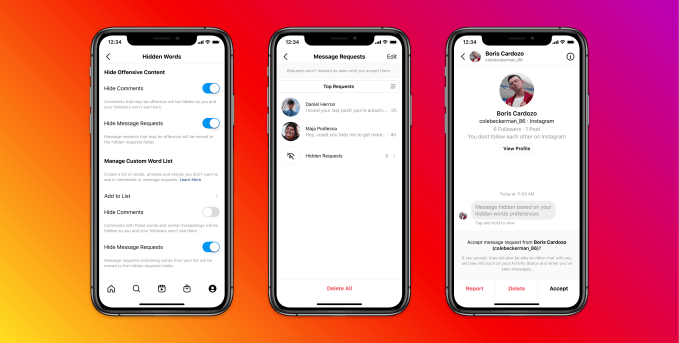
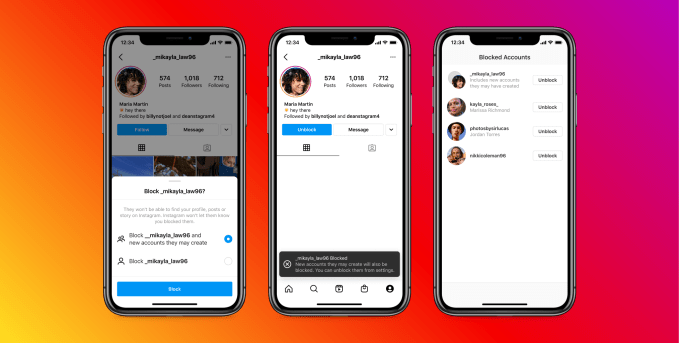
First, it’s introducing a new way for people to further shield themselves from harassment in their direct messages, specifically in message requests by way of a new set of words, phrases and emojis that might signal abusive content, which will also include common misspellings of those key terms, sometimes used to try to evade the filters. Second, it’s giving users the ability to proactively block people even if they try to contact the user in question over a new account.

The blocking account feature is going live globally in the next few weeks, Instagram said, and it confirmed to me that the feature to filter out abusive DMs will start rolling out in the UK, France, Germany, Ireland, Canada, Australia and New Zealand in a few weeks’ time before becoming available in more countries over the next few months.

Notably, these features are only being rolled out on Instagram — not Messenger, and not WhatsApp, Facebook’s other two hugely popular apps that enable direct messaging. The spokesperson confirmed that Facebook hopes to bring it to other apps in the stable later this year. (Instagram and others have regularly issued updates on single apps before considering how to roll them out more widely.)

Instagram said that the feature to scan DMs for abusive content — which will be based on a list of words and emojis that Facebook compiles with the help of anti-discrimination and anti-bullying organizations (it did not specify which), along with terms and emoji’s that you might add in yourself — has to be turned on proactively, rather than being made available by default.

Why? More user license, it seems, and to keep conversations private if uses want them to be. “We want to respect peoples’ privacy and give people control over their experiences in a way that works best for them,” a spokesperson said, pointing out that this is similar to how its comment filters also work. It will live in Settings>Privacy>Hidden Words for those who will want to turn on the control.
There are a number of third-party services out there in the wild now building content moderation tools that sniff out harassment and hate speech — they include the likes of Sentropy and Hive — but what has been interesting is that the larger technology companies up to now have opted to build these tools themselves. That is also the case here, the company confirmed.

The system is completely automated, although Facebook noted that it reviews any content that gets reported. While it doesn’t keep data from those interactions, it confirmed that it will be using reported words to continue building its bigger database of terms that will trigger content getting blocked, and subsequently deleting, blocking and reporting the people who are sending it.

On the subject of those people, it’s been a long time coming that Facebook has started to get smarter on how it handles the fact that the people with really ill intent have wasted no time in building multiple accounts to pick up the slack when their primary profiles get blocked. People have been aggravated by this loophole for as long as DMs have been around, even though Facebook’s harassment policies had already prohibited people from repeatedly contacting someone who doesn’t want to hear from them, and the company had already also prohibited recidivism, which as Facebook describes it, means “if someone’s account is disabled for breaking our rules, we would remove any new accounts they create whenever we become aware of it.”
The company’s approach to Direct Messages has been something of a template for how other social media companies have built these out.

In essence, they are open-ended by default, with one inbox reserved for actual contacts, but a second one for anyone at all to contact you. While some people just ignore that second box altogether, the nature of how Instagram works and is built is for more, not less, contact with others, and that means people will use those second inboxes for their DMs more than they might, for example, delve into their spam inboxes in email.

The bigger issue continues to be a game of whack-a-mole, however, and one that not just its users are asking for more help to solve. As Facebook continues to find itself under the scrutinizing eye of regulators, harassment — and better management of it — has emerged as a very key area that it will be required to solve before others do the solving for it.


from Social – TechCrunch https://ift.tt/3asoZHv
via IFTTT

Facebook is expanding Spotify partnership with new ‘Boombox’ project

Facebook is deepening its relationship with music company Spotify and will allow users to listen to music hosted on Spotify while browsing through its apps as part of a new initiative called “Project Boombox,” Facebook CEO Mark Zuckerberg said Monday.

Facebook is building an in-line audio player that will allow users to listen to songs or playlists being shared on the platforms without being externally linked to Spotify’s app or website. Zuckerberg highlighted the feature as another product designed to improve the experience of creators on its platforms, specifically the ability of musicians to share their work, “basically making audio a first-class type of media,” he said.

We understand from sources familiar with the Spotify integration that this player will support both music and podcasts. It has already been tested in non-U.S. markets, including Mexico and Thailand, and it’s expected to arrive in about a week.

The news was revealed in a wide-ranging interview with reporter Casey Newton on the company’s future pursuits in the audio world as Facebook aims to keep pace with upstart efforts like Clubhouse and increased activity in the podcasting world. 

“We think that audio is going to be a first-class medium and that there are all these different products to be built across this whole spectrum,” said Zuckerberg. “Of course, it includes some areas that, that have been, you know, popular recently like podcasting and kind of live audio rooms like this, but I also think that there’s some interesting things that are under-explored in the area overall.”

Spotify has already supported a fairly productive relationship with the Facebook and Instagram platforms. In recent years the music and podcasts platform has been integrated more deeply into Instagram Stories where users can share content from the service, a feature that’s also been available in Facebook Stories.


from Social – TechCrunch https://ift.tt/3txVDPk
via IFTTT

Daily Crunch: Facebook announces new audio products

Facebook reveals its Clubhouse competitor, Parler will return to Apple’s App Store and a helicopter flies on Mars. This is your Daily Crunch for April 19, 2021.

The big story: Facebook announces new audio products

Yes, these products include new Clubhouse-style Live Audio Rooms, as well as the ability for podcasters to share long-form audio, some new Spotify integration and a shorter format called Soundbites. Facebook is starting off by testing Live Audio Rooms in Facebook Groups.

“When we launched video rooms earlier last year, groups and communities were one of the bigger areas where that took off,” CEO Mark Zuckerberg said in an interview with Platformer. “So, I think around audio, just given how much more accessible it is, that’ll be a pretty exciting area as well.”

The tech giants

Apple confirms it will allow Parler to return to App Store — Apple says that after Parler’s proposed updates, it should be approved for reinstatement to the App Store.

Consumer agency warns against Peloton Tread+ use, as company pushes back — The U.S. Consumer Product Safety Commission is warning consumers to stop using the Tread+.

Xbox Cloud Gaming beta starts rolling out on iOS and PC this week — The service has been available in beta for Android users since last year, but it has been slow to expand to other platforms.

Startups, funding and venture capital

Clubhouse closes an undisclosed $4B valuation Series C round, as tech giants’ clones circle — We don’t know how much it raised, but it looks like Clubhouse has tripled the valuation it attained in January.

Alan raises $220M for its health insurance and healthcare super app — The company now covers 160,000 people.

General Motors leads $139M investment into lithium-metal battery developer, SES — GM is the latest big automaker to pick a horse in the race to develop better batteries for electric vehicles.

Advice and analysis from Extra Crunch

The Klaviyo EC-1 — Klaviyo may not be a household name yet, but in many ways, this startup has become the standard by which email marketers are judged.

European VC soars in Q1 — The blockbuster first quarter was not just an American affair.

Outdoor startups see supercharged growth during COVID-19 era — Startups that provide services like camper vans, private campsites and trail-finding apps became relevant to millions of new users when COVID-19 shut down indoor recreation.

(Extra Crunch is our membership program, which helps founders and startup teams get ahead. You can sign up here.)

Everything else

NASA makes history by flying a helicopter on Mars for the first time — This is a major achievement, in no small part because the atmosphere is so thin on Mars that creating a rotor-powered craft like Ingenuity that can actually produce lift is a huge challenge.

An interview with Andrew Yang — The New York mayoral candidate talks Amazon, cryptocurrency and automation.

Geico admits fraudsters stole customers’ driver’s license numbers for months — The second-largest auto insurer in the U.S. has fixed a security bug that allowed fraudsters to steal customers’ driver’s license numbers from its website.

The Daily Crunch is TechCrunch’s roundup of our biggest and most important stories. If you’d like to get this delivered to your inbox every day at around 3pm Pacific, you can subscribe here.


from Social – TechCrunch https://ift.tt/3aoALT6
via IFTTT

Facebook invests in audio with short-form Soundbites feature, podcast support, and a Clubhouse clone

Facebook today officially announced a suite of new audio products — an indication that it’s taking the threat from Clubhouse and other audio platforms more seriously. The company is doing more than just building its own take on Clubhouse, however, it’s also announcing tools that allow podcast creators to share long-form audio, a new Spotify integration for music, and a brand-new short-form experience called Sound Bites.

The Clubhouse clone was probably the most-discussed of the new products ahead of today’s announcement, given the increased interest in the audio networking market.

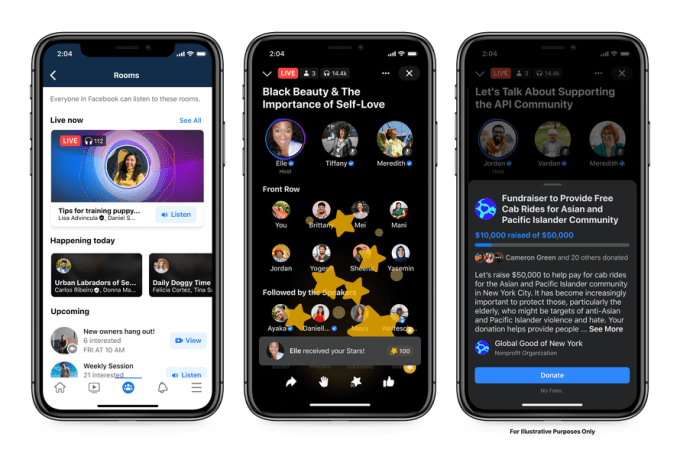
Like Clubhouse, the Facebook experience will also involve live audio rooms, where users can engage in topical discussions.

“I think the areas where is where I’m most excited about it on Facebook are basically in the large number of communities and groups that exist. I think that you already have these communities that are organized around interests, and allowing people to come together and have rooms where they can talk is — I think it’d be a very useful thing,” said Zuckerberg, in a friendly interview with Platformer, timed alongside the official announcement. “When we launched video rooms earlier last year, groups and communities were one of the bigger areas where that took off. So, I think around audio, just given how much more accessible it is, that’ll be a pretty exciting area as well.”

Image Credits: Facebook

The Live Audio Rooms will be available across both Facebook and Messenger, Facebook says in an official blog post.

The company will first test Live Audio Rooms in Groups, reaching Groups’ 1.8 billion monthly users. They’ll also be made available to public figures and experts. Early adopters of the feature will include American football quarterback Russell Wilson, Grammy-nominated electronic music artist TOKiMONSTA, artist and director Elle Moxley, and five-time Olympic medalist and entrepreneur Nastia Liukin, Facebook says.

Live Audio Rooms will be available to everyone on Facebook this summer. Also this summer, Live Audio Rooms will be made available on Messenger, for an experience that allows friends to hang out, too.

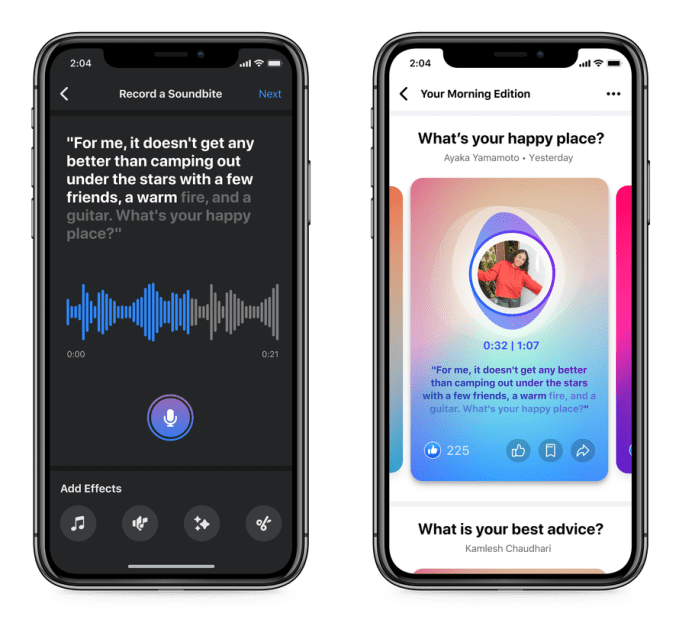
In addition to products that rehash audio functionality available in tech products from other companies, Zuckerberg also revealed that the company was working on an audio-only version of its TikTok competitor Instagram Reels that allows users to quickly move through algorithmically-sorted short audio clips, a project being called Soundbites. In its blog post, Facebook detailed that they will be testing Soundbites over the next few months with a small group of creators before making it widely available.

Image Credits: Facebook

“The idea here is it’s short form audio clips, whether it’s people sharing things that they find funny… or kind of pithy things that people want to share that cover a bunch of different genres and topics,” Zuckerberg said.

For podcast creators, Zuckerberg said the company will build out tools for those who follow podcasts and creators through Facebook Pages, but don’t currently have a way to access podcast content via the social network. He noted that there are now 170 million Facebook users who are connected to a Page for a podcast, which it why it wants to ensure they have a way to access this audio content more easily.

Image Credits: Facebook

For these users, they’ll be able to discover the audio and start playing it, even in the background. Or they could choose to launch a second app to continue play it, Zuckerberg said. We understand that the experience will actually allow users to directly open Spotify, if they would prefer to listen to the music or audio there, instead.

The feature will also help users with new podcast discovery based on your interests, and users will be able to comment on podcasts and recommend them to friends.

Related to these audio efforts, Zuckerberg referenced Facebook’s partnership with Spotify, which is now being expanded with something it has internally referred to as “Project Boombox” — is an integration that would allow people to share content from their favorite artists, playlists and other types of audio in their feed. That content would then appear in a little, in-line player for others to click and play.

We understand from sources familiar with the Spotify integration that this player will support both music and podcasts. It has already been tested in non-U.S. markets, including Mexico and Thailand. It’s expected to arrive in about a week.

“Facebook’s interest in audio is further validation of the category and reinforces what we’ve known all along — the power and potential for audio is limitless,” a spokesperson for Spotify told TechCrunch. “Our ambition has always been to make Spotify ubiquitous across platforms and devices — bringing music and podcasts to more people — and our new integration with Facebook is another step in these efforts. We look forward to a continued partnership with Facebook, fueling audio discovery around the world,” they added.

Zuckerberg also referenced the need to serve the growing creator economy with its new products.

With Live Audio Rooms, fans will be able to support creators through Stars, Facebook existing in-app tipping feature, or donate to causes. Facebook says it will later offer other monetization tools like access to Live Audio Rooms on subscriptions. There’s also an Audio Creator Fund being made available to kick off the launch of Soundbites.

More to come…


from Social – TechCrunch https://ift.tt/3dwLJrK
via IFTTT

Reddit unveils its Clubhouse clone, Reddit Talk

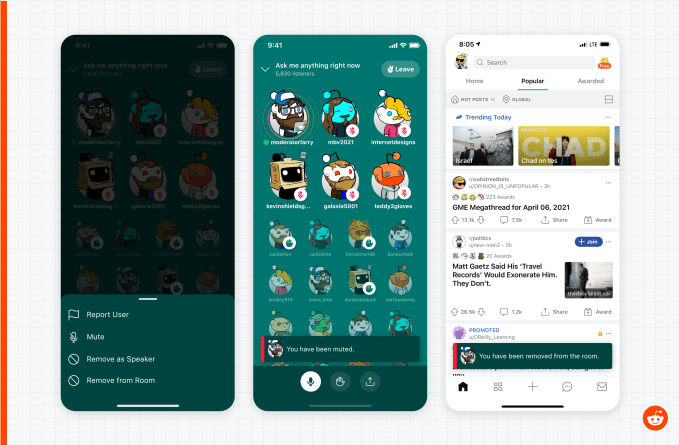
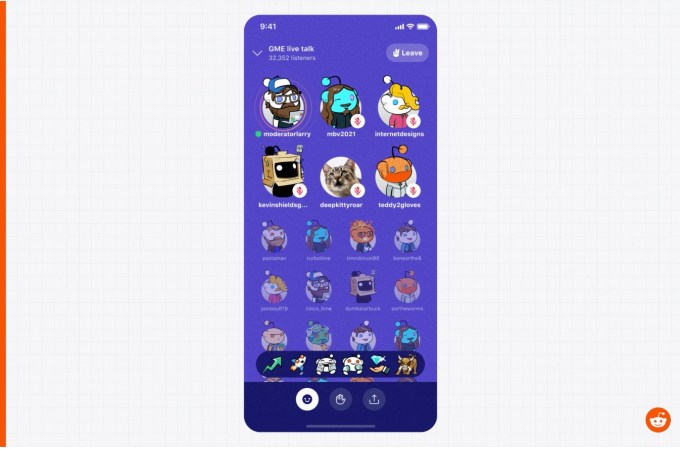
On the heels of Clubhouse’s latest fundraise, Reddit today officially unveiled its Clubhouse rival, Reddit Talk following a recent report from Mashable that revealed the company had been developing audio-based social networking features. Like many of the newly launched Clubhouse clones, Reddit’s voice chat experience hasn’t deviated much from Clubhouse’s overall design where speakers sit at the top of the screen in a stage area of sorts, and listeners appear below — all with rounded profile icons, plus tools to react or raise a hand to ask to speak.

In Reddit’s case, however, it’s repurposed this Clubhouse-style format for its own communities, known as subreddits. Initially, Reddit Talk will live within subreddits, which are individual forums focused on a given topic or theme. Those community’s moderators will be the only ones able to start a talk for the time being, as the audio feature is still being tested, Reddit says.

These moderators will be given tools that allow them invite users to join, mute participants, and remove speakers during the live sessions. They can also ban unwanted users from the talk entirely and stop them from being able to rejoin.

Although only the subreddit moderators can start talks, once they are underway, they can invite anyone they choose to join them to speak. The other users can listen the Reddit Talk sessions across both iOS and Android.

Image Credits: Reddit

While the overall style is very much Clubhouse-like, Reddit has added its own touches. For example, users can react to speakers using a different set of emojis than you might find on rival services. Reddit’s product images today showed reactions that included popular Reddit designs like a rocket ship, the Reddit alien, and the diamond emoji, among others. Reddit says it’s currently testing a way for moderators to customize the background colors and the emoji used in their own communities when they launch Reddit Talk. They’re also able to change their own avatar’s appearance to fit the talk, too.

Reddit suggests the new audio features will make sense for things like Q&As, AMAs (Ask Me Anything), lectures, sports radio-style discussions, community feedback sessions or even just hangouts.

The company is currently developing other features designed specifically to support AMAs and other types of conversations, it also noted.

In the comments of the Reddit Talk announcement, Reddit responded to questions from users about why it’s doing this, and acknowledged the Clubhouse similarities.

Image Credits: Reddit


“We believe that there is more to offer here by letting users have real-time live voice discussions with others in their communities — maybe talking about a sporting event while it’s on TV or listening to a casual chat or AMA with field experts,” Reddit’s Product Lead for creators wrote. “Yes, there are a few different platforms diving into live audio right now. Our hope is that by announcing this early with a community-first design, we will see engaging conversations hosted first by moderators, who we’ll be working with closely to ensure we’re creating a unique, supportive, and positive user experience,” the comment read.

There are more than a “few” other platforms now building out Clubhouse clones at this point, of course. Facebook has several tools on the way, Twitter has Spaces, and there are audio platforms in various stages of development from Discord, Telegram, Spotify and even LinkedIn, in the works.

Reddit Talk is not publicly available as it’s in a test period. But community moderators can join a waitlist to be alerted as to when they can try out the feature for themselves. After the test period, Reddit says it will work with moderators to allow other trusted users to host talks through the new feature, too.


from Social – TechCrunch https://ift.tt/3euDDPJ
via IFTTT

Clubhouse closes an undisclosed $4B valuation Series C round, as tech giants’ clones circle

Buzzy “social audio” app Clubhouse has raised a Series C funding round, reportedly valuing the company at $4 billion. Clubhouse said the new round of financing was led by Andrew Chen of Andreessen Horowitz, with participation from DST Global, Tiger Global and Elad Gil. This round means Clubhouse has tripled the valuation it attained in January when Andreessen Horowitz led its Series B funding round.

The funding comes as Twitter, Spotify, Facebook, Telegram, Discord and LinkedIn are all prepping similar features to Clubhouse’s live audio streaming rooms, which has attracted attention for hosting live chats with the likes of Elon Musk and Mark Zuckerberg. Indeed, Vox reported that Facebook will announce a series of “social audio” products only today.

But, unusually for such a late stage of funding, the company has not revealed the amount raised. Industry sources say that this is probably because the Series C funding round is “multi-stage” and therefore not officially closed. Alternatively, the company is “hyping” itself ahead of a sale, as is often the case with “hot” startups. Twitter reportedly broke off talks to acquire the startup at a $4 billion valuation, according to Bloomberg.

And despite appearances that this funding round has been timed to coincide with the launch this week of Facebook’s Clubhouse clone, one well-placed source told me “this funding round has been in the works for the last 1.5 months” and that some offers have been “above 2x” the $4 billion valuation. In other words, there are some investors out there who think Clubhouse is worth more than $8 billion.

So far Clubhouse is demurring on all this, and declining to comment more directly to the media. The company disclosed the news about the funding during its weekly “town hall” chat last Sunday night and in a blog post, the company said the fundraising will support a fresh burst of growth for the app.

“While we’ve quadrupled the size of our team this year, stabilized our infrastructure, launched Payments in beta to help creators monetize, and readied Android for launch, there is so much more to do as we work to bring Clubhouse to more people around the world. It’s no secret that our servers have struggled a bit these past few months, and that our growth has outpaced the early discovery algorithms our small team originally built,” said the post.

Noting that “it’s important to us to be building all of this with people who are invested in the community and who represent a diverse set of backgrounds and voices,” Clubhouse has, however, been struck by a wave of problems in the last few days, when anti-Semitic audio rooms seemed to proliferate on the platform. Clubhouse has previously been criticized for its seeming inability to moderate extremism on the app.

The year-old platform, which has reported 10 million weekly active users, has thrived during the pandemic while people were locked down and therefore unable to chat easily in person.

Tech news site The Information first reported details on the Clubhouse funding on Friday.


from Social – TechCrunch https://ift.tt/3syCY4u
via IFTTT

Facebook now lets users export posts and notes to Google Docs, Blogger and WordPress.com

Facebook today announced a new feature that will allow users to export their Facebook posts and notes to a number of third-party services. Although the company has long since offered tools that let you download the information you’ve posted to Facebook, the tool launching today offers a more practical way of saving that data — by allowing you to export your notes and posts to popular services like Google Docs, Blogger, or WordPress.com.

Facebook users will find this latest feature under the “Your Facebook Information” menu in Settings, where you’ll then click “Transfer Your Information.” A series of prompts will walk you through the process to transfer you data to the one of the available destinations.

To protect the data, Facebook says it will ask users to re-enter their password before the transfer begins, which it also does with other exports. The process will encrypt the data as it moves between Facebook and the other service, the company notes.

The move to support the export of text-based content is interesting, as it’s been reported Facebook is developing a competitor to newsletter platform Substack. The social network aims to capitalize on the growing momentum in the newsletter industry, which has recently seen a number of top writers leave larger publications in order to connect with their audience directly, via paid newsletters. Twitter also acquired a newsletter business, Revue, to pursue the same goals. While Facebook didn’t say if it’s upcoming product would be included in the export procedure announced today, it makes for a good hedge against any sort of anti-competitive claims if and when Facebook rolls out the new service.

Today’s addition is part of Facebook’s larger Data Transfer Project, a collaboration between tech giants designed to give users more ways to move their content between services. Last year, for example, Facebook added a feature that gave users a way to export their Facebook photos and videos to Google Photos, as a result of the team-up. Users can now also export photos and videos to Backblaze, Dropbox, and Koofr, as well.

Alongside news of its announcement, Facebook argued for regulation in the area of data portability. It said there should be laws that determine which data should be made portable, and who is responsible for protecting the data once it has been transferred. The company also pointed to comments it filed with the FTC last year as well as a white paper that explored the privacy questions that surround the development of data portability tools.


from Social – TechCrunch https://ift.tt/3ebCTPi
via IFTTT