This is default featured slide 1 title

Go to Blogger edit html and find these sentences.Now replace these sentences with your own descriptions.This theme is Bloggerized by Lasantha Bandara - Premiumbloggertemplates.com.

This is default featured slide 2 title

Go to Blogger edit html and find these sentences.Now replace these sentences with your own descriptions.This theme is Bloggerized by Lasantha Bandara - Premiumbloggertemplates.com.

This is default featured slide 3 title

Go to Blogger edit html and find these sentences.Now replace these sentences with your own descriptions.This theme is Bloggerized by Lasantha Bandara - Premiumbloggertemplates.com.

This is default featured slide 4 title

Go to Blogger edit html and find these sentences.Now replace these sentences with your own descriptions.This theme is Bloggerized by Lasantha Bandara - Premiumbloggertemplates.com.

This is default featured slide 5 title

Go to Blogger edit html and find these sentences.Now replace these sentences with your own descriptions.This theme is Bloggerized by Lasantha Bandara - Premiumbloggertemplates.com.

Tencent’s WeChat suspends new user registration in China to comply with ‘relevant laws and regulations’

Tencent’s WeChat said on Tuesday it is temporarily suspending registration of new users in China as it works to comply with “relevant laws and regulations,” the latest Chinese firm to face regulatory scrutiny in the world’s largest internet market.

In a social media post, Tencent said it is “upgrading” its security technology to align with all relevant laws and regulations and while this process in underway “registration of new Weixin (WeChat’s Chinese app) personal and official accounts has been temporarily suspended.”

“Registration services will be restored after the upgrade is complete, which is expected in early August,” said WeChat, which has amassed over 1.2 billion monthly active users in China as of earlier this year.

It’s not immediately clear which law WeChat is citing in its announcement but the move comes amid a broad crackdown on tech firms by Chinese regulators. The crackdown has wiped billions of dollars in market cap for Chinese firms in recent weeks and many high-profile global investors including SoftBank are impacted by it.

This is the first time WeChat, which operates as a super-app in China, has had to take a step of this kind in more than a decade. In addition to offering a messaging service, Weixin also allows users to make online payments and access a range of financial services.

(In other markets, it’s a different story. Donald Trump had signed an order to ban transactions with TikTok and WeChat in the U.S. last year. President Joe Biden revoked and replaced those actions last month.)

Some analysts believe that the Chinese government is concerned about the growing influence of tech firms in the country and also the privacy of its citizens’ data.

Earlier this month, China’s cybersecurity regulator ordered ride-hailing giant app Didi to stop signing up new users. That move had come days after Didi’s $4.4 billion initial public offering on the New York Stock Exchange. Didi’s app, which has been pulled from the app stores in China, illegally collected personal data of its customers, the regulator accused.


from Social – TechCrunch https://ift.tt/3BDACqO
via IFTTT

India’s ShareChat valued at $2.88 billion in $145 million fundraise

Indian social media platform ShareChat said on Tuesday it has raised an additional $145 million and is now valued at nearly $3 billion, less than three months after it secured $502 million at a valuation of $2.1 billion.

Temasek and Moore Strategic Ventures led the new tranche of investment while Mirae-Naver Asia Growth fund participated in the new financing round (Series F), the Bangalore-based startup said. TechCrunch reported earlier this month that six-year-old ShareChat was in talks to raise at around $2.8 billion valuation. ShareChat has now raised over $911 million to date.

“This additional investment for Series F is a validation of our market leadership and a reflection of investor trust in our execution capabilities. We are immensely proud of what we have been able to achieve with Moj and ShareChat in the last 12 months,” said Ankush Sachdeva, co-founder and chief executive of video app Moj and ShareChat.

“We have been very fortunate to attract a bunch of very high quality names in our series F and the list just got longer with Temasek, MSV and Mirae-Naver joining hands with us.”

In a recent interview with TechCrunch, Sachdeva said the short video app Moj, which the startup launched last year shortly after New Delhi banned TikTok citing cybersecurity concerns, is the fastest growing product within the firm and he expects it to be bigger that ShareChat one day.

ShareChat, which claims to have more than 160 million users, offers its social network app in 15 Indian languages and has a large following in small Indian cities and towns, or what venture capitalist Sajith Pai of Blume Ventures refers to as “India 2.”

Very few players in the Indian startup ecosystem have a reach to this segment of this population, which thanks to users from even smaller towns and villages — called “India 3” — getting online has expanded in recent years.

Moj, on the other hand, competes with a handful of players, including Times Internet’s MX TakaTak, as well as Glance’s Roposo and DailyHunt’s Josh — both of which received funding from Google late last year. The search giant was also in talks to invest in ShareChat late last year, TechCrunch reported earlier.

“With a monthly active user base of 160 million and 50+ million strong creator community, Moj in a year has grown into India’s number one short video app. To strengthen our leadership position, we will continue to invest in our AI capabilities, scaling our global AI org, building advanced editing tools and helping our creators monetize on the platform,” said Sachdeva, adding that the short video app clocks 4.5 billion views each day and a user typically spends about 34 minutes with the app daily.

TechCrunch also reported earlier that Twitter had held talks to acquire majority stakes in ShareChat and expand the Moj app globally.

“We are excited to partner with Moj as they build India’s premier short form video platform, and have been impressed by this management team’s speed and agility in capturing the opportunity. This round will help to accelerate that growth and allow Moj and ShareChat to continue to develop the best ecosystem for content creators and consumers alike,” said James McIntyre, Senior Managing Director and COO at MSV, in a statement.


from Social – TechCrunch https://ift.tt/3iSRfGl
via IFTTT

Snap had its best quarter in four years

If you’ve started using Snapchat more regularly this year, you’re not alone. At yesterday’s Q2 earnings call, Snap CEO Evan Spiegel announced that the platform grew both revenue and daily active users at the highest rates it has achieved in the last four years. Snapchat now has 293 million daily active users, growing 23% since last year.

Snap went public in 2017 with a $24 billion valuation, but not long before then, the ephemeral photo sharing app experienced a massive hiccup: Instagram cloned their then-unique Stories feature. After Instagram Stories launched, Snapchat’s growth slowed by 82%. Then, when Snapchat redesigned its app’s interface, Kylie Jenner tweeted that she didn’t use the app anymore, causing the company’s valuation to drop by $1.2 billion.

But Snapchat held on and made a comeback. Its revenue reached an all-time high of $911 million in Q4 of 2020, then went down to $770 million the following quarter. Now, Snapchat’s revenue in Q2 of 2021 surpasses its previous high to reach $982 million.

The app’s Q2 growth could be attributed to the return of advertisers who scaled back their spending during the height of the pandemic, as well as the retention of users that flocked to the app while in lockdown. Like many social media platforms, Snapchat grew its revenue and user base during the pandemic, but this isn’t just a matter of re-engaging users with an app that they grew out of. As TikTok exploded on the scene and the creator economy boomed, Snapchat kept up by creating Spotlight, a TikTok clone, and investing in the applications of augmented reality.

“We made significant progress with our augmented reality platform this quarter,” Spiegel said. “More than 200 million Snapchatters engage with AR every day on average, and over 200,000 creators use Lens Studio to build AR Lenses for our community.”

Last month, Snapchat went viral for its Cartoon 3D Style Lens, which makes you look like a character in a Pixar movie. Spiegel specifically mentioned this lens as a feature that “highlighted the power of Lenses to go viral both inside and outside of Snapchat.” But beyond fun face filters, Snapchat has been using AR to woo e-commerce partners. The app has developed AR experiences for Walt Disney World, Smile Direct Club, Zenni Optical, e.l.f. Cosmetics, Ralph Lauren and more. This includes try-on capabilities for watches, jewelry, eyewear, handbags, makeup and even clothing. At its Partner Summit in May, Snapchat revealed an update that lets users scan friends’ outfits to find shopping recommendations for similar styles.

“We have a lot more work ahead to build out our technology and increase AR adoption, but we are thrilled with the results that our partners are seeing as we invest in our long-term camera opportunity,” said Jeremi Gorman, Snap’s chief business officer. “We are confident in our long-term opportunity, and are excited to double down on shopping and commerce via augmented reality.”

In March, Snap acquired Fit Analytics, a Berlin-based startup that helps shoppers find the right-sized apparel and footwear when shopping online. Combined with Snap’s investment in AR, could we eventually use AR to see which size of clothing to order? The application of that sort of technology would need to be handled sensitively, especially as the rates of eating disorders in teens are on the rise.

Beyond e-commerce, Snapchat has sought out strategic partnerships with entertainment companies like HBO Max and Universal Music Group and doubled down on its Spectacles, glasses that create AR experiences. Of course, Facebook is working on AR glasses too. But for both companies, Snap’s recent successes show the rising adoption and value of AR experiences.


from Social – TechCrunch https://ift.tt/3iDv4E9
via IFTTT

Jack Dorsey says bitcoin will be a big part of Twitter’s future

Twitter CEO Jack Dorsey confirmed to investors that bitcoin will be a “big part” of the company’s future, as he sees opportunities to integrate the cryptocurrency into existing Twitter products and services, including commerce, subscriptions and other new additions like the Twitter Tip Jar and Super Follows.

Dorsey has been a staunch bitcoin advocate for years, but how it would be put into action on Twitter’s platform had not yet been spelled out in detail. However, Dorsey has often publicly touted the cryptocurrency, saying it reminds him of the “early days of the internet” and that there wasn’t “anything more important” in his lifetime for him to work on.

More recently, Dorsey launched a $23.6 million bitcoin fund with Jay Z and announced plans to lead his other company Square into the decentralized financial services market by way of bitcoin. Square also this year acquired a majority stake in Jay-Z’s TIDAL music service with an eye toward how blockchain technologies and cryptocurrencies could change the music business.

Today, Dorsey also dubbed bitcoin one of three key trends for Twitter’s future, along with AI and decentralization — the latter which Twitter is pursuing through its “Bluesky” initiative.

He touted bitcoin to investors on Twitter’s second quarter earnings call, saying it could help the company move faster in terms of its product expansions, while explaining that it was the “best candidate” to become the “native currency” of the internet. (Incidentally, Square’s $50 million in bitcoin purchased in 2020 was worth $253 million by February 2021, and it purchased $170 million more earlier this year.)

“If the internet has a native currency, a global currency, we are able to able to move so much faster with products such as Super Follows, Commerce, Subscriptions, Tip Jar, and we can reach every single person on the planet because of that instead of going down a market-by-market-by-market approach,” Dorsey explained. “I think this is a big part of our future. I think there is a lot of innovation above just currency to be had, especially as we think about decentralizing social media more and providing more economic incentive. So I think it’s hugely important to Twitter and to Twitter shareholders that we continue to look at the space and invest aggressively in it,” he added.

A Twitter rep confirmed this is the first time that Dorsey has spoken publicly about how Twitter could integrate bitcoin into its product lineup.

Dorsey also pointed out Twitter would not be alone in pursuing a crypto strategy, noting that Facebook was backing the digital currency Diem.

“There’s an obvious need for this, and appreciation for it. And I think that an open standard that’s native to the internet is the right way to go, which is why my focus and our focus eventually will be on bitcoin,” he noted.

Overall, Twitter delivered strong earnings in a pandemic rebound, which saw the company posting its fastest revenue growth since 2014, according to CNBC, which drove Twitter shares 9% higher in extended trading. The company pulled in Q2 revenue of $1.19 billion versus the $1.07 billion Wall Street expected, a majority ($1.05 billion) from its advertising business. It also saw earnings per share of 20 cents versus the 7 cents expected.

However, monetizable daily active users (mDAUs) — Twitter’s own invented metric meant to fluff up often flat monthly user growth — were only at 206 million, an 11% year-over-year increase, while analysts were counting on 206.2 million. The company blamed the decline on a slower news cycle and end of shelter-in-place in many U.S. communities, which may have impacted Twitter usage during the quarter.


from Social – TechCrunch https://ift.tt/3xYsXBm
via IFTTT

Trouble in fandom paradise: Tumblr users lash out against its beta subscription feature

The Tumblr community often refers to itself as the Wild West of the internet, and they’re not wrong. A text post with over 70,000 notes puts it best: “Tumblr is my favorite social media site because this place is literally uninhabitable for celebrities. No verification system, no algorithm that boosts their posts, it’s a completely lawless wasteland for them.”

But like any social media company, Tumblr needs to keep itself afloat in order for its users to continue sharing esoteric fan art, incomprehensible shitposts, and overly personal diary entries hidden beneath a “Read More” button. Yesterday, Tumblr announced the limited beta test of its Post+ subscription feature, which — if all goes as planned — will eventually let Tumblr users post paywalled content to subscribers that pay them $3.99, $5.99 or $9.99 per month.
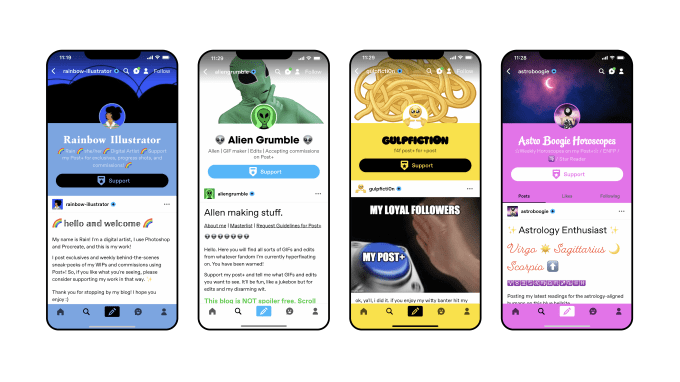
Image Credits: Tumblr

Tumblr is far from the first social media platform to seek revenue this way — Twitter is rolling out Super Follows and a Tip Jar feature, and this week, YouTube announced a tipping feature too. Even Instagram is working on its own version of Twitter’s Super Follows that would let users create “exclusive stories.” But on a website with a community that prides itself as being a “completely lawless wasteland” for anyone with a platform (save for Wil Wheaton and Neil Gaiman, who are simply just vibing), the move toward paywalled content was not welcomed with open arms.

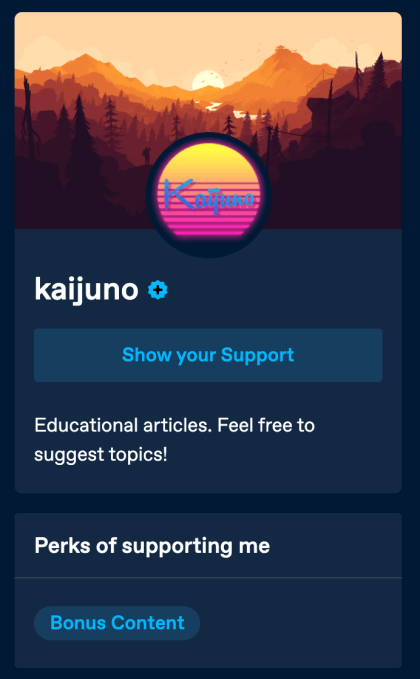
Monetization is a double-edged sword. It’s not considered uncool for a Tumblr artist to link to a third-party Patreon or Ko-fi site on their blog, where their most enthusiastic followers can access paywalled content or send them tips. So Post+ seems like an obvious way for Tumblr to generate revenue — instead of directing followers to other websites, they could build a way for fans to support creators on their own platform while taking a 5% cut. This isn’t unreasonable, considering that Twitter will take 3% revenue from its new monetization tools, while video-centric platforms like YouTube and Twitch take 30% and 50%, respectively. But Tumblr isn’t Twitter, or YouTube, or Twitch. Unlike other platforms, Tumblr doesn’t allow you to see other people’s follower counts, and no accounts are verified. It’s not as easy to tell whether the person behind a popular post has 100 followers or 100,000 followers, and the users prefer it that way. But Post+ changes that, giving bloggers an icon next to their username that resembles a Twitter blue check.
A Tumblr Post+ creator profile

Tumblr rolled out Post+ this week to a select group of hand-picked creators, including Kaijuno, a writer and astrophysicist. The platform announced Post+ on a new blog specific to this product, rather than its established staff blog, which users know to check for big announcements. So, as the most public user who was granted access, the 24-year-old blogger was the target of violent backlash from angry Tumblrites who didn’t want to see their favorite social media site turn into a hypercapitalist hellscape. When Kaijuno received death threats for beta testing Post+, Tumblr’s staff intervened and condemned harassment against Post+ users.

“We want to hear about what you like, what you love, and what concerns you. Even if it’s not very nice. Tell us. We can take it,” Tumblr wrote on its staff blog. “What we won’t ever accept is the targeted harassment and threats these creators have endured since this afternoon. […] all they’re doing is testing out a feature.”

Before making their post, a representative from Tumblr’s staff reached out to Kaijuno directly to check in on them regarding the backlash, but there’s only so much that Tumblr can do after a user has already been threatened for using their product.

“I felt like the sacrificial lamb, because they didn’t announce Post+ beforehand and only gave it to a few people, which landed me in the crosshairs of a very pissed-off user base when I’m just trying to pay off medical bills by giving people the option to pay for content,” Kaijuno told TechCrunch. “I knew there’d be some backlash because users hate any sort of change to Tumblr, but I thought that the brunt of the backlash would be at the staff, and that the beta testers would be spared from most of it.”

Why do Tumblr users perceive monetization as such a threat? It’s not a question of whether or not it’s valuable to support creators, but rather, whether Tumblr is capable of hosting such a service. Multiple long-time, avid Tumblr users that spoke to TechCrunch referenced an incident in late 2020 when people’s blogs were being hacked by spam bots that posted incessant advertisements for a Ray-Ban Summer Sale.

“Tumblr is not the most well-coded website. It’s easy to break features,” Kaijuno added. “I think anything involving trusting Tumblr with your financial information would have gotten backlash.”

Tumblr users also worried about the implications Post+ could have on privacy — in the limited beta, Post+ users only have the ability to block people who are subscribed to their blog if they contact Tumblr support. In cases of harassment by a subscriber, this could leave a blogger vulnerable in a potentially dangerous situation.

“Ahead of our launch to all U.S.-based creators this fall, Post+ will allow creators to block subscribers directly,” a Tumblr spokesperson told TechCrunch.

Still, the Extremely Online Gen Z-ers who now make up 48% of Tumblr know that they can’t expect the platform to continue existing if it doesn’t pull in enough money to pay for its staff and server fees. In 2018, Tumblr lost almost one-third of its monthly page views after all NSFW content was banned — since then, the platform’s monthly traffic has remained relatively stagnant.
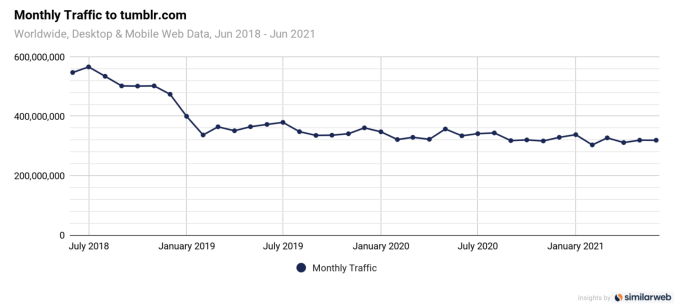
Image Credits: SimilarWeb

A former Tumblr employee told TechCrunch that the feature that became Post+ started out as a tip jar. But higher-ups at Tumblr — who do not work directly with the community — redirected the project to create a paywalled subscription product.

“I think a Tip Jar would be a massive improvement,” said the creator behind the Tumblr blog normal-horoscopes. Through the core audience they developed on Tumblr, they make a living via Patreon, but they don’t find Post+ compelling for their business. “External services [like Patreon] have more options, more benefits, better price points, and as a creator I get to choose how I present them to my audience.”

But a paywalled subscription service is different in the collective eyes of Tumblr. For a site that thrives on fandom, creators that make fan art and fanfiction worry that placing this derivative work behind a paywall — which Post+ encourages them to do — will land them in legal trouble. Even Archive of Our Own, a major fanfiction site, prohibits its users from linking to sites like Patreon or Ko-Fi.

“Built-in monetization attracts businesses, corporate accounts, people who are generally there to make money first and provide content second,” said normal-horoscopes. “It changes the culture of a platform.”

Across Tumblr, upset users are rallying for their followers to take Post+’s feedback survey to express their frustrations. The staff welcomes this.

“As with any new product launch, we expect our users to have a healthy discussion about how the feature will change the dynamics of how people use Tumblr,” a Tumblr spokesperson told TechCrunch. “Not all of this feedback will be positive, and that’s OK. Constructive criticism fuels how we create products and ultimately makes Tumblr a better place.”

Tumblr’s vocal community has been empowered over the years to question whether it’s possible for a platform to establish new revenue streams in a way that feels organic. The protectiveness that Tumblr’s user base feels for the site — despite their lack of faith in staff — sets it apart from social media juggernauts like Facebook, which can put e-commerce front and center without much scrutiny. But even three years after the catastrophic porn ban, it seems hard for Tumblr to grow without alienating the people that make the social network unique.

Platforms like Reddit and Discord have remained afloat by selling digital goods, like coins to reward top posters, or special emojis. Each company’s financial needs are different, but Tumblr’s choice to monetize with Post+ highlights the company’s lack of insight into its own community’s wishes.


from Social – TechCrunch https://ift.tt/3kIdOQN
via IFTTT

VOCHI raises additional $2.4 million for its computer vision-powered video editing app

VOCHI, a Belarus-based startup behind a clever computer vision-based video editing app used by online creators, has raised an additional $2.4 million in a “late-seed” round that follows the company’s initial $1.5 million round led by Ukraine-based Genesis Investments last year. The new funds follow a period of significant growth for the mobile tool, which is now used by over 500,000 people per month and has achieved a $4 million-plus annual run rate in a year’s time.

Investors in the most recent round include TA Ventures, Angelsdeck, A.Partners, Startup Wise Guys, Kolos VC, and angels from other Belarus-based companies like Verv and Bolt. Along with the fundraise, VOCHI is elevating the company’s first employee, Anna Bulgakova, who began as head of marketing, to the position of co-founder and Chief Product Officer.

According to VOCHI co-founder and CEO lya Lesun, the company’s idea was to provide an easy way for people to create professional edits that could help them produce unique and trendy content for social media that could help them stand out and become more popular. To do so, VOCHI leverages a proprietary computer-vision-based video segmentation algorithm that applies various effects to specific moving objects in a video or to images in static photos.

“To get this result, there are two trained [convolutional neural networks] to perform semi-supervised Video Object Segmentation and Instance Segmentation,” explains Lesun, of VOCHI’s technology. “Our team also developed a custom rendering engine for video effects that enables instant application in 4K on mobile devices. And it works perfectly without quality loss,” he adds. It works pretty fast, too — effects are applied in just seconds.

The company used the initial seed funding to invest in marketing and product development, growing its catalog to over 80 unique effects and more than 30 filters.

Image Credits: VOCHI

Today, the app offers a number of tools that let you give a video a particular aesthetic (like a dreamy vibe, artistic feel, or 8-bit look, for example). It can also highlight the moving content with glowing lines, add blurs or motion, apply different filters, insert 3D objects into the video, add glitter or sparkles, and much more.

In addition to editing their content directly, users can swipe through a vertical home feed in the app where they can view the video edits others have applied to their own content for inspiration. When they see something they like, they can then tap a button to use the same effect on their own video. The finished results can then be shared out to other platforms, like Instagram, Snapchat and TikTok.

Though based in Belarus, most of VOCHI’s users are young adults from the U.S. Others hail from Russia, Saudi Arabia, Brazil and parts of Europe, Lesun says.

Unlike some of its video editor rivals, VOCHI offers a robust free experience where around 60% of the effects and filters are available without having to pay, along with other basic editing tools and content. More advanced features, like effect settings, unique presents and various special effects require a subscription. This subscription, however, isn’t cheap — it’s either $7.99 per week or $39.99 for 12 weeks. This seemingly aims the subscription more at professional content creators rather than a casual user just looking to have fun with their videos from time to time. (A one-time purchase of $150 is also available, if you prefer.)

To date, around 20,000 of VOCHI’s 500,000 monthly active users have committed to a paid subscription, and that number is growing at a rate of 20% month-over-month, the company says.

Image Credits: VOCHI

The numbers VOCHI has delivered, however, aren’t as important as what the startup has been through to get there.

The company has been growing its business at a time when a dictatorial regime has been cracking down on opposition, leading to arrests and violence in the country. Last year, employees from U.S.-headquartered enterprise startup PandaDoc were arrested in Minsk by the Belarus police, in an act of state-led retaliation for their protests against President Alexander Lukashenko. In April, Imaguru, the country’s main startup hub, event and co-working space in Minsk — and birthplace of a number of startups, including MSQRD, which was acquired by Facebook — was also shut down by the Lukashenko regime.

Meanwhile, VOCHI was being featured as App of the Day in the App Store across 126 countries worldwide, and growing revenues to around $300,000 per month.

“Personal videos take an increasingly important place in our lives and for many has become a method of self-expression. VOCHI helps to follow the path of inspiration, education and provides tools for creativity through video,” said Andrei Avsievich, General Partner at Bulba Ventures, where VOCHI was incubated. “I am happy that users and investors love VOCHI, which is reflected both in the revenue and the oversubscribed round.”

The additional funds will put VOCHI on the path to a Series A as it continues to work to attract more creators, improve user engagement, and add more tools to the app, says Lesun.


from Social – TechCrunch https://ift.tt/3kMbQz0
via IFTTT

Democratic bill would suspend Section 230 protections when social networks boost anti-vax conspiracies

Two Democratic senators introduced a bill Thursday that would strip away the liability shield that social media platforms hold dear when those companies boost anti-vaccine conspiracies and other kinds of health misinformation.

The Health Misinformation Act, introduced by Senators Amy Klobuchar (D-MN) and Ben Ray Luján (D-NM), would create a new carveout in Section 230 of the Communications Decency Act to hold platforms liable for algorithmically promoted health misinformation and conspiracies. Platforms rely on Section 230 to protect them from legal liability for the vast amount of user-created content they host.

“For far too long, online platforms have not done enough to protect the health of Americans,” Klobuchar said. “These are some of the biggest, richest companies in the world and they must do more to prevent the spread of deadly vaccine misinformation.”

The bill would specifically alter Section 230’s language to revoke liability protections in the case of “health misinformation that is created or developed through the interactive computer service” if that misinformation is amplified through an algorithm. The proposed exception would only kick in during a declared national public health crisis, like the advent of COVID-19, and wouldn’t apply in normal times. The bill would task the Secretary of the Department of Health and Human Services (HHS) with defining health misinformation.

“Features that are built into technology platforms have contributed to the spread of misinformation and disinformation, with social media platforms incentivizing individuals to share content to get likes, comments, and other positive signals of engagement, which rewards engagement rather than accuracy,” the bill reads.

The bill also makes mention of the “disinformation dozen” — just 12 people, including anti-vaccine activist Robert F. Kennedy Jr. and a grab bag of other conspiracy theorists, who account for a massive swath of the anti-vax misinformation ecosystem. Many of the individuals on the list still openly spread their messaging through social media accounts on Twitter, Facebook and other platforms.

Section 230’s defenders generally view the idea of new carveouts to the law as dangerous. Because Section 230 is such a foundational piece of the modern internet, enabling everything from Yelp and Reddit to the comment section below this post, they argue that the potential for unforeseen second-order effects means the law should be left intact.

But some members of Congress — both Democrats and Republicans — see Section 230 as a valuable lever in their quest to regulate major social media companies. While the White House is pursuing its own path to craft consequences for overgrown tech companies through the Justice Department and the FTC, Biden’s office said earlier this week that the president is “reviewing” Section 230 as well. But as Trump also discovered, weakening Section 230 is a task that only Congress is positioned to accomplish — and even that is still a long shot.

While the new Democratic bill is narrowly targeted as far as proposed changes to Section 230 go, it’s also unlikely to attract bipartisan support.

Republicans are also interest in stripping away some of Big Tech’s liability protections, but generally hold the view that platforms remove too much content rather than too little. Republicans are also more likely to sow misinformation about the COVID-19 vaccines themselves, framing vaccination as a partisan issue. Whether the bill goes anywhere, it’s clear that an alarming portion of Americans have no intention of getting vaccinated — even with a much more contagious variant on the rise and colder months on the horizon.

“As COVID-19 cases rise among the unvaccinated, so has the amount of misinformation surrounding vaccines on social media,” Luján said of the proposed changes to Section 230. “Lives are at stake.”


from Social – TechCrunch https://ift.tt/2UHqbBQ
via IFTTT