This is default featured slide 1 title

Go to Blogger edit html and find these sentences.Now replace these sentences with your own descriptions.This theme is Bloggerized by Lasantha Bandara - Premiumbloggertemplates.com.

This is default featured slide 2 title

Go to Blogger edit html and find these sentences.Now replace these sentences with your own descriptions.This theme is Bloggerized by Lasantha Bandara - Premiumbloggertemplates.com.

This is default featured slide 3 title

Go to Blogger edit html and find these sentences.Now replace these sentences with your own descriptions.This theme is Bloggerized by Lasantha Bandara - Premiumbloggertemplates.com.

This is default featured slide 4 title

Go to Blogger edit html and find these sentences.Now replace these sentences with your own descriptions.This theme is Bloggerized by Lasantha Bandara - Premiumbloggertemplates.com.

This is default featured slide 5 title

Go to Blogger edit html and find these sentences.Now replace these sentences with your own descriptions.This theme is Bloggerized by Lasantha Bandara - Premiumbloggertemplates.com.

TikTok expands mental health resources, as negative reports of Instagram’s effect on teens leak

TikTok announced this morning that it is implementing new tactics to educate its users about the negative mental health impacts of social media. As part of these changes, TikTok is rolling out a “well-being guide” in its Safety Center, a brief primer on eating disorders, expanded search interventions, and opt-in viewing screens on potentially triggering searches.

Developed in collaboration with International Association for Suicide Prevention, Crisis Text Line, Live For Tomorrow, Samaritans of Singapore, and Samaritans (UK), the new well-being guide offers more targeted advice toward people using TikTok, encouraging users to consider how it might impact them to share their mental health stories on a platform where any post has the potential to go viral. TikTok wants users to think about why they’re sharing their experience, if they’re ready for a wider audience to hear their story if sharing could be harmful to them, and if they’re prepared to hear others’ stories in response.

The platform also added a brief, albeit generic memo about the impact of eating disorders under the “topics” section of the Safety Center, which was developed with the National Eating Disorders Association (NEDA). NEDA has a long track record of collaborating with social media platforms, most recently working with Pinterest to prohibit ads promoting weight loss.

Already, TikTok directs users to local resources when they search for words or phrases like #suicide,* but now, the platform will also share content from creators with the intent of helping someone in need. The platform told TechCrunch that it chose this content following consultation with independent experts. Additionally, if someone enters a search phrase that might be alarming (TikTok offered “scary makeup” as an example), the content will be blurred out, asking users to opt-in to see the search results.

As TikTok unveils these changes, its competitor Instagram is facing scrutiny after The Wall Street Journal leaked documents that reveal its parent company Facebook’s own research on the harm Instagram poses for teen girls. Similar to the Gen Z-dominated TikTok, more than 40% of Instagram users are 22 or younger, and 22 million teens log into Instagram in the U.S. each day. In one anecdote, a 19-year-old interviewed by The Wall Street Journal said that after searching Instagram for workout ideas, her explore page has been flooded with photos about how to lose weight (Instagram has previously fessed up to errors with its search function, which recommended that users search topics like “fasting” and “appetite suppressants”). Angela Guarda, director for the eating-disorders program at Johns Hopkins Hospital, told The Wall Street Journal that her patients often say they learned about dangerous weight loss tactics via social media.

“The question on many people’s minds is if social media is good or bad for people. The research on this is mixed; it can be both,” Instagram wrote in a blog post today.

As TikTok nods to with its advice on sharing mental health stories, social media can often be a positive resource, allowing people who are dealing with certain challenges to learn from others who have gone through similar experiences. So, despite these platforms’ outsized influence, it’s also on real people to think twice about what they post and how it might influence others. Even when Facebook experimented with hiding the number of “likes” on Instagram, employees said that it didn’t improve overall user well-being. These revelations about the negative impact of social media on mental health and body image aren’t ground-breaking, but they generate a renewed pressure for these powerful platforms to think about how to support their users (or, at the very least, add some new memos to their security center). 

*If you or someone you know is struggling with depression or has had thoughts of harming themselves or taking their own life, The National Suicide Prevention Lifeline (1-800-273-8255) provides 24/7, free, confidential support for people in distress, as well as best practices for professionals and resources to aid in prevention and crisis situations.


from Social – TechCrunch https://ift.tt/3EglQaK
via IFTTT
Twitter re-opens its account verification process after another pause

Twitter has again restarted its account verification process, the company said on Monday evening by way of a post to its Twitter Verified account, where it publishes updates about the system’s status. Since launching the revamped verification program this spring, Twitter had hit a few snags which have forced it to shut down verifications more than once. The most recent of these pauses was announced on August 13, when the company said it need to make improvements to both the application and review process.

Twitter has struggled with account verifications for years. Everyone wanted the coveted blue badge that was previously doled out to public figures and other accounts of high public interest who have confirmed they are who they say they are — like a government official, journalist, celeb, brand or business, or another notable name.

But while the original system was meant to communicate only account authenticity, many viewed Twitter verification badgeholders as having some sort of elevated status. This issue came to a head when it was discovered in 2017 Twitter had verified the account belonging to Jason Keller, the person who organized the deadly white supremacist rally in Charlottesville, Virginia. Shortly thereafter, Twitter officially paused verifications, but continued to quietly verify certain individuals including candidates running for public office, elected public officials, journalists, and others.

Image Credits: Twitter

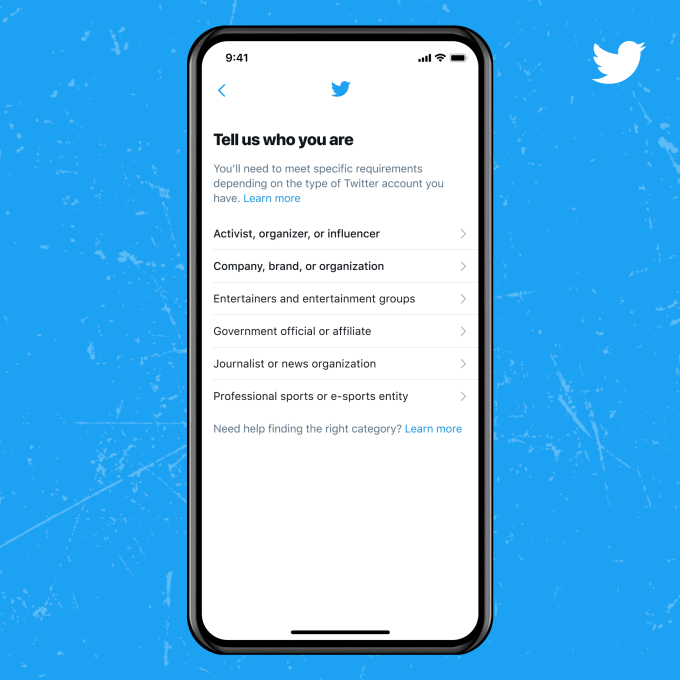
Finally, the company rebooted the system in May 2021, saying it had been rebuilt and would now have a dedicated team. It also issued new rules that more explicitly spelled out who could request verification and who could not. But demand for verification was so great that Twitter had to temporarily pause verification only 8 days after it launched so the team could catch up with the number of requests.

After it restarted, Twitter again put the system on pause in August, explaining it needed more time to get things right. It’s not clear how well verifications were going at this point, as social media consultant Matt Navarra pointed out that Twitter had accidentally verified a fake account for Rockstar Games. And earlier this summer, Twitter had admitted that it had permanently suspended some fake accounts that it had mistakenly verified, as well.

Now, Twitter says users who are looking to be verified should keep checking their account settings screen for access to the in-app application. It didn’t detail what, specifically had changed — but hopefully the system will now remain open for good.


from Social – TechCrunch https://ift.tt/3lpW2R6
via IFTTT

LinkedIn is launching its own $25M fund and incubator for creators

When LinkedIn first launched Stories format, and later expanded its tools for creators earlier this year, one noticeable detail was that the Microsoft-owned network for professionals hadn’t built any kind of obvious monetization into the program — noticeable, given that creators earn a living on other platforms like Instagram, YouTube and TikTok, and those apps had lured creators, their content, and their audiences in part by paying out.

“As we continue to listen to feedback from our members as we consider future opportunities, we’ll also continue to evolve how we create more value for our creators,” is how LinkedIn explained its holding pattern on payouts to me at the time. But that strategy may have backfired for the company — or at least may have played a role in what came next: last month, LinkedIn announced it would be scrapping its Stories format and going back to the proverbial drawing board to work on other short-form video content for the platform.

Now comes the latest iteration in that effort. To bring more creators to the platform, the company today announced that it would be launching a new $25 million creator fund, which initially will be focused around a new Creator Accelerator Program.

It’s coming on the heels of LinkedIn also continuing to work on one of its other new-content experiments: a Clubhouse-style live conversation platform. As we previously reported, LinkedIn began working on this back in March of this year. Now, we are hearing that the feature will make an appearance as part of a broader events strategy for the company.

Notably, in a blog post announcing the creator fund, LinkedIn also listed a number of creator events coming up. Will the Clubhouse-style feature pop up there? Watch this space. Or maybe… listen up.

In any case, the creator accelerator that LinkedIn is announcing today could help feed into that wider pool of people that LinkedIn is hoping to cultivate on its platform as a more dynamic and lively set of voices to get more people talking and spending time on LinkedIn.

Andrei Santalo, global head of community at LinkedIn, noted in the blog post that the accelerator/incubator will be focused on the whole creator and the many ways that one can engage on LinkedIn.

“Creating content on LinkedIn is about creating opportunity, for yourselves and others,” he writes. “How can your words, videos and conversations make 774+ million professionals better at what they do or help them see the world in new ways?”

The incubator will last for 10 weeks and will take on 100 creators in the U.S. to coach them on building content for LinkedIn. It will also give them chances to network with like-minded individuals (naturally… it is LinkedIn), as well as a $15,000 grant to do their work. The deadline for applying (which you do here) is October 12.

The idea of starting a fund to incentivize creators to build video for a particular platform is definitely not new — and that is one reason why it was overdue for LinkedIn to think about its own approach.

Leading social media platforms like TikTok, Snapchat, Instagram and Facebook, and YouTube all have announced hundreds of millions of dollars in payouts in the form of creator funds to bring more original content to their platforms.

You could argue that for mass-market social media sites, it’s important to pay creators because competition is so fierce among them for consumer attention.

But on the other hand, those platforms have appeal for creators because of the potential audience size. At 774 million users, LinkedIn isn’t exactly small, but the kind of content that tends to live on there is so different, and maybe drier — it’s focused on professional development, work, and “serious” topics — that perhaps it might need the most financial incentive of all to get creators to bite.

LinkedIn’s bread and butter up to now has been around professional development: people use it to look for work, to get better jobs, to hire people, and to connect with people who might help them get ahead in their professional lives.

But it’s done so in a very prescribed set of formats that do not leave much room for exploring “authenticity” — not in the modern sense of “authentic self”, and not in the more old-school sense of just letting down your guard and being yourself. (Even relatively newer initiatives like its education focus directly play into this bigger framework.)

With authenticity becoming an increasing priority for people — and maybe more so as we have started to blur the lines between work and home because of Covid-19 and the changes that it has forced on us — I can’t help but wonder whether LinkedIn will use this opportunity to rethink, or at least expand the concept of, what it means to spend time on its platform.


from Social – TechCrunch https://ift.tt/3A6skXn
via IFTTT

Twitch sues two users for harassing streamers with hate raids

Twitch filed a lawsuit late last week against two people on its own platform for running automated hate and harassment campaigns.

The harassment, often targeted at Black and LGBTQ streamers, manifests in a unique Twitch phenomenon as a “hate raid.” On Twitch, creators regularly point viewers toward another friendly account after their stream concludes to boost their audiences, a practice known as a “raid.” Hate raids invert that formula, sending swarms of bots to harass streamers who have inadequate tools at their disposal to block the influx of abuse.

The hate raids leverage Twitch’s new tagging system, which many transgender users had requested to make it easier to build community and to discover content that resonates. In May, Twitch added more than 350 new tags to help viewers sort streams by “gender, sexual orientation, race, nationality, ability, mental health, and more.” Accounts spreading abuse now use those tags to target racist, sexist, transphobic and homophobic harassment toward streamers, another unfortunate misuse of a tool explicitly designed to give creators a boost.

In the suit, Twitch described hate raiders as “highly motivated” malicious individuals who improvise new ways to circumvent the platform’s terms of service. Twitch named two users, “CruzzControl” and “CreatineOverdose,” in the suit but the company was unable to obtain their legal names. The users are based in the Netherlands and Austria, respectively, and their activity began in August of this year. Twitch alleges that CruzzControl alone has been linked to 3,000 bot accounts involved in hate raids.

While it’s possible that Twitch won’t be able to identify the real identities of individuals behind the recent harassment campaigns, the lawsuit could act as a deterrent for other accounts directing waves of abuse on the streaming platform.

“While we have identified and banned thousands of accounts over the past weeks, these actors continue to work hard on creative ways to circumvent our improvements, and show no intention of stopping,” the lawsuit reads. “We hope this Complaint will shed light on the identity of the individuals behind these attacks and the tools that they exploit, dissuade them from taking similar behaviors to other services, and help put an end to these vile attacks against members of our community.”

“This Complaint is by no means the only action we’ve taken to address targeted attacks, nor will it be the last,” a Twitch spokesperson told TechCrunch. “Our teams have been working around the clock to update our proactive detection systems, address new behaviors as they emerge, and finalize new proactive, channel-level safety tools that we’ve been developing for months.”

Prior to Twitch’s legal action, some Twitch creators organized #ADayOffTwitch to protest the company’s failure to offer solutions for users targeted by hate raids. People participating in the protest demanded that Twitch take decisive actions toward protecting streamers from hate raids, including letting creators deny incoming raids and screen out chat participants with newly made accounts. They also drew attention to Twitch policies that allow unlimited accounts to be linked to a single email address, a loophole that makes it easy to create and deploy armies of bot accounts.


from Social – TechCrunch https://ift.tt/2X925kt
via IFTTT

Instagram is building a ‘Favorites’ feature so you don’t miss important posts

Instagram confirmed it’s developing a new feature called “Favorites,” which would allow users to select certain accounts whose posts they would like to see higher in their feed. A similar feature already exists on Facebook where it gives users a bit more control over the News Feed algorithm. On Facebook, users can select up to 30 friends or Facebook Pages whose posts get shown higher in the News Feed. It’s unclear what limit an Instagram Favorites feature would have, however.

The Instagram Favorites feature was recently spotted in development by reverse engineer Alessandro Paluzzi, who found a new pushpin icon for Favorites in the Instagram Settings menu, and other details about how the feature may work.

According to screenshots Paluzzi posted on Twitter, users will be able to search across the Instagram accounts they are currently following to create a list of Favorites. This list can be edited at any time, and Instagram notes that users would not be notified when they’re added to someone’s Favorites.

This is a similar level of privacy as offered by Instagram’s several years-old “Close Friends” feature, which instead focuses on allowing users to create a separate list of followers so they can share their more private and personal Instagram Stories with a select group of their own choosing.

Paluzzi tells us he was able to add contacts to the Favorites list, but didn’t yet notice any changes to the Instagram feed after doing so. That implies the feature is still being built and a launch is not imminent.

“This feature is an internal prototype that’s still in development, and not testing externally,” an Instagram spokesperson told TechCrunch. They declined to share any other specifics about the feature.

A Favorites feature could play into Instagram’s larger plans to better establish itself as a home for creator content. In other leaks, Paluzzi had also found the company was building out “Fan Subscriptions,” which would allow users to pay for elevated access to creator content — like exclusive live videos or Stories, for example. Paid subscribers may also be given a special badge that would highlight their name when they commented, DM’ed, or viewed the creator’s Stories.

Given that users who were paying for content would not want to miss a moment, it would make sense to give them tools to designate those creators as “Favorites” whose posts were also more highly ranked in their Feed.

A Favorites feature could also be useful to those who had taken a break from Instagram and would rather see the important photos and videos they missed from favorite accounts upon their return, rather than just the most recent or interesting updates from across all of the accounts they follow.

And while not likely the main goal, the new feature could help to address users’ complaints about the algorithmic feed in general.

Today, there are still a number of people who want to be able to see Instagram posts in chronological order, preferring to not have posts re-ordered by an algorithm they can’t control. Favorites wouldn’t give in to this demand (though Instagram has tested a chronological feed in the past). But it would at least give users the ability to ensure they weren’t missing the posts from those whose updates they wanted to see the most.

Though Instagram did say it’s working on the development of Favorites, it doesn’t necessarily mean such a feature will launch to the public. Companies of Instagram’s size often prototype new ideas, but only some of those tests make it to a general release.


from Social – TechCrunch https://ift.tt/3tDf3TD
via IFTTT

WhatsApp will finally let users encrypt their chat backups in the cloud

WhatsApp said on Friday it will give its two billion users the option to encrypt their chat backups to the cloud, taking a significant step to put a lid on one of the tricky ways private communication between individuals on the app can be compromised.

The Facebook-owned service has end-to-end encrypted chats between users for more than a decade. But users have had no option but to store their chat backup to their cloud — iCloud on iPhones and Google Drive on Android — in an unencrypted format.

Tapping these unencrypted WhatsApp chat backups on Google and Apple servers is one of the widely known ways law enforcement agencies across the globe have been able to access WhatsApp chats of suspect individuals for years.

Now WhatsApp says it is patching this weak link in the system.

“WhatsApp is the first global messaging service at this scale to offer end-to-end encrypted messaging and backups, and getting there was a really hard technical challenge that required an entirely new framework for key storage and cloud storage across operating systems,” said Facebook’s chief executive Mark Zuckerberg said in a post announcing the new feature.

Store your own encryption keys

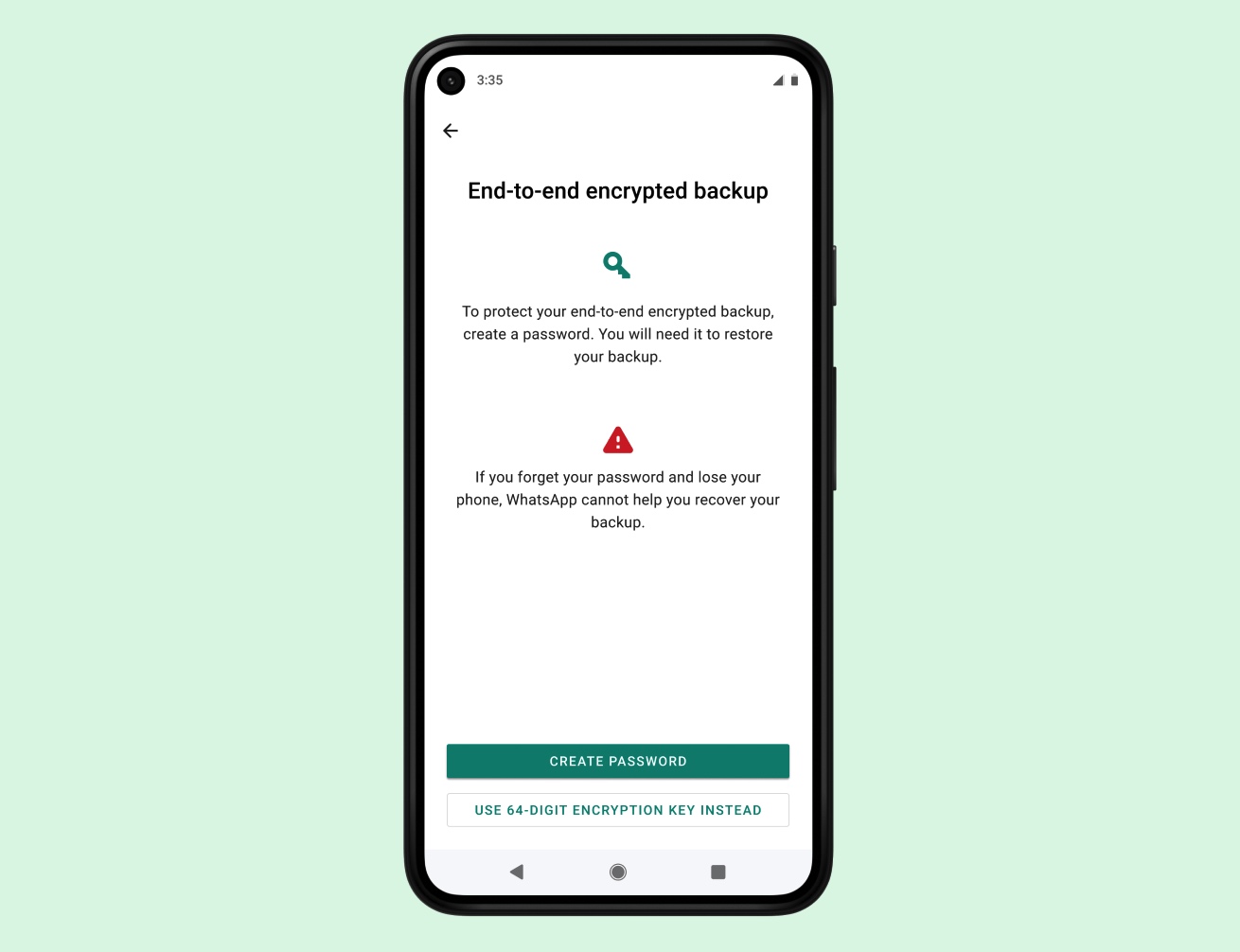
The company said it has devised a system to enable WhatsApp users on Android and iOS to lock their chat backups with encryption keys. WhatsApp says it will offer users two ways to encrypt their cloud backups, and the feature is optional.

In the “coming weeks,” users on WhatsApp will see an option to generate a 64-digit encryption key to lock their chat backups in the cloud. Users can store the encryption key offline or in a password manager of their choice, or they can create a password that backs up their encryption key in a cloud-based “backup key vault” that WhatsApp has developed. The cloud-stored encryption key can’t be used without the user’s password, which isn’t known by WhatsApp.

(Image: WhatsApp/supplied)

“We know that some will prefer the 64-digit encryption key whereas others want something they can easily remember, so we will be including both options. Once a user sets their backup password, it is not known to us. They can reset it on their original device if they forget it,” WhatsApp said.

“For the 64-digit key, we will notify users multiple times when they sign up for end-to-end encrypted backups that if they lose their 64-digit key, we will not be able to restore their backup and that they should write it down. Before the setup is complete, we’ll ask users to affirm that they’ve saved their password or 64-digit encryption key.”

A WhatsApp spokesperson told TechCrunch that once an encrypted backup is created, previous copies of the backup will be deleted. “This will happen automatically and there is no action that a user will need to take,” the spokesperson added.

Potential regulatory pushback?

The move to introduce this added layer of privacy is significant and one that could have far-reaching implications.

End-to-end encryption remains a thorny topic of discussion as governments continue to lobby for backdoors. Apple was reportedly pressured to not add encryption to iCloud Backups after the FBI complained, and while Google has offered users the ability to encrypt their data stored in Google Drive, the company allegedly didn’t tell governments before it rolled out the feature.

When asked by TechCrunch whether WhatsApp, or its parent firm Facebook, had consulted with government bodies — or if it had received their support — during the development process of this feature, the company declined to discuss any such conversations.

“People’s messages are deeply personal and as we live more of our lives online, we believe companies should enhance the security they provide their users. By releasing this feature, we are providing our users with the option to add this additional layer of security for their backups if they’d like to, and we’re excited to give our users a meaningful advancement in the safety of their personal messages,” the company told TechCrunch.

WhatsApp also confirmed that it will be rolling out this optional feature in every market where its app is operational.  It’s not uncommon for companies to withhold privacy features for legal and regulatory reasons. Apple’s upcoming encrypted browsing feature, for instance, won’t be made available to users in certain authoritarian regimes, such as China, Belarus, Egypt, Kazakhstan, Saudi Arabia, Turkmenistan, Uganda, and the Philippines.

At any rate, Friday’s announcement comes days after ProPublica reported that private end-to-end encrypted conversations between two users can be read by human contractors when messages are reported by users.

“Making backups fully encrypted is really hard and it’s particularly hard to make it reliable and simple enough for people to use. No other messaging service at this scale has done this and provided this level of security for people’s messages,” Uzma Barlaskar, product lead for privacy at WhatsApp, told TechCrunch.

“We’ve been working on this problem for many years, and to build this, we had to develop an entirely new framework for key storage and cloud storage that can be used across the world’s largest operating systems and that took time.”


from Social – TechCrunch https://ift.tt/2YK5fvU
via IFTTT

Twitter introduces a new label that allows the ‘good bots’ to identify themselves

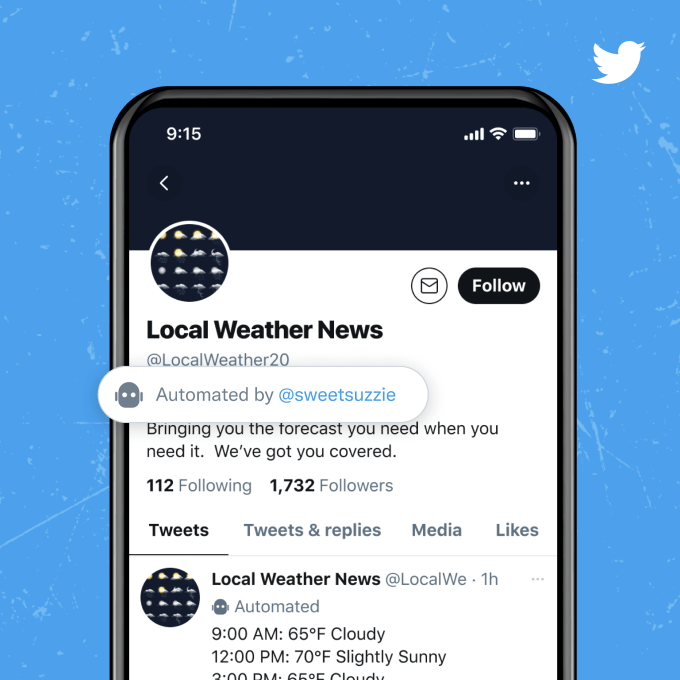
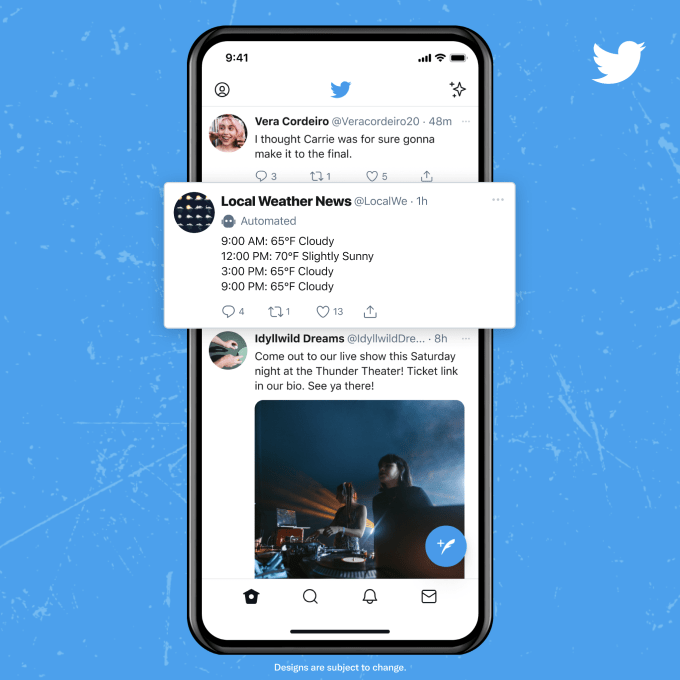
Twitter today is introducing a new feature that will allow accounts to self-identify as bots by adding a label to their profile. This feature is designed to help people better differentiate between automated accounts — like bots that retweet the news, public service announcements, or other updates — from those operated by humans. It’s not, however, designed to help users identify the “bad bots” which are those that pose as people, often to spread misinformation or spam.

The company has been contemplating labeling bots for years.

In 2018, Twitter CEO Jack Dorsey was asked during a Senate Intelligence Committee hearing whether he believed users had a “right to know” if they were speaking to a bot or a human on Twitter’s platform. He agreed that Twitter should add more context to tweets and was considering identifying bots, to the extent that it could. However, Dorsey also pointed out it would be more difficult to identify bots that were using scripting to give the appearance of being a human, compared with those that were leveraging Twitter’s API.

Last year, the company finally solidified those plans, saying it would later introduce new features that would allow users to be able to distinguish between human-run accounts and those that were automated. When Twitter launched its account verification system in May, it reminded users that it would soon offer other ways to identify different types of accounts beyond the long-coveted blue badge — such as labels for bots.

Image Credits: Twitter

Today, Twitter says its new “Automated Account” label that identifies “good bots” will be made available to over 500 Developer Accounts. This group will test the feature and provide feedback before it’s opened up more broadly to all Twitter developers. As it’s still a test for the time being, the label won’t be required.

However, when Twitter updated its Developer Policy last year, it did ask developers to indicate in their account profile or bio whether the account was a bot, what the account is, and who’s behind it. These account labels would allow developers an easier way to comply with that policy rather than having to handwrite this information in their bio.

Twitter tells TechCrunch that based on what it learns during this experiment, it may decide to make adopting the label a requirement for all developers who run automated accounts in the future, once it becomes broadly available.

Image Credits: Twitter

To be clear, Twitter doesn’t have any problem with those who run good bots, as it understands how automation can allow accounts to update people with helpful, relevant, or, sometimes, just fun information. The company even celebrated a few of its favorite bots when announcing today’s developer news, including the public service account @earthquakesSF; a bot offering COVID-19 updates, @vax_progress; a bot that offers an ongoing breakdown of the last 100 bills introduced in Congress, @last100bills; an accessibility-focused bot, @AltTxtReminder; and others that just add value in their own way, like @met_drawings, which shares public domain works from The Met’s Drawings & Prints department, or the goofy @EmojiMashupBot, among others.

All these will be a part of the initial test group.

Twitter is also less concerned with how consumers may use automation to update their own accounts, perhaps by using third-party tools like IFTTT to post links or other content.

“You are ultimately responsible for the actions taken with your account, or by applications associated with your account,” Twitter’s policy advises Twitter users. “Before authorizing a third-party application to access or use your account, make sure you’ve thoroughly investigated the application and understand what it will do.” It also adds that Twitter users that adopt automation will still need to adhere to Twitter’s guidelines.

Twitter has not said how long the test would run before the Automated Account labels are rolled out more broadly.


from Social – TechCrunch https://ift.tt/3BVzRsz
via IFTTT